The Sudbury Story — History, Lakes, Mining, Culture & Life in Greater Sudbury
Sudbury is one of those places people think they understand in a single sentence: mines, the Big Nickel, rocky landscapes, long winters. But the real Sudbury story is much bigger than that. It starts with Indigenous history and treaty land, runs through one of the world’s most famous impact structures, grows into a railway and mining centre, survives the smoke era, and becomes one of Canada’s best comeback stories — greener, more diverse, more livable, and far more layered than outsiders expect.
Today, Greater Sudbury is a city of lakes, research, healthcare, post-secondary education, Franco-Ontarian culture, proud former towns, and neighbourhoods that still carry their own identity. It is one municipality on paper, but in everyday life it still feels like a collection of hometowns tied together by work, family, sport, and northern practicality.
Indigenous Foundations & Early History
Long before rail lines, smelters, or subdivision maps, this region was and remains part of the traditional territory of Atikameksheng Anishnawbek and Wahnapitae First Nation, within the Robinson-Huron Treaty territory. The land, lakes, and travel routes that shape Greater Sudbury today were already meaningful as places of movement, harvesting, gathering, and community long before “Sudbury” existed as a municipal name.
Modern Sudbury’s story is really several stories running at once: a geological story shaped over immense time, an Indigenous story rooted in land and treaty relationships, and an industrial story accelerated by rail and resource extraction. When those layers are viewed together, Sudbury feels less like a random northern city and more like a place whose identity was built by land, labour, and adaptation.
A Short Sudbury Timeline
- ~1.8 billion years ago — A massive impact event helps create the Sudbury Basin, one of the world’s best-known impact structures.
- 1850 — Robinson-Huron Treaty signed, shaping the legal and political framework of the region.
- 1880s — Railway construction and mineral discoveries accelerate settlement and industrial growth.
- 1893 — Sudbury is incorporated as a town.
- 1930 — Sudbury becomes a city.
- 1970s onward — Regreening efforts help transform the landscape from a smoke-era moonscape to a globally recognized recovery story.
- January 1, 2001 — Amalgamation creates the City of Greater Sudbury by merging the former Regional Municipality and surrounding municipalities into one city.
The Sudbury Basin — Meteor Impact Story
Sudbury sits within one of the most famous geological formations on Earth. The Sudbury Basin was formed roughly 1.8 billion years ago when a giant impact event reshaped this part of the Canadian Shield. Over time, that geology helped concentrate mineral deposits that would eventually make the region globally important.
Yes — astronauts trained here
In the 1970s, Apollo astronauts trained in the Sudbury Basin because the exposed rock and impact geology made it an ideal place to learn how to read terrain and identify geological clues relevant to lunar exploration.
Why the Basin still matters
The Basin is not just a science fact or tourism hook. It is one of the reasons Sudbury became a mining centre, a research centre, and a place with a surprisingly strong identity around geology, earth science, and underground innovation.
Rails, Mines & the Birth of a Boomtown
Sudbury’s rapid growth is tied closely to the railway. Once rail lines pushed through Northern Ontario and the mineral potential of the region became clear, Sudbury evolved from a stop along a route into an industrial centre with real staying power.
Communities formed around mine sites, smelters, rail access, and work routes. That pattern still matters today. Many neighbourhoods and former towns did not grow outward from one neat centre — they developed around practical needs, then built their own schools, arenas, churches, and identities.
The early industrial years were demanding. Smoke, hard labour, shift work, cold weather, and company-town routines shaped daily life. But that environment also created a local culture built on resilience, independence, coaching, volunteering, and looking after your own people.
Nickel Capital of the World Era
For much of the 20th century, Sudbury became internationally known as the Nickel Capital of the World. That reputation shaped everything from employment patterns and family schedules to neighbourhood growth and local identity. Mining here was never just one industry among many. For generations, it was the rhythm underneath everyday life.
You can still feel the legacy of that era in the built form of the city: work-linked communities, housing that made sense for families tied to industrial jobs, and neighbourhood loyalties that often track with former municipal boundaries, plants, or commute routes more than any outsider would expect.
Regreening — The Comeback Story
Sudbury’s regreening story is one of the most important parts of its identity — and one of the most misunderstood. The iconic black-and-white images of bare rock and smoke damage are real, but they are not the full story. Since 1978, Greater Sudbury’s regreening efforts have helped transform the landscape through long-term soil treatment, liming, grassing, planting, monitoring, and community involvement.
What it feels like today
Modern Sudbury is green, trail-connected, and lake-oriented in ways that surprise people who only know the old industrial stereotypes. Downtown and trail access are often minutes apart. Lake life and city life regularly overlap in the same daily routine.
Why newcomers notice it fast
People arrive expecting a heavy industrial city and quickly realize the lifestyle conversation is really about trees, trails, shorelines, schools, recreation, and breathing room. That contrast is one of Sudbury’s biggest surprises.
City of Lakes — Geography, Water & Lake Life
“City of Lakes” is not just branding. It is a practical description of how Greater Sudbury is built. The city covers 3,627 km², includes 330 lakes over 10 hectares, and has 16.5% of its total surface area covered by water. In everyday life, that means lakes are not special-occasion destinations here. They are woven into neighbourhood choice, recreation, commuting views, and weekend routines.
Lake Wanapitei
Lake Wanapitei holds the distinction of being the largest lake in the world completely contained within the boundaries of a single city. That is one of those facts that sounds made up until you realize just how geographically large Greater Sudbury actually is.
Why lakes shape daily life
In many cities, lake access is a niche luxury. In Sudbury, water is part of the backdrop. Ramsey Lake, Long Lake, Vermilion, Nepahwin, and many others influence how people spend time, where they buy, how they define a good summer, and what “close to nature” actually means.
Science, Research & Innovation
Sudbury’s modern identity is not just industrial — it is scientific. The same geology that shaped the mining story also helped create a city with unusual depth in earth science, underground research, health care, and applied innovation.
Science North, Dynamic Earth & the Big Nickel
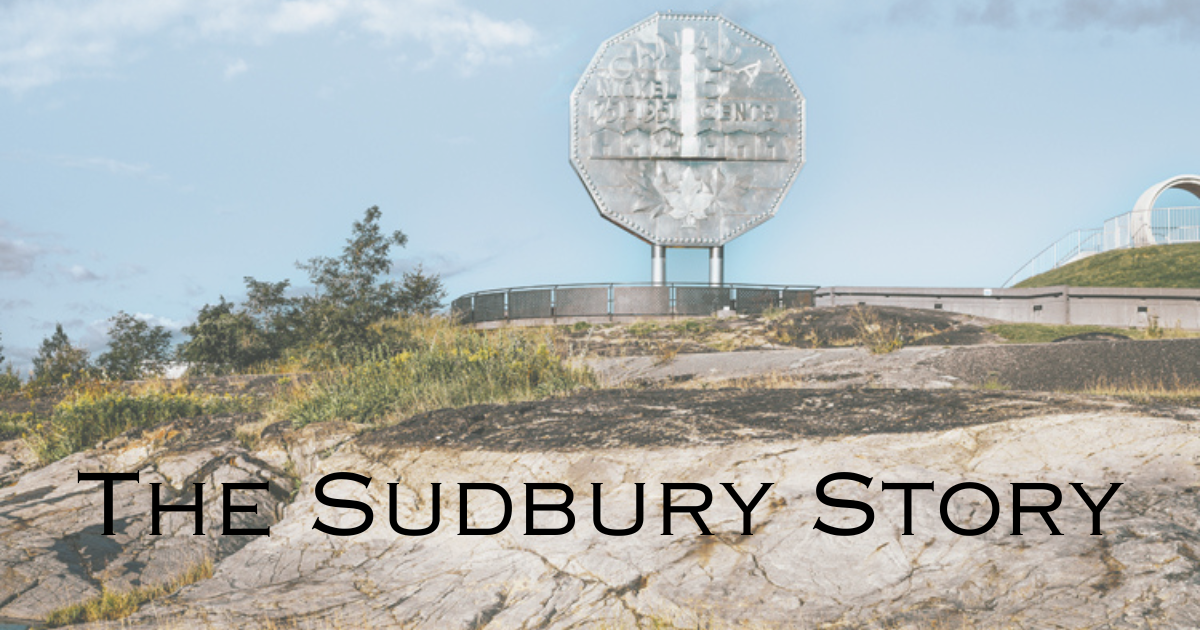
Science North and Dynamic Earth help translate Sudbury’s geology and mining legacy into something hands-on, visual, and accessible. Dynamic Earth, home of the Big Nickel, keeps the mining story public, local, and tangible instead of leaving it buried in history books.
SNOLAB
Near Sudbury, SNOLAB operates deep underground in Vale’s Creighton mine and is recognized as a world-class science facility. It is one of those rare local assets that quietly reminds you Sudbury is connected to global research in a very real way.
The 2001 Amalgamation
On January 1, 2001, several municipalities and the Regional Municipality of Sudbury were merged into one city: the City of Greater Sudbury. On paper, it created a single municipal identity. In real life, it did not erase the strong local loyalties that had developed over generations.
That is why people still say they are from Hanmer, Chelmsford, Lively, Garson, Copper Cliff, Capreol, or the South End before they say “Greater Sudbury.” It is not just habit. It is how local identity works here.
Neighbourhoods & Communities
Greater Sudbury is not really “one city with suburbs.” It is a patchwork of former towns, established neighbourhoods, lake pockets, and family communities with their own rhythms.
- New Sudbury — shopping, schools, services, and practical access to a lot of daily life.
- South End — strong school draw, trails, and a popular move-up market feel.
- Valley East — Hanmer, Val Caron, and Blezard Valley offer small-town identity within the city.
- Walden — Lively, Naughton, and Whitefish bring space, trails, and community pride.
- Core Sudbury — Downtown, West End, Flour Mill/Donovan, Gatchell, and Minnow Lake offer character, walkable pockets, and varied housing stock.
- Smaller communities — Azilda, Chelmsford, Garson, Dowling, Copper Cliff, and Onaping/Levack all carry their own pace and identity.
- Lake-oriented areas — Ramsey, Long Lake, Vermilion, and surrounding pockets blur the line between primary residence and northern lifestyle.
Culture, Francophone Life & Sudbury-isms
Sudbury’s culture is more layered than the standard mining-town stereotype. It is shaped by Northern Ontario practicality, strong volunteer culture, sports, arts, and a meaningful Franco-Ontarian presence that influences language, community life, and local identity. Place des Arts, for example, describes itself as a gathering place for Francophones and for the whole community — which captures Sudbury well.
- Directions often rely on landmarks and local memory more than polished wayfinding.
- French and English naturally bounce off each other in schools, arenas, arts spaces, and everyday conversation.
- Winter has its own practical vocabulary: freeze-thaw cycle, route choices, and knowing which roads get messy first.
- Community events, fundraisers, sports, and local arts all punch above their weight because people here show up.
Sudbury Today — More Than Mining
Modern Greater Sudbury is still deeply connected to mining, but it is not defined by mining alone. The city functions as a regional centre for health care, education, government, research, and services across northeastern Ontario. It is home to major institutions, post-secondary education, science tourism, and a level of regional infrastructure that gives it a bigger role than many people expect.
Regional services
Health Sciences North serves as the regional hospital for Northeastern Ontario. Sudbury also functions as a centre for public services, shopping, specialized care, and everyday amenities that draw people in from surrounding communities.
Education & learning
The city has long been positioned as a centre of learning and applied research for northeastern Ontario, supported by institutions such as Laurentian University, Cambrian College, Collège Boréal, and a broader research and innovation network.
Sudbury by the Numbers & Fun Facts
A few facts that help explain why Greater Sudbury feels different from most Ontario cities:
- It’s geographically huge. Greater Sudbury covers 3,627 km² — the largest municipality by area in Ontario.
- Water is everywhere. The city has 330 lakes over 10 hectares and 16.5% of its total surface area is covered by water.
- Lake Wanapitei is a record-holder. It is the largest lake in the world completely contained within one city’s boundaries.
- Sudbury helped train astronauts. Apollo-era geology training took place here because the Basin’s rock formations were so valuable for field learning.
- Regreening is not cosmetic. More than 10 million trees have been planted since 1978.
- Science runs deep here. SNOLAB operates deep underground near Sudbury in one of the world’s leading underground research facilities.
- Arena culture is real. If you want to understand Sudbury fast, spend some time around local hockey.
If You’re Thinking of Moving Here
Here’s the honest version: most people do not move to Sudbury for just one reason. It is usually a stack of reasons — space, affordability, family, work, education, health care, lakes, pace of life, and community fit. The biggest mistake is treating Greater Sudbury like one uniform market or one generic city. It is not. It is a collection of communities, each with a different feel.
Use the Community Guides to compare vibe, commute, schools, amenities, and what daily life actually feels like.
The Relocation Guide keeps the move practical, organized, and grounded in local context.
Want me to translate the Sudbury story into real streets, real listings, and the right neighbourhood fit for your move? Reach out any time. Expect Moore for your move.
Sources & Further Reading
This page is meant to feel local and readable, but it is also meant to be grounded in solid sources. These are the references behind the history, geography, science, and community facts used throughout the page:
- City of Greater Sudbury — History
- City of Greater Sudbury — Indigenous Relations
- City of Greater Sudbury — Lakes
- City of Greater Sudbury — Lake Wanapitei
- City of Greater Sudbury — Regreening Program
- Canadian Space Agency — Training in geology
- SNOLAB — World-class underground science facility
- Dynamic Earth — About
- Science North — About
- Place des Arts — About
- Place des Arts — Nouvel-Ontario cultural heritage
- Health Sciences North — About Us
- City of Greater Sudbury — Education