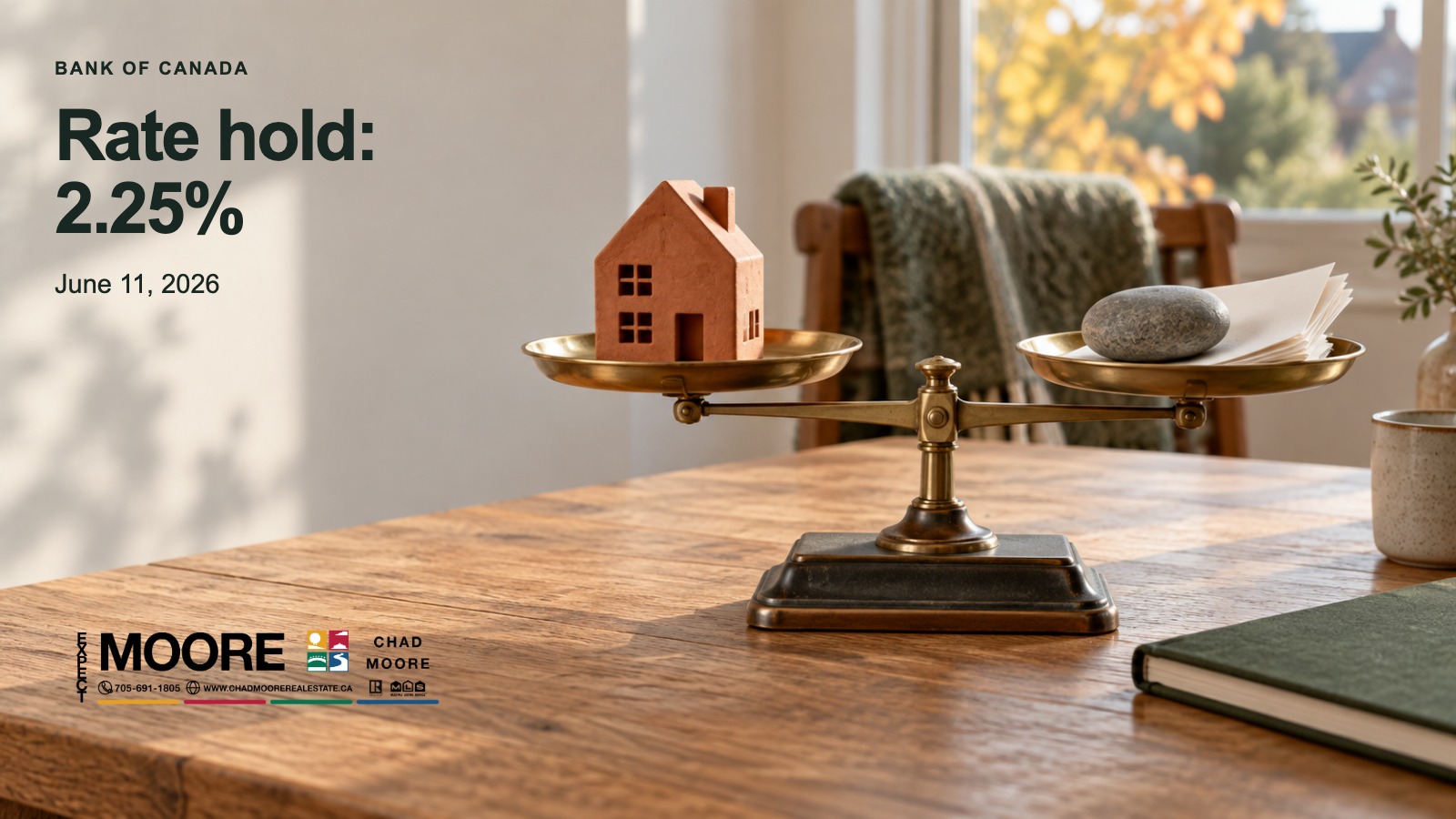
The Bank of Canada held its overnight rate at 2.25%. That part was expected. The more important question is why.

The Bank of Canada held its overnight rate at 2.25% yesterday. This was not a rate hold because everything is calm. It was a rate hold because the Bank of Canada is trying to balance two very different problems at the same time.

On one side, the Canadian economy is soft. On the other side, inflation risk has not gone away. That is the world buyers and sellers are making decisions in right now.

This is not a panic market. It is not a boom market either. And it is not a market waiting for one single interest rate announcement to fix everything. It is a careful market. In Greater Sudbury, that distinction matters.

📌 The short version

The rate did not change, but the pressure around the decision is real. Buyers are still active, sellers still have opportunity, but the market is asking for realistic pricing, clear value, and better strategy.

🌎 The Rate Stayed the Same, But the Background Changed

A lot of people look at the headline and think, “Nothing changed.” The overnight rate is still 2.25%. Variable-rate borrowers did not get a cut. Prime-rate-linked products did not suddenly become cheaper. Mortgage affordability did not magically improve overnight. It also helps to remember that the Bank of Canada is not the whole story behind mortgage rates.

But the background behind the decision is important. The Bank of Canada pointed to global risks that are not small. Conflict in the Middle East has pushed energy prices higher, and higher oil prices can work their way through the economy because transportation, shipping, production, heating, food distribution, and consumer goods all depend on energy in some way.

At the same time, global supply chains are under pressure again. Trade uncertainty with the United States remains a major issue. Tariffs, trade negotiations, and political uncertainty all matter to Canada because we are a trading economy. When businesses do not know what costs, rules, or demand will look like six months from now, they tend to become more cautious.

That caution can show up in hiring. It can show up in investment. It can show up in consumer confidence. Eventually, it can show up in housing decisions too. That is why yesterday’s rate hold should not be read as “everything is fine.” It should be read as “the Bank is not ready to move.”

📉 Why the Bank Did Not Cut

For buyers hoping for immediate rate relief, this was not the announcement they wanted. The Bank of Canada did not cut because inflation is still too sensitive.

Even if some of the current inflation pressure is coming from energy prices, the Bank has to be careful. If higher fuel, shipping, and production costs start spreading into the broader economy, inflation can become harder to control. That is what the Bank wants to avoid.

A central bank can sometimes look through temporary price spikes, but only if it believes they will stay temporary. Right now, that is not guaranteed. So while the economy is soft enough to make a rate hike risky, inflation is still uncomfortable enough to make a rate cut difficult. That is the squeeze.

📈 Why the Bank Did Not Hike

The Bank also did not raise rates, and that matters too. If inflation were the only concern, a hike would be easier to justify. But the economy is not strong enough to make that a simple call.

Higher interest rates would put more pressure on households, mortgage renewals, borrowers, businesses, and buyers. Canada is already dealing with mortgage payment resets from people who borrowed when rates were much lower. Many households are renewing into higher payments than they had before, even with the overnight rate now well below the peak.

That is one of the most important real estate stories in the country right now. The pressure is not only coming from today’s rate. It is also coming from the lag effect of past rates. People are still adjusting.

That is part of why the Bank held. Cutting could feed inflation risk. Hiking could add too much pressure to an already cautious economy. So the Bank waited.

🏡 Greater Sudbury Is Still Moving, But Buyers Are Selective

Locally, this matches what we are already seeing in the Greater Sudbury real estate market. The market is not frozen. Homes are selling. Some are selling quickly. Some are still attracting strong interest. Some are still selling over asking.

But it is not a market where every listing gets rewarded just for existing. That is the part sellers need to understand, and it is exactly why what failed listings reveal about price, condition, and buyer acceptance matters in an active but selective market.

The 2026 single-family data I have been tracking across the City of Greater Sudbury shows an active market, but a selective one. A little over half of the house records reviewed had sold, while a meaningful share remained active, conditional, new, back on market, or price adjusted. There was also a noticeable group of listings that cancelled, expired, suspended, or withdrew.

That tells the story better than the rate announcement alone. Demand exists, but buyer acceptance is not automatic.

Under $500,000, demand remains the strongest. Buyers are still watching Greater Sudbury homes under $500,000 closely because affordability is tighter and options are limited. Well-priced homes that show value can still move quickly.

Between roughly $500,000 and $600,000, buyers compare harder. This is where condition, layout, garage, updates, location, bedrooms, bathrooms, and presentation matter more. If you are watching homes between $450,000 and $600,000, the lowest price is not always the best value. A home can absolutely sell in this range, but it usually has to make sense against the alternatives.

Above that, the buyer pool becomes more selective again. That does not mean higher-priced homes cannot perform well. They can. But the value has to be clear.

💡 Local takeaway

The Greater Sudbury market is active, but selective. Buyers are still there, but they are looking closely at price, condition, payment, and value.

💰 A Stable Rate Does Not Remove Payment Sensitivity

This is the practical point. A stable overnight rate is helpful because it creates some predictability, but predictability is not the same as affordability.

Buyers are still dealing with monthly payment reality. They are still looking at property taxes, insurance, utilities, repairs, maintenance, renovation costs, and the mortgage stress test that can affect how much buying power they actually have. They are still thinking about job security, family budgets, and whether they want to take on a larger payment in an uncertain economy.

That is why pricing strategy matters so much right now. When buyers feel confident about the value, they act. When they feel like the price is too far ahead of the property, they wait. And when enough buyers wait, a listing starts to tell the market something.

Days on market become feedback. Showings become feedback. Lack of offers becomes feedback. Price reductions become feedback. The best sellers listen early.

🏷️ Sellers Need to Price for This Market, Not the Market They Wish They Had

A rate hold can create a false sense of comfort. Some sellers hear “rates are stable” and assume buyers will automatically step up. That is not how this market works.

Buyers are active, but they are not careless. They know borrowing is still expensive compared with the ultra-low-rate years. They know renovation costs are high. They know utilities and household costs have increased. They know that if they stretch too far, the payment has to be lived with every month.

So sellers need to be honest about where their home fits. If you are trying to understand what your home could realistically sell for, the starting point is local data, condition, timing, and how buyers are comparing your home against the alternatives. If the home is move-in ready, show that clearly. If the home has updates, explain why they matter. If the home has a strong layout, make it easy for buyers to understand. If the home needs work, price it with that reality in mind.

If the home is unique, do not assume buyers will figure it out on their own. In this market, marketing is not just exposure. Marketing is explanation.

🔎 Buyers Should Not Wait for Perfect Conditions

For buyers, the message is different. Do not confuse caution with paralysis.

If your finances are not ready, waiting can be the right decision. But if you are financially prepared, pre-approved, comfortable with your payment, and clear on what you want, waiting for the perfect rate environment can come with its own cost.

If rates fall later, more buyers may come back into the market. That can increase competition. In the more affordable price ranges, competition can change quickly. A slightly lower rate does not help much if the house costs more, if you are competing against multiple offers, or if the best options in your budget have already sold.

The better strategy is to understand your numbers before you shop. Not the numbers you hope for. Not the numbers from three years ago. Your real numbers today. Then shop accordingly.

🧭 My Read on the Decision

My read is that the Bank of Canada is not trying to send a dramatic message. It is trying to avoid making the wrong move too early.

There is too much inflation risk to cut. There is too much economic weakness to hike. So they held.

For Greater Sudbury real estate, that keeps us in the same kind of market we have already been moving through: active, but selective. Buyers are still there. Sellers still have opportunity. But the easy-money market is gone, and the market is not going to do all the work for you.

Good homes can still perform very well. Well-priced homes can still attract strong interest. Prepared buyers can still find opportunity. But this is not a market for guessing. It is a market for strategy.

That is the real takeaway from this Bank of Canada announcement. The rate did not change, but the pressure around the decision is real.

✅ Final Word

The Bank of Canada’s decision did not create a brand-new market yesterday. It confirmed the one we are already in.

Greater Sudbury real estate is still active, but it is not automatic. Buyers are still buying, sellers still have opportunity, and good homes can still perform very well. But this is not a market where guessing is good enough.

If you are buying, selling, or trying to decide what comes next, the right move depends on your price range, neighbourhood, timing, condition, financing, and competition. The rate announcement is only one piece of the picture. Your strategy has to match the market we are actually in, and if you are thinking about selling, that starts with a strategy that fits your goals, timing, and home.


Expect Moore for Your Real Estate.

— Chad Moore, REALTOR® | Lake City Realty