


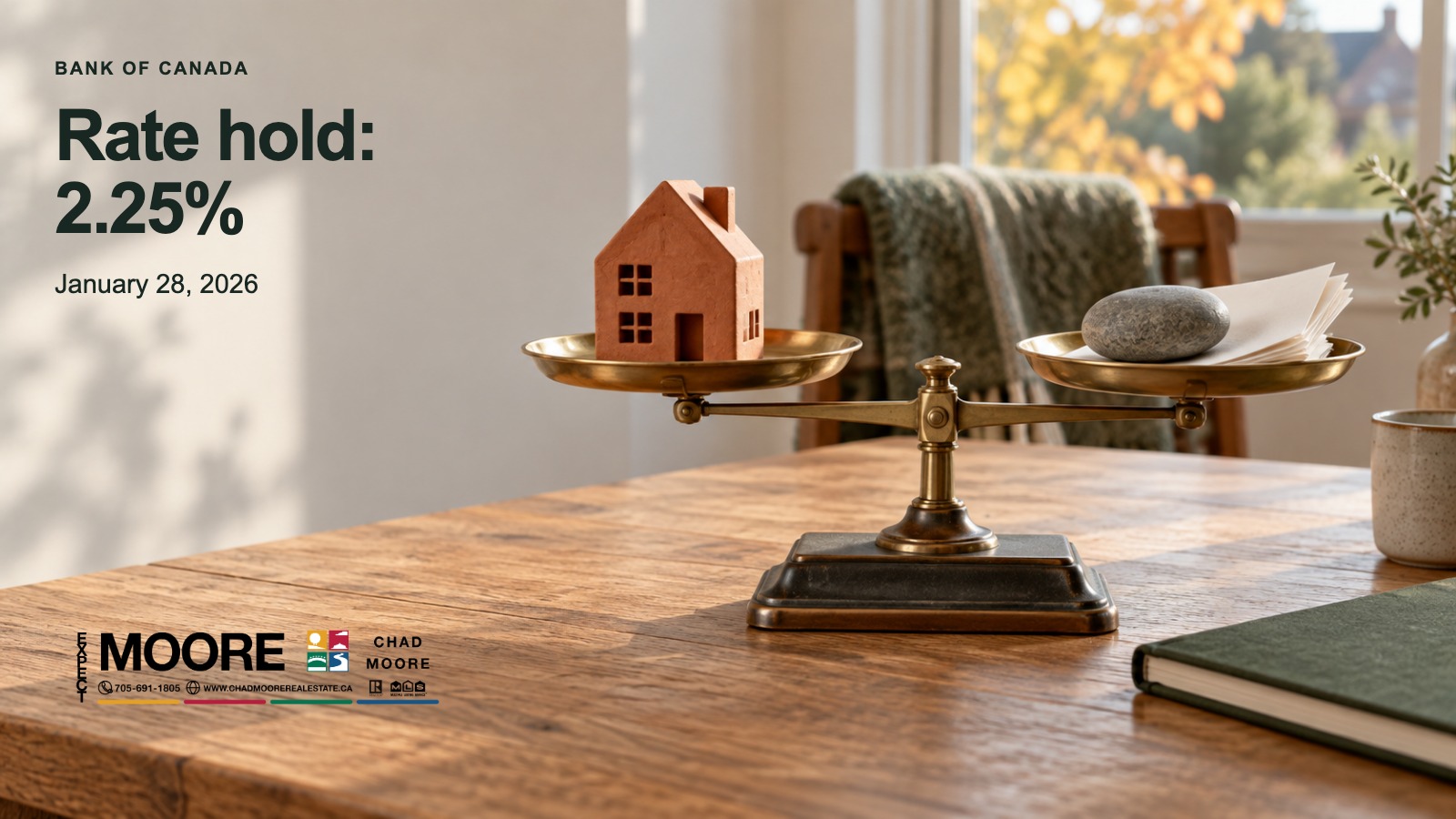
Today, January 28, 2026, the Bank of Canada has held its target for the overnight rate at 2.25%.
The policy settings
| Measure | Setting | Why it matters |
|---|---|---|
| Target overnight rate | 2.25% | Anchor for the Bank's monetary-policy stance |
| Change at this decision | No change | Most direct signal for variable-rate borrowing |
| Bank Rate | 2.50% | Rate charged on one-day advances to financial institutions |
| Deposit rate | 2.20% | Rate paid on deposits held at the Bank |
Why the Bank makes this choice
Growth and jobs. Fourth-quarter growth likely stalls after a strong third quarter, exports remain exposed to US tariffs and unemployment is 6.8%, although domestic demand and employment have recently improved.
Inflation. December CPI is 2.4% because of tax-holiday base effects; core measures ease toward 2.5% and the Bank expects inflation near 2% over the projection.
The policy judgment. The current rate remains appropriate under the Bank's baseline, with trade policy and geopolitical uncertainty arguing for flexibility rather than an immediate move.
What changes for borrowers
A hold leaves the Bank's policy setting unchanged; it does not freeze every mortgage quote. Variable products remain anchored to lender prime rates, while fixed offers can still move with bond yields, funding costs, term length and competition.
Because the policy rate does not move, there is no new Bank-driven basis-point change to apply to a balance today. Existing payment pressure remains, and individual lender offers can still change.
When comparing fixed and variable products, look beyond the starting rate. Payment structure, prepayment privileges, portability, penalties and conversion terms affect the cost of changing plans. Ask a lender or licensed mortgage professional to calculate the result for your balance and expected time in the home.
For Greater Sudbury buyers
Start with three numbers: a comfortable monthly housing cost, a purchase-price ceiling and the cash left after closing. Two homes at the same price can carry very different costs once taxes, heating, insurance, condo fees and immediate repairs are included. Use comparable sales and available alternatives to test the price of the specific property.
- Refresh the pre-approval and confirm the rate-hold expiry.
- Test the payment at the offered rate and a higher renewal rate.
- Keep closing costs and a repair reserve separate from the down payment.
- Match financing and inspection conditions to the property’s actual risks.
For owners approaching renewal
Compare equivalent offers before deciding whether to stay with the current lender. Include discharge charges, appraisal or legal requirements and the flexibility you may need during the term. Extending amortization may lower the payment while increasing total interest and slowing principal repayment. A sustainable structure matters more than correctly guessing the next announcement.
For sellers
The rate decision can influence buyer confidence and financing, but it does not automatically reset Greater Sudbury prices. Position the home against current competition and recent relevant sales. Resolve avoidable objections, make the carrying costs and condition clear, and use actual showing and offer feedback to guide adjustments.
What to watch next
US trade restrictions, the CUSMA review, hiring plans and whether domestic spending can offset export weakness. Those developments will help show whether the Bank’s assessment is holding up. A household plan should still work under more than one rate or market outcome.
Read the official Bank of Canada announcement.
For a local plan, explore the Buyer Experience or Seller Experience.
Expect Moore for Your Real Estate.
— Chad Moore, REALTOR®
— Lake City Realty Ltd., Brokerage