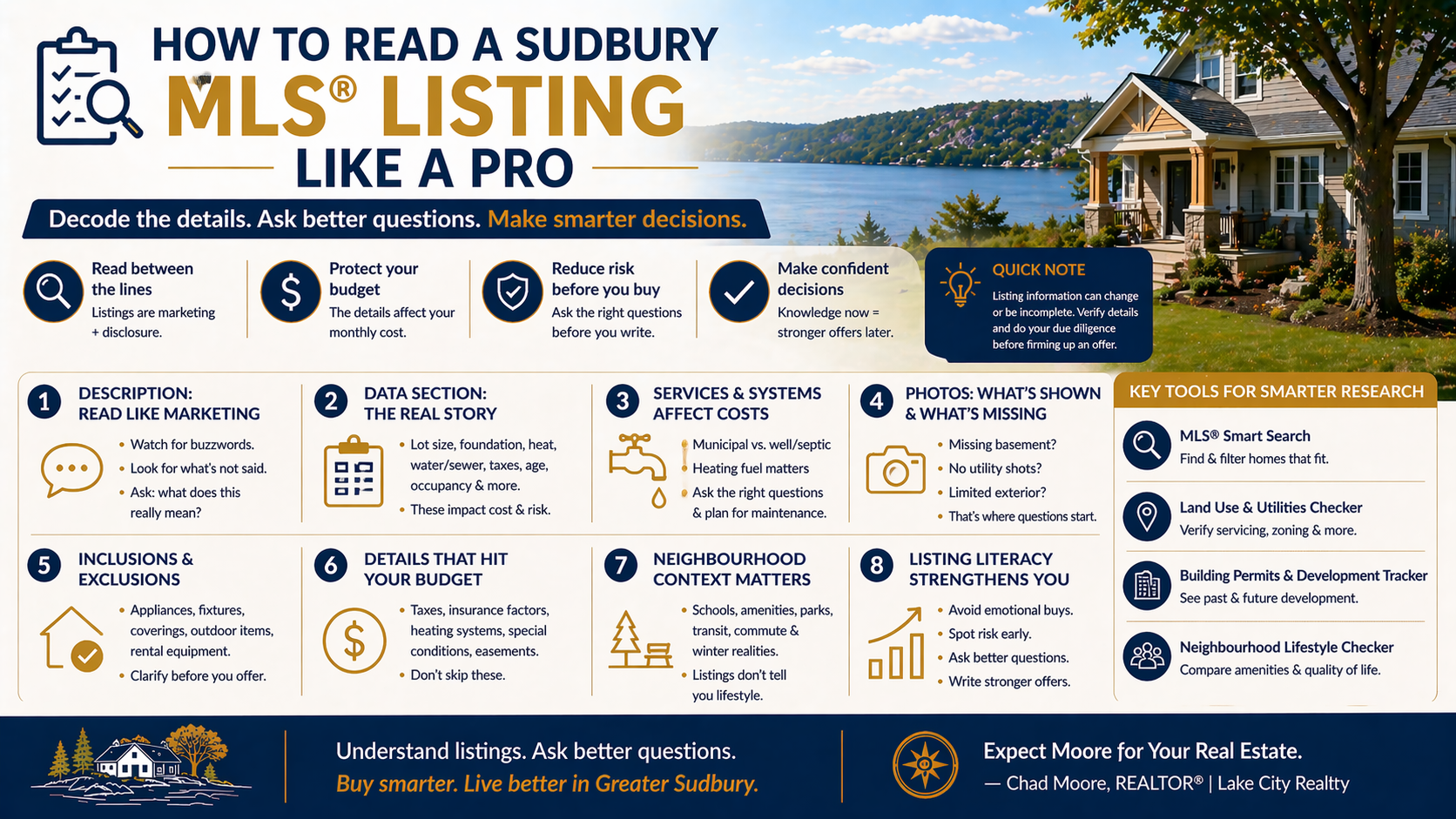
Most buyers scroll listings. Smart buyers analyze them. 🔎
If you’ve ever clicked on a Sudbury MLS® listing and thought, “What does any of this mean?” — you’re not alone. Between abbreviations, buzzwords, and details tucked into the data fields, it’s easy to miss the stuff that actually affects your budget, your lifestyle, and your risk.
The good news? Once you know where to look — and what to question — listings get a lot easier to read.
Quick note: Listing information is marketing and disclosure rolled into one. Details can change, be incomplete, or require verification. The goal is to use the listing to ask better questions and do smarter due diligence before you firm up an offer.
📝 1) Start With the Property Description (But Read It Like Marketing)
Descriptions are designed to highlight strengths. That doesn’t mean they’re “wrong” — but they’re written to sell the home. Watch for phrases like:
- “Cozy” 🏠 (often smaller square footage)
- “Charming” 🏛️ (often older — sometimes with older systems)
- “Opportunity” / “Bring your vision” 🔧 (may need work)
- “Fixer-upper” 🛠️ (can range from cosmetic to major)
- “As-is” ⚠️ (limited seller representations — ask what it means in context)
- “Updated” ✨ (always ask: what year? what scope?)
- “Investment potential” 📈 (ask: legal duplex? zoning? permits? separate meters?)
If terminology feels unclear, keep this handy: Real Estate Dictionary.
And when the wording triggers questions about what’s included, what’s excluded, or what’s “assumed,” you’ll usually find the real answers in the data fields and schedules — not the headline sentence.
📊 2) The Data Section Tells the Real Story
The structured data in an MLS® listing often matters more than the adjectives. Pay close attention to:
- 📏 Lot size / frontage / depth (and whether it’s irregular)
- 🏠 Property type (detached, semi, condo, rural, waterfront access, etc.)
- 🧱 Foundation (block, poured concrete, stone, slab, crawlspace)
- 🔥 Heating type + fuel (forced air, boiler, electric, propane, oil, wood)
- 💧 Water & sewer (municipal vs. well/septic)
- 🏷️ Property taxes (and whether they reflect reassessment/changes)
- 🔧 Year built / age (helps you anticipate systems and maintenance cycles)
- 🔒 Occupancy / possession (tenants, timelines, flexibility)
These details directly impact your monthly cost and long-term maintenance — long after the excitement wears off.
If you want to verify context beyond the listing text, especially when servicing, amenities, neighbourhood fit, or property due diligence could matter, use the tools inside MLS® Smart Search:
- 📍 Municipal Services & Amenities Checker — useful for checking nearby services, amenities, and Greater Sudbury open data context.
- 🏡 Property & Neighbourhood Due Diligence Checker — useful when you want to look beyond the listing and think through local due diligence questions.
- 🌳 Neighbourhood Lifestyle Checker — useful for reviewing parks, trails, amenities, and lifestyle fit before you get too attached to a listing.
🏡 3) “Municipal” vs. “Rural” Costs: Water, Sewer, Heat, and What That Means
Two homes at the same price can have very different ownership costs depending on services and systems.
- Municipal water & sewer tends to be simpler day-to-day, but you still want to understand bills, aging infrastructure, and any known issues.
- Well & septic can be totally fine — but it’s a different maintenance world (water quality, pump systems, septic capacity, inspections, and long-term replacement planning).
- Heating fuel matters in Sudbury. Older homes, rural homes, and certain layouts can change heating costs dramatically.
If a listing says “well” or “septic,” that’s not automatically a red flag — it’s a cue to ask the right questions and structure the right due diligence. When you get to the offer stage, this guide ties it together: Making an Offer.
📸 4) Photos Tell a Story — and What’s Missing Tells More
Photos are curated. So don’t just look at what’s shown — look for what’s not shown.
- If every room is photographed except the basement, there’s usually a reason.
- If there are only a handful of exterior shots (or awkward angles), curb appeal may not hold up in person.
- If there are no shots of the mechanical room, electrical panel, or utility areas, plan to ask.
- If the yard is barely shown, ask about grading, drainage, and lot usability.
Gaps in the gallery are often where the best questions start.
Once you’re booking showings, this is how I recommend viewing homes strategically: Home Shopping.
📦 5) Inclusions & Exclusions: The “Wait… I Thought That Stayed?” Section
Always review what’s included in the sale — and what isn’t. Misunderstandings happen here all the time.
Common items to confirm:
- Appliances
- Light fixtures
- Window coverings
- Outdoor structures (sheds, gazebos, play structures)
- Any “attached” item that looks permanent but might be excluded
- Rental items (hot water tank, HVAC, propane tanks, water treatment equipment)
If you care about it, we clarify it before you write an offer — and we make sure the paperwork matches what you think you’re buying.
For contract language and common terms, these references help: Legal & Contract Terms.
🔍 6) Don’t Skip the Details That Hit Your Budget
Buried in the listing details are the things that make or break affordability:
- Heating type and approximate age
- Water and sewer (and what that implies for maintenance)
- Property taxes (and whether they reflect recent changes)
- Insurance considerations (older wiring, wood stoves, past claims, etc.)
- Any notes about easements, access, shared driveways, or special conditions
If you’re still building your buying plan (and figuring out your real budget), start here: Market Preparation.
📍 7) Neighbourhood Context: Listings Don’t Tell You Lifestyle
A listing tells you about the home — not what it feels like to live there day-to-day.
Before you commit, consider:
- 🏫 Schools and routes
- 🛍️ Amenities and errands
- 🌳 Parks, trails, and recreation
- 🚗 Commute patterns (and winter realities)
You can compare areas here: Sudbury Communities. And if you want a faster inventory view (by price, area, and features), start with: MLS® Smart Search.
Want quick “filter hubs” to reduce overwhelm? These are great starting points:
⚖️ 8) Why Listing Literacy Protects You (And Strengthens Your Offers)
When you understand listings deeply:
- ✅ You avoid emotional decisions
- ✅ You identify risk earlier
- ✅ You ask better questions before conditions expire
- ✅ You write stronger, cleaner offers with fewer surprises later
Want the next step after you’ve found “the one”? Start here: Making an Offer.
💪 My Advice (How I Help You Read Between the Lines)
I decode listings for my clients every day. I’ll flag when wording is doing heavy lifting, when key details are missing, and when a “small” detail could turn into a big cost later. My job is to help you reduce surprises before the offer is signed and conditions are removed.
If you want to cut through the noise, start with MLS® Smart Search and use the tools that help you verify what you’re seeing — not just what’s being sold to you.
Expect Moore for Your Real Estate.
— Chad Moore, REALTOR® | Lake City Realty