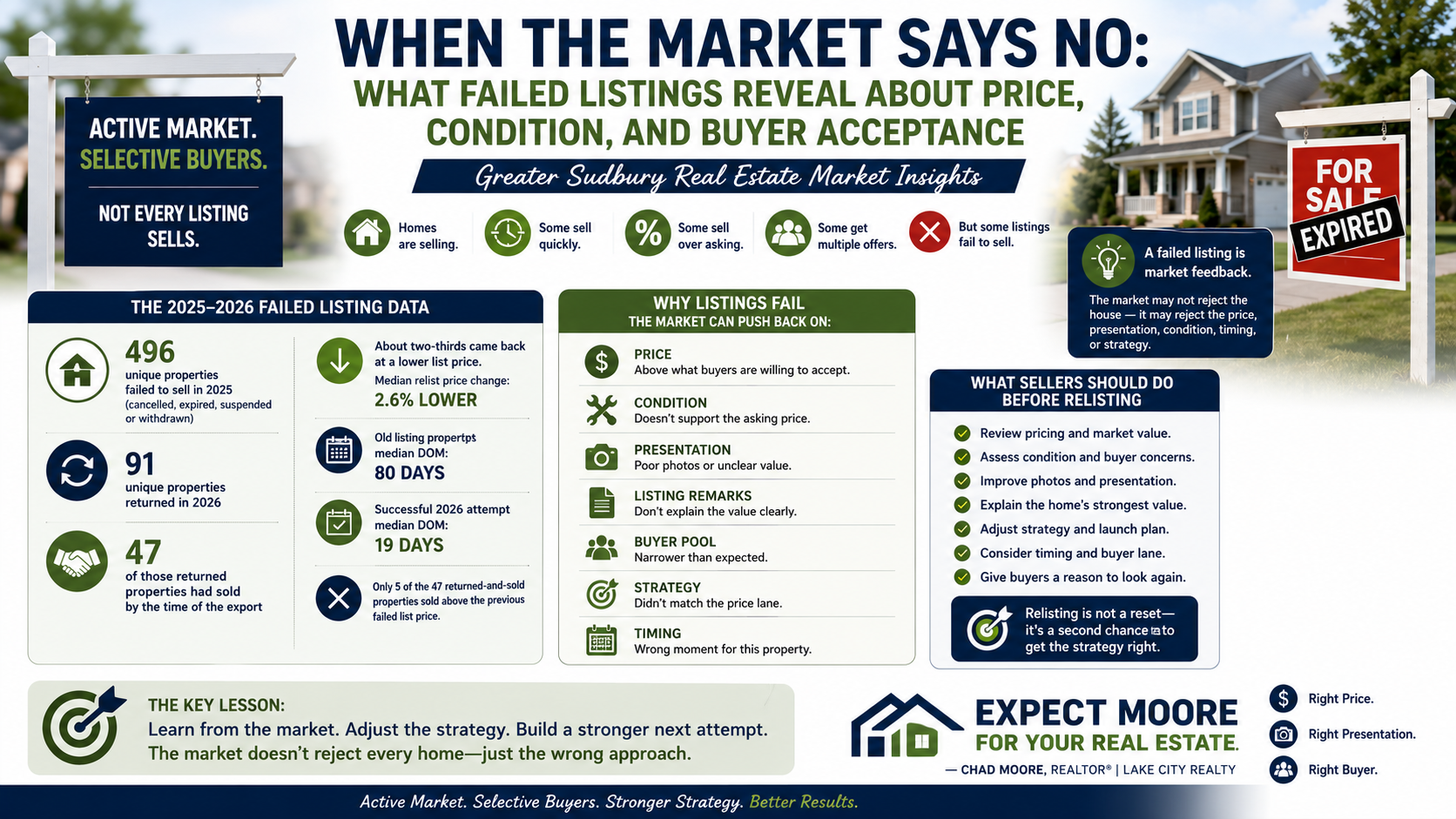
An active real estate market does not mean every listing sells.
That is one of the biggest lessons sellers need to understand in Greater Sudbury right now.
Homes are selling.
Some are selling quickly.
Some are still selling over asking.
Some are attracting multiple offers.
But some listings are also expiring, cancelling, suspending, withdrawing, relaunching, reducing expectations, or returning to market with a different strategy.
That does not mean the house is automatically unsellable.
It means the market said no to something.
Sometimes the market rejects the house. More often, it rejects the price, the presentation, the condition, the timing, or the strategy.
After reviewing the 2025 failed-listing data and comparing it with properties that returned in the 2026 Greater Sudbury MLS® data, the message is clear:
A failed listing is market feedback.
And if sellers understand that feedback properly, the next attempt can be much stronger.
📊 What the Failed-Listing Data Showed
The data reviewed included failed single-family listing attempts from 2025 and compared them against properties that returned to market in 2026.
In the 2025 failed-listing data, there were approximately 496 unique properties that had failed to sell through cancelled, expired, suspended, or withdrawn listing outcomes.
Of those, 91 unique properties returned to market in the 2026 data reviewed.
By the time of the export, 47 of those returned properties had sold.
That is important.
It means the market did not reject every one of those homes forever.
Many came back and sold.
But they usually did not come back with the exact same story.
- About two-thirds of the returned-and-sold properties came back at a lower list price.
- The median relist price change was about 2.6% lower.
- The old listing attempt had a median DOM of about 80 days.
- The successful 2026 attempt had a median DOM of about 19 days.
- Only 5 of the 47 returned-and-sold properties sold above the previous failed list price.
That tells us a lot.
The market was not necessarily saying, “Nobody wants this house.”
In many cases, it was saying:
Not at that price. Not with that presentation. Not with that strategy. Not at that moment.
⚖️ A Failed Listing Is Not Always a Failed House
This is where sellers need to be careful.
When a listing expires or cancels, it is easy to take it personally.
The seller may feel like the market rejected their home.
But that is not always the right interpretation.
A failed listing can happen for several reasons:
- The home was priced above what buyers were willing to accept.
- The condition did not support the asking price.
- The photos or presentation did not create enough confidence.
- The listing remarks did not explain the value clearly.
- The home needed better preparation before launch.
- The buyer pool for that property was narrower than expected.
- The strategy did not match the price lane the home was actually in.
That is why a failed listing should be studied, not ignored.
There is usually a reason buyers did not act.
Sometimes the feedback is obvious.
Sometimes it is buried in showing activity, comments, comparable sales, price resistance, days on market, online engagement, or how buyers reacted once they saw the home in person.
The key is to be honest about what the market was saying.
Because if the next listing attempt repeats the same mistakes, the result may not change.
If you want a broader seller-focused breakdown, my article on why a home may not be selling in Sudbury is a useful related read.
💰 Price Is Usually the First Place Buyers Push Back
Price is not the only reason a listing fails.
But it is usually the first place buyers show resistance.
That resistance can show up in different ways.
No showings.
Showings but no offers.
Low offers.
Negative feedback.
Buyers comparing the home to better options.
Agents saying their clients liked the house, but not at that price.
That does not mean the home has no value.
It means buyers are weighing the property against alternatives and deciding whether the price makes sense.
In the returned-and-sold group, about two-thirds came back at a lower price, and the successful listing attempt moved much faster than the previous one.
That does not mean every failed listing needs a massive reduction.
It means the market often needs a better match between price and buyer expectations.
Buyers do not price homes based on what the seller needs. They price them against what else they can buy.
That is why pricing strategy matters so much.
A seller may believe the home is worth more because of memories, renovations, carrying costs, plans, replacement cost, or what they hoped to net.
But buyers are comparing value.
They are looking at condition, location, features, layout, updates, risk, and competing homes.
If the home does not line up with the price, the market usually shows it.
For more on this, see my article on the risks of overpricing a Sudbury home.
🛠️ Condition Can Make or Break the Price
Condition matters more than many sellers realize.
Buyers are not just asking, “Do I like this house?”
They are asking:
- How much work does it need?
- How soon will I need to spend money?
- Can I get insurance?
- Will financing be affected?
- Can I live with the repairs?
- Do I have the time and budget to renovate?
- Is this priced like a project or priced like a finished home?
That last question is the big one.
A project home can absolutely sell.
But it needs to be priced like a project.
If buyers walk into a house and immediately start adding up roof, windows, furnace, basement, electrical, plumbing, kitchen, bathroom, flooring, paint, grading, water issues, or deferred maintenance, they are not thinking about the home the same way the seller is.
The seller may see potential.
The buyer sees cost.
The seller may see what the house could become.
The buyer sees what they need to pay for after closing.
That gap matters.
A home can be a great opportunity and still be overpriced if the asking price does not reflect the work buyers see.
This is where preparation before launch can make a real difference. My Seller Experience is built around understanding that before the home hits the market — not after buyers have already judged it.
📸 Presentation Is Not Just Decoration
Presentation is not about making a home look fake.
It is about helping buyers understand the home clearly.
Strong presentation can help buyers see:
- how the rooms function
- how much space the home offers
- what has been updated
- what the layout feels like
- where the value is
- why the home is worth seeing in person
Weak presentation does the opposite.
Poor photos, cluttered rooms, dark images, vague remarks, missing details, or unclear value can make buyers hesitate.
And hesitation matters.
Online buyers are making quick judgments.
They compare your listing against everything else in their price range.
If another home looks cleaner, clearer, easier, better maintained, or more move-in ready, buyers may choose that one first.
That does not mean presentation can overcome a bad price.
It cannot.
But presentation can help the right price work harder.
That is why the launch matters. Media, preparation, copy, timing, and positioning all shape how buyers respond in the first week.
For more on how buyers judge listings before they ever step inside, read my article on the hidden judgment happening in listing photos.
🎯 The First Strategy Matters Because the Market Remembers
A listing launch is not just a listing going live.
It is the market forming its first opinion.
That first opinion matters.
If a home launches too high and sits, buyers notice.
If the photos are weak, buyers may skip it.
If the price drops later, buyers may wonder what changed.
If the listing disappears and comes back, buyers may ask why.
None of that is impossible to overcome.
But it means the next attempt needs to be sharper.
In the data reviewed, the old failed listing attempts had a median DOM around 19 days on the successful relist attempt. By comparison, fresh new listing had a median DOM of only 10 days.
That is a major difference.
It suggests that many properties did not need endless time. They needed a better match between the listing strategy and the market. But they still suffered from their previous attempt.
That could mean better pricing.
Better preparation.
Better photos.
Better positioning.
Better timing.
Better explanation of value.
Or a more realistic understanding of what buyers were willing to accept.
If you are preparing to list, this is why the Hitting the Market stage matters so much.
🔁 Relisting Is Not a Reset Unless the Strategy Changes
Some sellers think relisting creates a clean slate.
Sometimes it helps.
But only if the relaunch gives buyers a reason to look again.
If the home comes back with the same price, same photos, same condition, same remarks, and same strategy, buyers may treat it like the same listing.
A proper relaunch should answer a simple question:
What is different this time?
That difference might be price.
It might be staging.
It might be repairs.
It might be updated media.
It might be a stronger launch plan.
It might be better timing.
It might be a clearer explanation of the buyer profile the home fits.
But something has to change.
The data supports that idea.
Many returned-and-sold properties came back with a lower list price, and the successful attempt moved much faster than the previous failed attempt.
That does not mean every relist must be discounted heavily.
But it does mean sellers need to be honest about why the first attempt did not work.
Relisting without learning from the first attempt is not strategy.
It is repetition.
🧠 Buyer Acceptance Is the Real Test
Sellers often ask, “What is my home worth?”
That is the right question.
But the answer is not only about comparable sales.
It is also about buyer acceptance.
Buyer acceptance means the market looks at the home and says:
- the price makes sense
- the condition makes sense
- the location makes sense
- the features make sense
- the tradeoffs make sense
- the risk makes sense
If buyers accept the value, they act.
If they do not, the listing struggles.
That is true in every price range.
It is true under $400K.
It is true under $500K.
It is true at $700K.
It is true with waterfront.
It is true with unique homes.
It is true with project homes.
It is true with premium homes.
The buyer pool changes by price and property type, but the principle stays the same.
Buyers pay when they understand the value and believe it is worth the price.
That is why understanding Sudbury buyer psychology matters when pricing and presenting a home.
🪧 What Sellers Should Do Before Listing Again
If your home failed to sell, the next step is not simply to put it back on MLS® and hope for a different result.
The next step is to diagnose the problem.
Before relisting, sellers should ask:
- Was the original price supported by the market?
- Did buyers object to condition?
- Did the home photograph well?
- Were the strongest features obvious?
- Were the tradeoffs priced properly?
- Was the buyer pool narrower than expected?
- Did the listing explain the value clearly?
- Did the first week create enough activity?
- Did feedback point to the same issue repeatedly?
Then the relaunch should be built around the answer.
If price was the problem, fix the price.
If presentation was the problem, fix the presentation.
If condition was the problem, either improve the condition or price accordingly.
If the value was unclear, explain it better.
If the buyer pool was narrow, market to the right buyer instead of trying to appeal to everyone.
A strong relaunch is not about pretending the first attempt did not happen.
It is about learning from it.
The Seller Consultation, Home Valuation, Media Day, and Offer Negotiation parts of my seller process are designed to address those questions before they become expensive market feedback.
✅ Final Thoughts
A failed listing does not always mean the house is unsellable.
Sometimes it means the first strategy did not match the market.
The data showed that many failed 2025 listings that returned in 2026 were able to sell.
But most of the returned-and-sold properties did not simply prove that the original strategy was right.
They often came back with a different price, a different presentation, different remarks, different timing, or a better match between the home and buyer expectations.
That is the lesson.
The market is active.
But it is selective.
Buyers are still moving.
But they are not accepting everything.
If a home fails to sell, the question is not just:
“Why didn’t it sell?”
The better question is:
What did the market tell us, and how do we use that feedback to build a better strategy?
That is how a failed listing becomes a stronger next attempt.
Expect Moore for Your Real Estate.
— Chad Moore, REALTOR® | Lake City Realty