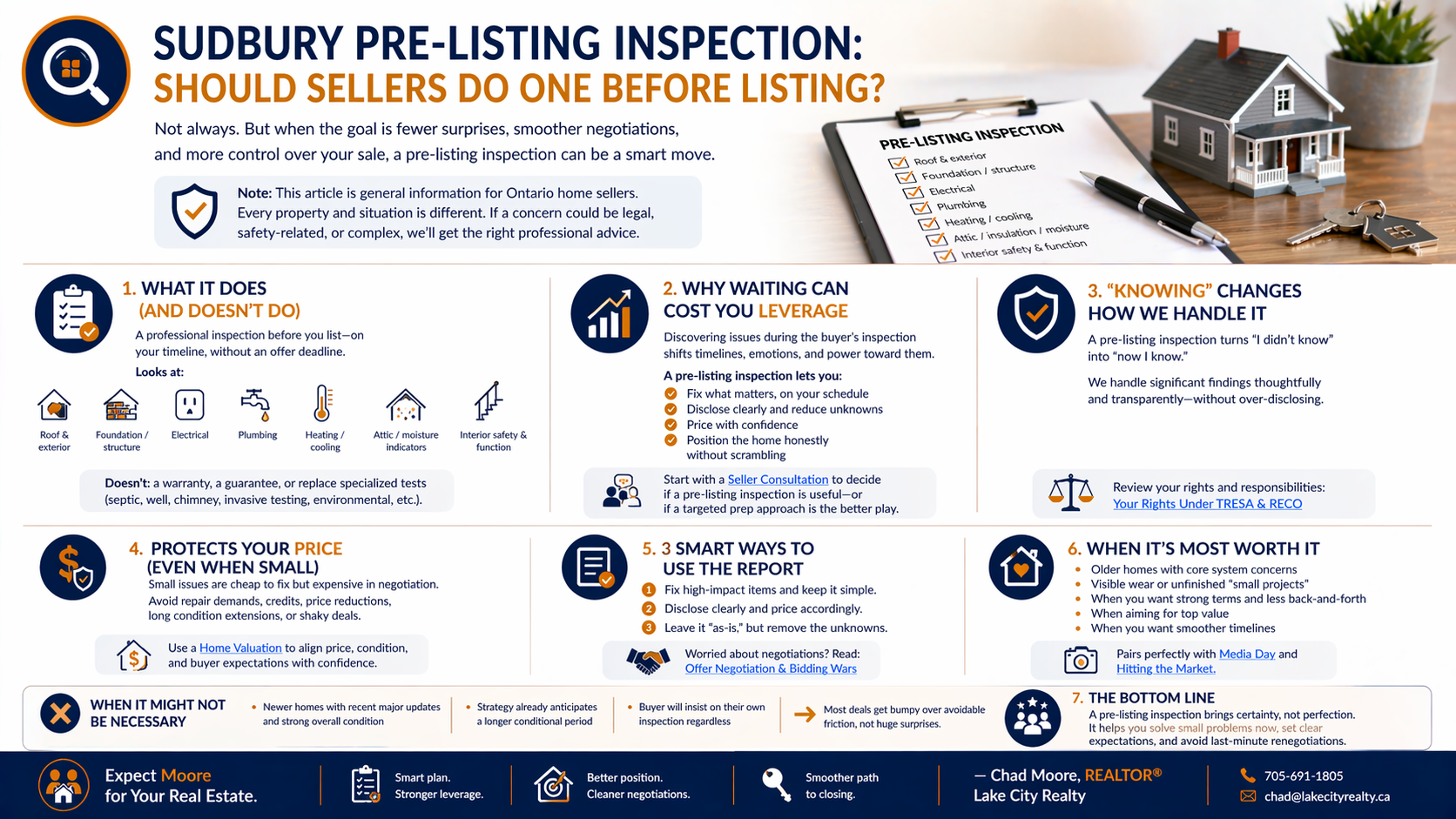
When I sit down with Greater Sudbury sellers, one question comes up early:
“Do I really need a pre-listing inspection?”
My honest answer is still the same: not always.
But when the goal is fewer surprises, smoother negotiations, and more control over your sale, a pre-listing inspection can be a smart move — especially in a market where buyers compare condition just as much as price.
Note: This article is general information for Ontario home sellers. Every property and situation is different. If a concern could be legal, safety-related, structural, environmental, or complex, we’ll treat it that way and get the right professional advice.
🧭 What a Pre-Listing Inspection Actually Does
A pre-listing inspection is simply a home inspection completed before you list — on your timeline, without an offer deadline hanging over your head.
Most inspections are visual and non-invasive, focusing on accessible components and systems.
Typically, an inspector is looking at:
- Roof and exterior conditions, where accessible
- Foundation and visible structural indicators
- Electrical panels, outlets, and visible safety concerns
- Plumbing fixtures, visible leaks, and drainage indicators
- Heating, cooling, and ventilation systems, where applicable
- Attic, insulation, and visible moisture indicators, where accessible
- Interior safety and function items such as doors, stairs, railings, and obvious defects
What it does not do: it is not a warranty, it is not a guarantee, and it does not replace specialized tests.
For example, septic, well, chimney, environmental, mould, asbestos, engineering, or invasive investigations may require separate professionals.
That does not make the inspection less useful. It simply means sellers need to understand what the report is — and what it is not.
The value is that it can identify potential issues early, before you are negotiating under pressure.
🧨 Why Waiting for the Buyer’s Inspection Can Cost You Leverage
In many Greater Sudbury transactions, the buyer will still want their own inspection.
That is normal.
But if the first time you learn about a meaningful issue is during the buyer’s condition period, you may be negotiating from a weaker position.
At that point:
- the buyer is already emotionally invested but cautious
- the clock is ticking on the condition deadline
- the buyer may ask for repairs, credits, or a price reduction
- you may feel pressure to keep the deal together
- the issue may sound larger because it appeared in a formal report
A pre-listing inspection flips the script.
You get to decide how to handle findings before the market is watching:
- Fix what matters, on your schedule
- Disclose clearly, where appropriate, and reduce unknowns
- Price with confidence so the market response matches reality
- Position the home honestly, without scrambling mid-deal
If you want a clean, proactive game plan from day one, start with a Seller Consultation. That’s where we decide whether a pre-listing inspection is useful — or whether a targeted prep approach is the better play.
🧾 The Part Sellers Miss: “Knowing” Something Changes How We Handle It
Here’s the most important strategic detail: a pre-listing inspection can turn “I didn’t know” into “now I know.”
That matters.
In Ontario, sellers and agents need to take disclosure seriously, especially around issues that could be considered material to a buyer’s decision.
That does not mean you panic over every minor maintenance item.
It does mean we handle significant findings thoughtfully and professionally.
If you want to understand the framework we work under, you can review your rights and responsibilities here: Your Rights Under TRESA & RECO.
The goal is not to make the home sound scary.
The goal is to reduce deal risk by being honest, clear, and organized — and by avoiding last-minute surprises that derail negotiations or invite a re-trade.
💰 How a Pre-Listing Inspection Protects Your Price
Small issues are rarely expensive to fix.
But they can become expensive in negotiation.
A loose railing, slow drain, missing downspout, or visible electrical concern might be manageable on your timeline.
But when those same items show up in a buyer’s inspection report as a growing list, it can create doubt.
And doubt shows up as:
- repair demands
- credits
- price reductions
- longer condition extensions
- or a deal that gets shaky
That’s why I like using pre-listing inspections as a pricing and positioning tool — not just a checklist.
When condition is clear, the market response is more predictable.
If you’re trying to line up price, condition, and buyer expectations in a smart way, use the Home Valuation page as a starting point — and then we’ll build a plan around your home specifically.
This also connects closely to strategic pricing. If the report reveals something meaningful, the question becomes whether we repair it, disclose it, price around it, or prepare for it in negotiation. That is why pricing and condition should be reviewed together. For the broader pricing framework, see How to Price Your Home Strategically in Greater Sudbury.
✅ Three Smart Ways to Use the Report
A pre-listing inspection is only as helpful as the strategy behind it.
Here are three clean, practical approaches:
1) Fix the high-impact items
Focus on safety, obvious function issues, and items that show up loudly in reports.
That might mean tightening a railing, repairing a leak, addressing an obvious electrical concern, improving drainage, servicing a heating system, or correcting a small issue that would otherwise become a negotiation talking point.
Then we document what was done and keep the listing story clean.
2) Disclose clearly and price accordingly
Sometimes the best move is not to renovate.
It is to be upfront, price appropriately, and avoid a mid-deal crisis.
If you’re unsure how conditions, representations, warranties, and disclosures work in Ontario agreements, this page helps: Legal & Contract Terms.
3) Leave it “as-is,” but remove the unknowns
Even if you don’t fix everything, you can still reduce uncertainty by clarifying what’s going on — and by planning your negotiation posture before the first offer arrives.
If negotiations are the part you’re most concerned about, especially conditions, repair requests, inspection issues, and re-trades, read this next: Offer Negotiation & Bidding Wars.
🧠 When a Pre-Listing Inspection Is Most Worth It in Greater Sudbury
A pre-listing inspection is not automatically needed for every home.
But it is often worth considering when the property has features or conditions that buyers are likely to question.
It can be especially useful for:
- Older homes where buyers may worry about core systems such as roof, electrical, plumbing, heating, foundation, or moisture
- Homes with visible wear or a handful of unfinished small projects
- Homes with basements buyers may scrutinize, especially where moisture, age, or layout questions may come up
- Properties where you want strong terms and less back-and-forth after acceptance
- Homes aiming for top value where obvious objection points should be handled before listing
- Sellers who want smoother timelines from offer to closing, with fewer surprises
And if your listing plan includes professional presentation, this is where the inspection can pair perfectly with the rest of the launch process.
Here are the two pages that map to that workflow:
📌 When It Might Not Be Necessary
There are also situations where a pre-listing inspection may not be the best use of time or money.
For example:
- newer homes with recent major updates and strong overall condition
- homes where the likely buyer pool will still insist on their own inspection regardless
- situations where the seller is comfortable with a normal conditional period
- properties where the better strategy is targeted preparation rather than a full inspection
Even then, I still like having a prep plan — because most deals don’t get bumpy over huge surprises.
They get bumpy over avoidable friction.
That is why preparation still matters, inspection or not. If you want the practical prep framework, start here: How to Prepare Your Home for Sale in Sudbury.
🧩 Buyer Confidence Is Really About Risk
Buyers don’t just inspect homes.
They inspect risk.
They are asking themselves:
- What am I not seeing?
- What could this cost me later?
- Will this inspection turn into a problem?
- Is the seller being clear?
- Does this home feel cared for?
When a seller can show that the home has been professionally evaluated and prepared, it can reduce the “what else is wrong?” mindset and support cleaner negotiations.
Clean terms matter just as much as price: fewer conditions, fewer re-trades, fewer surprises.
And if you want to see what buyers are comparing you against right now — condition, features, price, and competition — take a look at MLS® Smart Search. It’s a fast way to understand what else is on the shelf in your price range.
🧾 My Advice
Think of a pre-listing inspection as certainty.
Not perfection.
Certainty.
It helps you solve small problems on your timeline, set expectations clearly, and avoid last-minute renegotiations that cost money and momentum.
If you want a clear, step-by-step selling plan — inspection or not — start here: The Seller Experience.
And if you like proof over promises, browse the outcomes from local listings here: Seller Success Stories.
Expect Moore for Your Real Estate.
— Chad Moore
REALTOR® | Lake City Realty