



Most homeowners don’t set out to make a mistake when selling their home.
They research pricing.
They clean and prepare.
They trust that once the home hits MLS®, buyers will find it.
And yet, many listings still sit longer than expected, attract the wrong kind of interest, or require price reductions that feel frustrating and avoidable.
The reason is rarely one big error.
It’s usually one overlooked piece of the strategy.
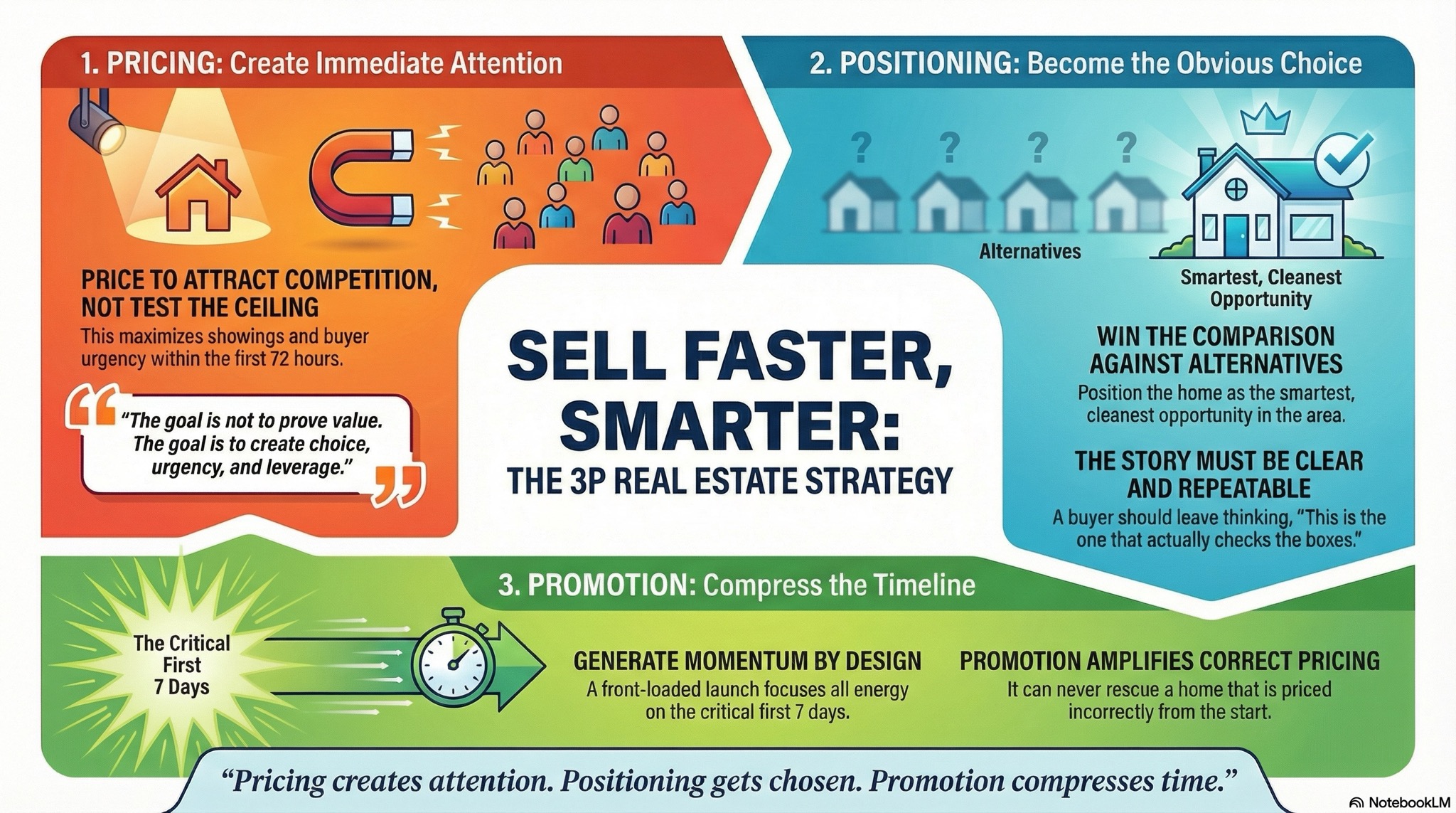
When I list a home, I work from a simple framework I call the 3Ps:
Pricing creates attention.
Positioning gets chosen.
Promotion concentrates attention during the launch.
P #1: Pricing — Create Immediate Attention (Not Just a Number)
Pricing is the most emotional part of selling a home — and the most misunderstood.
Many sellers think pricing is about proving what their home is worth.
In reality, pricing is about creating attention and competition, especially during the initial launch.
Here’s the part most people miss: price isn’t a number — it’s a lane.
- Your list price determines which buyers see your home in their search filters.
- It determines which homes you’re compared to.
- It determines whether you show up as “the best option” — or “the expensive one.”
When a home is priced to “test the ceiling,” here’s what typically happens:
- Buyers hesitate instead of acting
- Showings trickle instead of stack
- The listing becomes something to “watch” rather than pursue
By contrast, pricing designed to attract competition creates:
- Urgency
- Choice
- Leverage
That leverage is what allows the market to reveal true value — often upward.
A good real-world example is 1070 Valecrest in Blezard Valley. The pricing strategy there went against the sellers’ instincts at first, but the goal was to create competition instead of resistance. That is exactly what strategic pricing is supposed to do: attract the right attention early so the market can do its job.
This is why pricing is addressed right at the start of the Seller Experience, beginning with a clear Seller Consultation and a realistic, data-backed approach — not guesses or hopeful numbers.
For a deeper breakdown of this pricing lane approach, see How to Price Your Home Strategically in Greater Sudbury. And if you are still trying to establish a realistic starting point, the Home Valuation process can help anchor the conversation before the listing strategy is finalized.
P #2: Positioning — Become the Obvious Choice
Homes don’t sell in isolation.
They sell in comparison to everything else a buyer is considering — and in 2026, that comparison starts online.
Buyers don’t walk into your home first — they walk into their phones.
Positioning answers a buyer’s question:
“Why should I choose this home over the others?”
This is where many listings fall short. They’re “nice”… but not decisive.
Strong positioning means:
- The value story is clear and repeatable
- Key features are framed as solutions, not just specs
- Buyers leave a showing knowing exactly how this home fits their life
It also means you understand what you’re truly up against:
- Active competition: what buyers can choose right now
- Recent sales: what the market has actually accepted recently
- Buyer expectations: what “good” looks like at your price point in Sudbury today
Positioning is shaped through:
- Thoughtful preparation
- Professional media
- Clear messaging online and in-person
This is why prep, presentation, and media aren’t cosmetic details — they’re strategic ones.
111 Pinellas Rd in Chelmsford is a strong example of that. The strategy there was not just to make the home look good — it was to present it in a way that matched buyer expectations, highlighted the right improvements, and helped the home feel like the obvious choice when buyers started comparing options.
I cover those steps in Hitting the Market and Media Day.
If the home needs work before launch, sellers should also review How to Prepare Your Home for Sale in Sudbury. Preparation is not about chasing perfection. It is about removing the friction that causes buyers to hesitate.
P #3: Promotion — Compress the Timeline
Promotion doesn’t mean “more exposure.”
Most homes already get exposure.
Promotion, done properly, is about focusing qualified-buyer attention during the launch, when active buyers are likely to notice a new listing.
A front-loaded launch:
- Concentrates demand
- Aligns showing activity
- Forces comparisons to happen quickly
Early momentum can be difficult to rebuild later.
1342 Orange Grove Drive in Sudbury is a good example of that principle in action. The promotion was built to focus attention quickly, reduce buyer uncertainty, and create a strong early response. When the launch window is used properly, the market tends to respond faster and more decisively.
Promotion can amplify correct pricing — but it cannot reliably correct pricing the market rejects.
That’s why promotion follows the first two Ps, not the first.
This is also why the first week on market matters so much. Promotion is most powerful when it is timed with the moment buyers are already paying the most attention.
What Happens When One P Is Overlooked
- Strong promotion + weak pricing → lots of views, little action
- Good pricing + weak positioning → showings without offers
- Great pricing and positioning + slow promotion → missed urgency
2023 St. Jean Baptiste in Chelmsford is the cautionary tale of this. The positioning and promotion were strong, the home was showcased professionally, and the listing got real visibility and engagement. But when pricing is not grounded in current market reality, even strong media and strong exposure cannot fully compensate for it.
For sellers, visibility is not the same as alignment. A home can be seen by a lot of people and still lose momentum if one part of the strategy is out of sync with the others.
Selling well isn’t about doing one thing perfectly.
It’s about doing the right things together, in the right order.
If one of those pieces is missed, the listing can stall. That is where a seller may need to diagnose whether the issue is pricing, presentation, access, promotion, or buyer perception. I break that down further in Why Your Sudbury Home Isn’t Selling.
One More Truth: Positioning Must Adapt
Rates shift. Inventory changes. Competing listings appear or disappear.
Positioning is ongoing. A strong strategy reassesses your lane, your competition, and buyer feedback — and adjusts before momentum is lost.
That matters because once a listing sits, the “stale listing effect” kicks in:
- Buyers assume leverage
- They wait for reductions
- They negotiate harder
Momentum is easier to protect than it is to rebuild.
This is where structured Offer Negotiation matters too. A strong sale is not just about attracting attention. It is about understanding which offers are strongest, which conditions create risk, and how to protect leverage once buyers start responding.
What Sellers Should Expect
A smart listing strategy should:
- Create attention immediately
- Make the home easy to choose
- Encourage decisive buyer behaviour early
If you’re planning to sell, it’s worth understanding how these three elements work together — whether you work with me or not.
If you’d like to see how this framework applies to your home specifically, it starts with a conversation — not a commitment.
Start here: Seller Consultation or Home Valuation.
Final Thought
Selling a home doesn’t require gimmicks or guesswork.
It requires clarity.
Pricing creates attention.
Positioning gets chosen.
Promotion concentrates attention during the launch.
Overlooking one doesn’t mean you failed — it just means you weren’t shown the full picture.
Ready to Sell?
If you want a smart plan that builds urgency, protects leverage, and gets your home in front of the right buyers the right way, start here:
Expect Moore for Your Real Estate.
— Chad Moore
REALTOR® | Lake City Realty