Local evidence. Practical guidance.

Greater Sudbury Real Estate Blog

Market updates, buying and selling guidance, Ontario real estate information and straight answers for people making real decisions in Greater Sudbury.

Latest articles

New and recently refreshed guidance appears first.

June 1, 2026

How Much Down Payment Do You Need to Buy a Home in Greater Sudbury?

How Much Down Payment Do You Need to Buy a Home in Greater Sudbury?

One of the first questions buyers ask when entering the market is simple:

How much down payment do I actually need to buy a property in Greater Sudbury?

For many buyers the question starts with purchasing a home, but in Northern Ontario buyers are also commonly considering cottages, camps, or vacant land.

The answer depends on the type of property and the purchase price. But the real conversation goes deeper than the minimum requirement. In practice, the smartest buyers in Greater Sudbury aren’t just asking what the minimum down payment is — they’re asking how to structure their purchase so the numbers still feel comfortable long after closing day.

Minimum Down Payment Rules for Homes in Greater Sudbury

For most residential home purchases in Canada, minimum down payment requirements are based on the purchase price of the property:

  • 5% for homes priced $500,000 or less
  • 5% on the first $500,000 and 10% on the portion above $500,000 for homes priced between $500,000 and $1,499,999
  • 20% minimum for homes priced $1.5 million or more

Many homes in Greater Sudbury fall within the price range where a 5% down payment may qualify buyers for a mortgage. But qualifying for financing and buying comfortably are two different things. Smart buyers build their plan using tools like MLS® Smart Search or by narrowing options through the Greater Sudbury Curated Hot Sheets.

What Down Payments Look Like in Greater Sudbury

To put the numbers into perspective, here are examples based on typical local price ranges:

  • $350,000 home → minimum down payment $17,500
  • $450,000 home → minimum down payment $22,500
  • $600,000 home → minimum down payment $35,000

These numbers only reflect the down payment itself. Buyers should also consider their financing strength, closing costs, and the financial flexibility they want after moving into the home.

Down Payments for Cottages and Camps

In Northern Ontario, many buyers are also looking at recreational properties such as cottages, camps, or seasonal waterfront homes.

Some cottages can qualify for financing similar to a primary residence, but this depends heavily on the property's characteristics.

If a cottage is considered a year-round property with road access, proper utilities, and standard construction, lenders may allow similar minimum down payment rules as a primary home.

However, lenders often require larger down payments if the property:

  • is seasonal or not winterized
  • has water-only access
  • is on leased land
  • has limited services or utilities
  • is considered a recreational camp rather than a residential dwelling

In these situations, buyers may be required to put down 10% to 20% or more depending on the lender and property type.

This is why financing cottages in areas around Greater Sudbury — such as Vermilion Lake, Wanapitei Lake, Long Lake, or other recreational areas — often requires a more detailed mortgage conversation before making an offer.

Down Payments for Vacant Land

Vacant land is financed very differently than homes.

From a lender’s perspective, land is typically considered higher risk because it does not produce housing immediately and may take years to develop.

As a result, most lenders require significantly larger down payments when purchasing land.

Typical down payment ranges include:

  • 20% to 25% for serviced building lots
  • 25% to 35% or more for rural or unserviced land
  • larger down payments for remote or recreational parcels

Some lenders may also require buyers to demonstrate a plan to build within a certain timeframe.

Because of these factors, many land buyers either purchase with a large down payment or leverage equity from an existing home. And because financing is only one part of the equation, buyers looking at raw land should also understand the due diligence, zoning, servicing, title, and cash-planning differences that come with that type of purchase. I break that down further here: Buying Vacant Land in Greater Sudbury? What Buyers Need to Know Before They Start Shopping.

What Happens If You Put Less Than 20% Down?

If your down payment is less than 20%, your mortgage will typically require default insurance. Many buyers casually refer to this as “CMHC insurance,” although there are multiple mortgage insurers operating in Canada.

What matters for buyers is how this affects the mortgage:

  • the insurance premium increases the total mortgage amount
  • the premium is usually added to the mortgage rather than paid upfront
  • monthly payments increase slightly because the financed amount is larger

This is why the minimum down payment is not always the most strategic option.

And because lenders price risk differently depending on the structure of the deal, it also helps to understand how banks actually set mortgage rates in Canada.

If you're still setting up your financing foundation, start with Pre-Approval & Budgeting and Mortgage Types in Ontario.

Why Some Buyers Choose a Larger Down Payment

Even when buyers qualify with 5%, many choose to put more down.

A larger down payment can:

  • reduce the total mortgage amount
  • lower monthly payments
  • reduce or eliminate mortgage insurance
  • create stronger long-term affordability

The right number depends on your comfort level, income stability, and how much financial flexibility you want after closing.

Your Down Payment Is Only Part of the Cash Needed

Another important point for buyers in Greater Sudbury: the down payment is not the only money required to buy a property.

You may also need funds for:

  • legal fees
  • title insurance
  • land transfer tax
  • property tax adjustments
  • home inspection costs
  • moving expenses

That’s why this article pairs closely with Closing Costs in Sudbury: What Buyers Should Budget For.

Savings Tools First-Time Buyers May Use

Many first-time buyers use registered savings tools to build their down payment.

  • First Home Savings Account (FHSA) – a tax-advantaged savings account designed specifically for first-time buyers
  • Home Buyers’ Plan (HBP) – allows eligible buyers to withdraw funds from an RRSP toward a home purchase

These tools can help accelerate savings, but they don’t replace the need for a well-structured home buying plan.

What This Means for Buyers in Greater Sudbury

The real question for local buyers isn’t simply:

“What’s the minimum down payment?”

The smarter question is:

“What down payment puts me in the strongest position to buy in Greater Sudbury?”

For some buyers the answer is 5%. For others, waiting until they can comfortably put 10% or 20% down creates a much stronger financial position.

This is especially true when purchasing cottages, camps, or land, where lenders often require larger down payments and more detailed financing approvals.

If you’re preparing to buy, the best place to start is the full Buyer Experience roadmap.

The Bottom Line

Yes, many buyers can purchase a home in Greater Sudbury with a relatively modest down payment.

But successful buyers focus on the full picture — budgeting, financing, closing costs, and long-term affordability — before writing an offer.

Whether you're buying a home, a cottage, or a piece of land to build on, understanding how down payments work is one of the most important steps in building a strong buying plan.

Expect Moore for Your Real Estate.
Chad Moore, REALTOR® | Lake City Realty

May 26, 2026

Gross Underpricing in Sudbury Real Estate | Chad Moore

Gross Underpricing in Sudbury Real Estate | Chad Moore

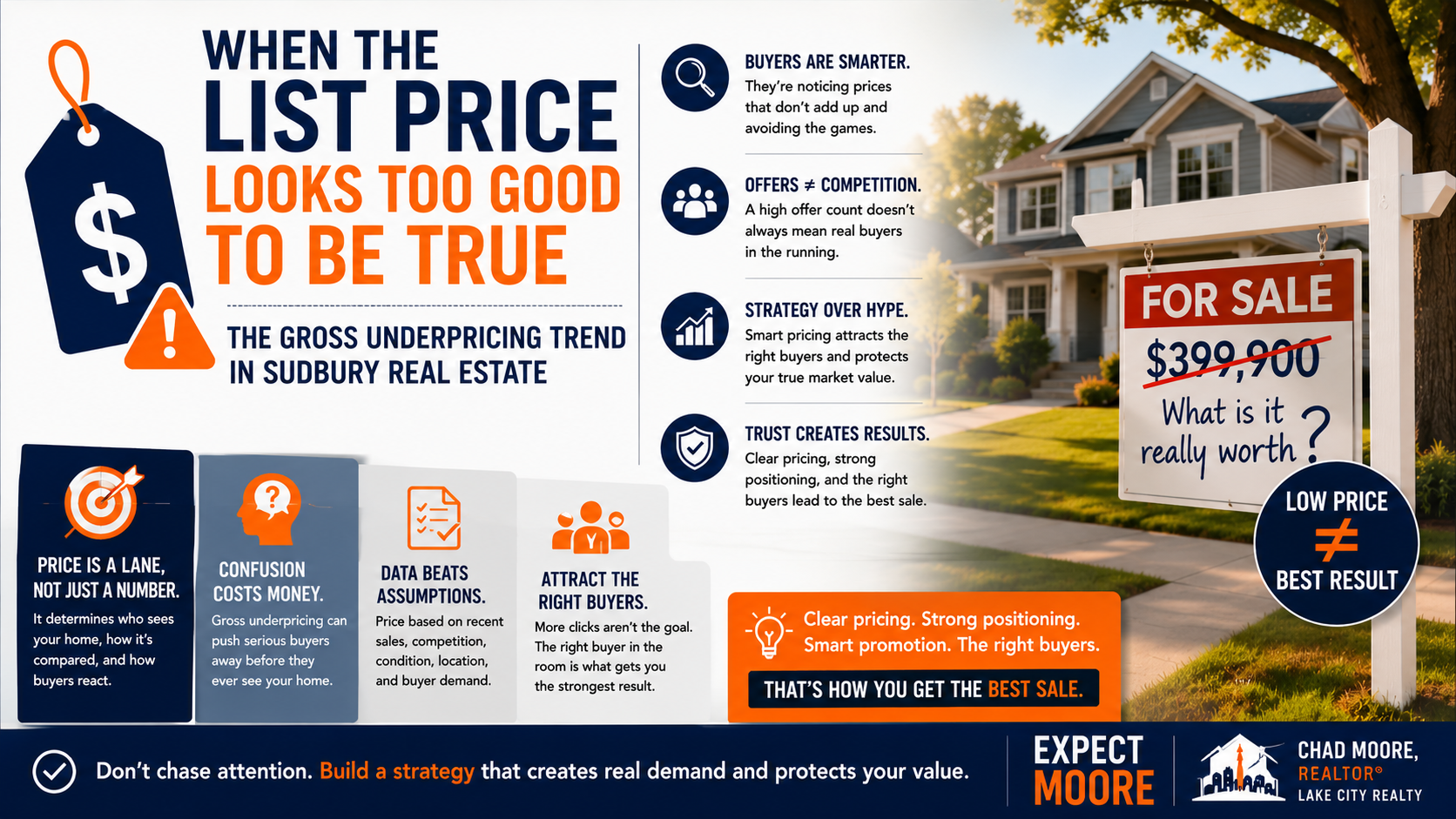
Gross underpricing in Greater Sudbury real estate and how unrealistic list prices can frustrate buyers and cost sellers money

There is a trend I am seeing more often in the Greater Sudbury real estate market, and I think both buyers and sellers need to pay attention to it.

More homes are being listed at prices that appear to be far below any realistic expectation of market value.

Not slightly underpriced.

Not strategically positioned a little below a key search threshold.

I am talking about list prices that appear to be $75,000, $100,000, or even closer to $200,000 below where the seller likely expects the home to sell.

And buyers are noticing.

Over the last couple of years, I have spoken with many buyers who have avoided certain properties altogether because they felt the listing price made no rational sense. They were not avoiding the home because they disliked it. In many cases, the home itself was appealing.

They avoided it because the process looked like a game.

That matters.

Because when buyers stop trusting the list price, the list price stops doing its job.

This Is Not About Normal Strategic Pricing

I want to be clear about something right away.

This is not an argument that every home should be listed high.

It is also not an argument that every home should be listed exactly at the seller’s dream number.

There is a legitimate place for strategic pricing.

Sometimes a home is positioned slightly below expected market value to create urgency, generate early activity, or land in the right buyer search lane. When that is done properly, it can be part of a thoughtful listing strategy.

But that is not what I am talking about here.

I am talking about something different.

I am talking about gross underpricing — where the list price appears so disconnected from reality that buyers have no meaningful way to interpret it.

That is when a list price stops being useful information.

It becomes bait.

And buyers are getting tired of it.

I have already written about the risks of underpricing a home, but this trend deserves its own conversation because it is not just about pricing low. It is about a growing lack of trust in list prices that appear to have no real connection to value.

The Rise of “Price Low and Pray”

There is a version of listing strategy that seems to be showing up more often:

List low.
Hold offers.
Hope the market takes care of the rest.

But hope is not a pricing strategy.

A thoughtful pricing strategy should be based on:

  • Current comparable sales
  • Active competition
  • Property condition
  • Location
  • Features
  • Buyer search behaviour
  • Market timing
  • Financing conditions
  • The realistic pool of buyers for that home

When the number is chosen mainly to manufacture attention, the entire strategy becomes fragile.

Yes, a low list price may get clicks.

Yes, it may produce showing requests.

Yes, it may create the appearance of activity.

But activity is not the same thing as strategy.

That is the part sellers need to be very careful with.

A proper Hitting the Market plan should not depend on confusion. It should be built around the right buyer pool, the right price lane, the right presentation, and a realistic expectation of how buyers are likely to respond.

Holding Offers Does Not Automatically Mean Competition

This is one of the biggest shifts I am watching.

For a while, buyers became conditioned to believe that if a home was listed low and holding offers, it would automatically result in competition.

That is not always happening anymore.

Recently, I have seen listings holding offers that did not generate the kind of competition the strategy appeared to be banking on. In one recent stretch, only about half of the listings holding offers ended up in meaningful competition.

That is important.

Because if a home is priced low, marketed around an offer date, and still does not attract the right competitive response, then the strategy has not done what it was supposed to do.

At that point, the seller may be left with the worst of both worlds:

  • The price was low enough to create buyer skepticism.
  • But the strategy was not strong enough to create meaningful competition.

That is not smart positioning.

That is a gamble.

Holding offers can be a legitimate tool when the situation supports it, but sellers should understand how holding offers and seller’s directions in Ontario actually work before assuming that an offer date alone will create competition.

The Offer Count Can Be a Misleading Metric

This is another part of the conversation that needs more honesty.

A listing that receives 8, 10, or 15 offers may sound like a huge success.

And sometimes it is.

But sellers and buyers both need to understand that the number of offers does not always tell the full story.

In many multiple-offer situations, only a small number of offers are truly competitive.

  • Some offers are well below where the seller expects to land.
  • Some are conditional when the seller is hoping for firm.
  • Some buyers are taking a shot because the list price gave them false hope.
  • Some buyers were never financially positioned to compete at the home’s likely value.

That is why the raw offer count can become an artificial metric of activity.

It looks impressive from the outside.

But it does not always tell you whether the seller attracted the right buyers, created the right competition, or achieved the strongest possible result.

That is why I wrote about the truth about bidding wars. A large number of offers can sound dramatic, but the real competition is often much smaller than people think.

For sellers, that distinction matters.

Ten offers do not automatically mean the strategy worked.

The better question is:

How many of those offers were actually in the running?

And even more importantly:

Did the strategy attract the best buyer for the home?

Buyer Frustration Is Becoming a Real Market Factor

Buyers are not naive.

They are watching the market.

They are saving listings.

They are comparing homes.

They are talking to their agents.

They are looking at recent sales.

They know when something does not feel right.

And after the last few years, many buyers are much more skeptical of obvious pricing games.

I have heard it directly from buyers:

“I do not want to play that game.”
“There is no point.”
“They are obviously expecting way more.”
“That price makes no sense.”
“Let’s wait for something priced more honestly.”

That buyer frustration matters because it changes behaviour.

Some buyers still participate.

Some buyers submit long-shot offers.

Some buyers book the showing just to see what happens.

But many serious buyers simply disengage.

They skip the showing.

They wait for another listing.

They assume the offer night will be chaotic.

They assume the seller’s expectations are nowhere near the list price.

And when that happens, the seller may lose the exact buyer they needed most.

That is where this becomes more than a buyer frustration issue.

It becomes a seller risk.

The Best Buyer May Never Walk Through the Door

This is the point I think sellers need to take most seriously.

When a property sells for less than expected, people often say, “That is what the market decided.”

Sometimes that is true.

But sometimes the better question is:

Did the market decide?
Or did the strategy fail to attract the best buyer?

Those are not the same thing.

If the most motivated, best-qualified, best-fit buyer never books the showing, never walks through the door, and never submits an offer, then the final sale price may not reflect the true ceiling of the property.

It may simply reflect the ceiling of a flawed launch strategy.

That is what I believe we have seen with several properties this year.

Some homes appeared to sell below where our team expected them to land based on the property, market conditions, competition, and buyer demand. When that happens, and when the home was launched with a list price that appeared disconnected from its likely value, the logical question is whether the pricing strategy pushed the right buyers away.

That is the danger of gross underpricing.

It may create noise.

But noise is not the same as demand.

And demand is only useful if the right buyers are actually participating.

“Sold Over Asking” Does Not Always Mean Maximum Value

This is one of the most misunderstood parts of the market.

A home selling $75,000 over asking sounds impressive.

A home selling $100,000 over asking sounds even better.

But the real question is not how far over asking it sold.

The real question is whether the asking price made sense in the first place.

If a home is listed $100,000 below realistic market value and sells $80,000 over asking, that is not automatically a win.

It may actually mean the home sold below where it should have.

That is why “sold over asking” can be a misleading headline.

The goal should not be to create the largest gap between list price and sale price.

The goal should be to achieve the strongest possible sale result.

Those are not the same thing.

A seller does not win because the final sale price looks dramatic compared to an artificially low list price.

A seller wins when the strategy attracts the right buyers, creates real competition, protects leverage, and reaches the highest realistic result the market could support.

Price Is a Lane, Not Just a Number

This connects directly to one of the biggest pricing lessons in real estate:

Price is not just a number.

Price is a lane.

Your list price determines which buyers see your home in their search filters.

It determines which other homes your property gets compared against.

It determines whether your home looks like a realistic opportunity, an overpriced listing, or a pricing game.

That is why pricing has to be connected to strategy.

In my 3Ps of selling a home framework, pricing creates attention, positioning gets chosen, and promotion compresses time.

But the attention has to be the right attention.

If a home worth somewhere around $575,000 is listed at $399,900, it may attract a lot of buyers.

But which buyers?

Buyers shopping around $400,000 may feel misled once they realize where the seller likely expects to land.

Buyers shopping around $575,000 may miss it, dismiss it, or assume the process will be chaotic.

That is not just a pricing problem.

That is a positioning problem.

A stronger approach is to understand how to price your home strategically in Greater Sudbury so the listing attracts the right buyers, sits in the right competitive lane, and still creates urgency without destroying trust.

The $399,900 Problem Was a Warning Sign

This trend did not come out of nowhere.

One of the reasons I wrote about why $399,900 has become one of the hardest list prices to trust in Sudbury real estate is because buyers have learned that certain price points do not always mean what they appear to mean.

Sometimes $399,900 means the seller is hoping for $415,000.

Sometimes it means $450,000.

Sometimes it means $500,000 or more.

That is the problem.

When the same list price can represent wildly different seller expectations, the number stops being useful information.

It becomes noise.

And once a price point becomes noise, buyers start making assumptions.

  • Some assume they cannot compete.
  • Some assume the process will be frustrating.
  • Some assume the listing is not meant for them.
  • Some assume they are being baited.
  • Some move on.

That is why overused pricing tactics eventually lose power.

Buyers adapt.

And when buyers adapt, sellers need to adapt too.

For Buyers: If It Looks Too Good to Be True, It Probably Is

For buyers, the takeaway is simple:

Do not rely only on list price.

If a property appears to be priced far below what similar homes usually sell for, be careful.

That does not mean you should automatically avoid it.

But you should not assume the list price represents the seller’s true expectation either.

In today’s market, a buyer needs to ask better questions:

  • What is this home likely worth?
  • What have similar homes sold for recently?
  • Is the seller holding offers?
  • Is the list price realistic or just a strategy?
  • How many buyers are likely to be interested?
  • What price range would actually be competitive?
  • Is this worth pursuing, or is it just creating false hope?

This is where buyer strategy matters.

A low list price should not make you abandon logic.

It should make you look deeper.

️ Search by Area and Features, Not Just Price

This is one of the most practical ways buyers can protect themselves.

If you are searching for a home in Greater Sudbury, especially in a market where some listings are being priced far below expectation, do not build your entire search around list price.

Price matters, obviously.

But it should not be the only filter.

Focus on:

  • Location
  • Neighbourhood
  • Style of home
  • Garage
  • Waterfront
  • Bedroom count
  • Lot size
  • Condition
  • Layout
  • School area
  • Commute
  • Renovation level
  • Future use

A home listed under $400,000 may not really be competing in the under-$400,000 market.

A home listed under $500,000 may still sell well above that range.

A home that looks affordable at first glance may be intentionally positioned to attract far more attention than the seller’s actual expectations would suggest.

That is why tools like MLS® Smart Search and the Curated Hot Sheets can be useful. The goal is to search the way buyers actually make decisions — by area, features, lifestyle fit, and realistic value — not just by the headline list price.

Instead of only searching by price, buyers may be better served by watching the features that matter most to them, such as homes with garages, waterfront homes, homes with 4 or more bedrooms, or homes with pools.

Area matters too. A buyer focused on a certain part of Greater Sudbury may need to watch specific search lanes like Sudbury homes for sale, Valley East homes for sale, Chelmsford homes for sale, Azilda homes for sale, Garson homes for sale, or Walden homes for sale.

The list price is only one piece of the story.

The better question is:

Does this home actually match what I want, and what is it realistically worth?

That is a much stronger way to search.

For Sellers: Low Attention Is Not Always Good Attention

For sellers, the lesson is just as important.

The goal is not to attract the most people.

The goal is to attract the right people.

A dramatically low list price may bring in more showings, but that does not mean those showings are all valuable.

Some buyers may be far below the realistic value of the home.

Some may only be attending because the list price gave them false hope.

Some may never be able to compete.

Meanwhile, some of the strongest buyers may avoid the listing entirely because they do not trust the process.

That is a dangerous trade-off.

The seller does not need every buyer.

The seller needs the best buyer.

And if the best buyer never walks through the door, the seller may never know what was lost.

That is why the conversation should start with a realistic Home Valuation and a clear Seller Consultation, not just a flashy suggested list price.

A strong strategy should be explainable.

If the only explanation is “this will bring people in,” that is not enough.

Bring in who?

At what expectation?

With what plan?

And with what backup strategy if the market does not respond?

Those questions matter.

️ A Balanced Approach Still Wins

The answer is not to overprice.

Overpricing creates its own problems.

A home that is listed too high can sit, lose momentum, attract weaker feedback, and eventually need a price reduction. Buyers may start to assume there is room to negotiate, and the listing can become stale.

That is why I have also written about the risks of overpricing a Sudbury home.

But gross underpricing creates a different kind of risk.

It can create confusion.

It can attract the wrong buyers.

It can frustrate serious buyers.

It can make the offer process feel less credible.

It can generate activity without producing the strongest result.

That is why balance matters.

A good pricing strategy should be aggressive enough to create urgency, but realistic enough to maintain buyer trust.

There is a line between smart tension and obvious manipulation.

The best strategies know where that line is.

️ What a Thoughtful Pricing Strategy Should Consider

A thoughtful pricing strategy should answer more than one question.

It should not just ask:

“How do we get attention?”

It should also ask:

  • Who is the likely buyer for this home?
  • What are they comparing it against?
  • What price range are they actually searching in?
  • Will this list price attract them or confuse them?
  • Does the price align with the home’s condition and features?
  • Does the price align with the offer strategy?
  • Are we creating real urgency or artificial activity?
  • What happens if multiple offers do not materialize?
  • What is the plan if the market response is weaker than expected?

Those questions matter because the market does not reward gimmicks forever.

Buyers adjust.

Strategies get overused.

And when too many listings use the same playbook, the playbook starts to lose power.

That is what I believe we are starting to see with gross underpricing.

The Current Market Is Less Forgiving Than People Think

A few years ago, almost anything priced low enough seemed to attract a crowd.

That is not the same market we are in today.

Buyers are more cautious.

Financing is tighter.

Monthly payments matter more.

Condition matters more.

Renovation costs matter more.

Insurance, utilities, taxes, and carrying costs are part of the conversation.

And buyers are more aware of pricing games than they used to be.

So when a home is grossly underpriced today, the result is not always a stampede.

Sometimes it is skepticism.

Sometimes it is hesitation.

Sometimes it is a handful of offers that are not where the seller hoped they would be.

Sometimes it is no competition at all.

And sometimes it is a missed opportunity.

That is why sellers need to be careful about assuming that a strategy that worked in a hotter market will automatically work now.

The market has changed.

Buyer psychology has changed.

The strategy needs to change with it.

The Bottom Line for Buyers

If a listing price looks too good to be true, it probably is.

That does not mean the home is not worth considering.

But it does mean you should slow down, look at the bigger picture, and avoid anchoring your expectations to a number that may not reflect the seller’s true expectations.

Do not get caught up in the hype.

Do not assume a low list price means a bargain.

Do not assume a high offer count means every offer was competitive.

And do not let one artificial number define your search.

Use price as one filter.

But also search by area, features, condition, and realistic value.

That is how buyers make better decisions in a market where list prices are not always telling the full story.

The Bottom Line for Sellers

If you are selling, be careful with any strategy that depends on confusion.

A low list price can create attention.

But attention alone is not the goal.

The goal is to attract the right buyers, create real competition, protect your leverage, and reach the strongest realistic result.

That requires more than a low number.

It requires pricing, positioning, promotion, preparation, timing, and negotiation working together.

It also requires honesty about the market.

If a pricing strategy cannot be clearly explained, supported by data, and connected to a larger plan, sellers should be cautious.

Because once your home hits the market, the first impression is already being made.

And if buyers look at the list price and immediately think, “That makes no sense,” the strategy may already be working against you.

Final Thought

The list price is not just a marketing hook.

It is the first message buyers receive.

If that message feels clear, credible, and compelling, buyers lean in.

If it feels manipulative, confusing, or disconnected from reality, buyers pull back.

That is the risk with gross underpricing.

It may create noise.

It may generate clicks.

It may even produce offers.

But if it fails to attract the best buyer, it may also cost the seller money.

Underpricing can be a tool.

Gross underpricing is a gamble.

And in the current Greater Sudbury market, I think more buyers and sellers are starting to see the difference.

The goal should never be to create the loudest listing.

The goal should be to create the strongest result.

That still comes down to a balanced plan:

  • The right price
  • The right positioning
  • The right promotion
  • The right buyers in the room

If you are planning to sell, start with a complete Seller Experience strategy that is built around your home, your timing, and today’s market — not just a low number and a hope for the best.

Expect Moore for Your Real Estate.
Chad Moore
REALTOR® | Lake City Realty

May 21, 2026

Greater Sudbury Real Estate Market Update: May 2026

Greater Sudbury Real Estate Market Update: May 2026

May 2026 is still in progress. The latest complete month is April 2026, with 180 new-listing events, 116 sold-close events and a $542,500 median close price. That completed baseline is the most useful way to judge choices in the market now.

New listings180
Sold closes116
Median close price$542,500
Median paired ratio99.57%

The numbers and the questions they answer

Latest complete Greater Sudbury period: April 2026
Measure April 2026 Change from March 2026
New-listing events 180 +25.0%
Sold-close events 116 +11.5%
Median close price $542,500 +11.0%
Median close-price-to-export-list relationship 99.57%

Within the completed April 2026 baseline behind this May 2026 update, new-listing events describe the flow of properties entering the dataset. Sold-close events describe transactions whose recorded closing falls in that period. They are not the same group of properties, so one count divided by the other is not a sales conversion rate.

In the completed April 2026 baseline behind this May 2026 update, compared with March 2026, new-listing events change +25.0%, sold-close events change +11.5%, and the median close price changes +11.0%. These are period-to-period movements in separate event groups—not a resale gain or loss for one home.

What the activity flow suggests

Within the completed April 2026 baseline behind this May 2026 update, there is more listing flow than closing flow: the difference between 180 new-listing events and 116 sold-close events is 64. Another way to show the relationship is about 64.4 sold-close events for every 100 new-listing events recorded in the same period. That comparison is directional because a listing can close in a different month or quarter.

The practical point from the completed April 2026 baseline behind this May 2026 update is the combination of a 64-event gap and a 64.4-per-100 relationship—not a label for the whole city. The better question is whether a specific property segment is gaining fresh alternatives faster than qualified buyers are absorbing them. Price range, condition, neighbourhood and property type can produce a very different balance from the city-wide summary.

How to read the $542,500 median

In the completed April 2026 baseline behind this May 2026 update, the median close price is the middle value among the valid positive close prices. It is less sensitive to one extreme sale than an average, but it can still move because a larger share of higher-priced or lower-priced homes happens to close.

The composition of the completed April 2026 baseline behind this May 2026 update is why the $542,500 result cannot be applied as a percentage adjustment to a specific Greater Sudbury property. A valuation needs recent comparable sales with similar location, lot, age, condition, size, utility, updates and market exposure. The median gives the conversation a scale; the comparable set gives it precision.

What the 99.57% paired relationship does—and does not—show

Across the completed April 2026 baseline behind this May 2026 update, the median close-price-to-export-list relationship is 99.57%, which places the midpoint very close to the export list field. Here, the midpoint sits close to that field, even though individual results vary. This measure uses the ListPrice field present in the export; it does not prove the property's original asking price or capture every price change made before the sale.

For a buyer using the completed April 2026 baseline behind this May 2026 update, the ratio is not an automatic offer formula; for a seller, it is not a promise. The useful comparison is the group of current and recently sold homes that compete with the subject property, including the differences that explain why one attracts stronger terms than another.

What buyers can do with April 2026's signal

Start with a monthly carrying-cost ceiling and work backward to price. In the completed April 2026 baseline behind this May 2026 update, the $542,500 market median is not the buyer's budget, and the 99.57% paired relationship is not the required bid. Financing, property tax, utilities, insurance, condo fees and immediate repairs all determine the real monthly cost.

  • Confirm the rate, term, amortization and expiry date of the pre-approval.
  • Compare each serious home with current alternatives and recent closes.
  • Estimate near-term repairs before deciding which property is the better value.
  • Use financing and inspection conditions according to the property's risks and the offer environment.
  • Keep closing costs and an emergency reserve outside the down payment.

The figures in the completed April 2026 baseline behind this May 2026 update are most useful as a prompt to investigate. If new choices are accumulating in the buyer's exact segment, there may be room to slow down and compare. If well-positioned homes are disappearing quickly, preparation and clean decision-making matter more than a city-wide label.

What sellers can do with April 2026's signal

Price against the homes a qualified buyer can choose today. The gap inside the completed April 2026 baseline behind this May 2026 update—180 listing events against 116 sold closes—creates 64 more listing events, but the decisive competition is still the small set visible to the same buyer.

  • Build the price range from comparable sales and active competition.
  • Account for condition, updates, deferred work and recurring carrying costs.
  • Make the online presentation answer the questions buyers use to eliminate options.
  • Track showing quality, repeat interest and objections from the opening days.
  • Adjust when the competing set and buyer response do not support the original position.

A strong sale within the completed April 2026 baseline behind this May 2026 update still requires alignment among price, property and exposure. The market summary can identify the environment; it cannot compensate for an asking price that qualified buyers cannot defend against the alternatives.

How these Greater Sudbury measures are calculated

For the completed April 2026 baseline behind this May 2026 update, the counts come from nine geographically divided MLS exports used in this local series. Listing events use the recorded ListingContractDate. Sold-close events require a valid CloseDate and a positive ClosePrice. The median paired relationship uses ClosePrice and the export's ListPrice field.

The exports behind the completed April 2026 baseline behind this May 2026 update may not contain every board-wide or City of Greater Sudbury record. These are raw activity and price measures rather than a benchmark index, a same-home appreciation calculation or a forecast. That limitation is why property-level comparable work remains essential.

To compare the completed April 2026 baseline behind this May 2026 update with another public view of the region, see the Sudbury Real Estate Board statistics page from CREA.

The May 2026 bottom line

The completed April 2026 baseline behind this May 2026 update provides a clear four-part snapshot: 180 listing events, 116 sold-close events, a $542,500 median close price and a 99.57% median paired relationship. Read together, they describe activity, price mix and negotiating outcomes without pretending that every home or neighbourhood moves the same way.

Bring the market down to one property

If you are buying or selling in Greater Sudbury while the completed April 2026 baseline behind this May 2026 update shapes the conversation, I can build the current comparison around the home, neighbourhood, condition, financing and timing that actually shape your decision.

Explore the buyer process Explore the seller process

Expect Moore for Your Real Estate.
— Chad Moore
Lake City Realty

May 18, 2026

What Makes a Good Deal in Greater Sudbury Real Estate?

What Makes a Good Deal in Greater Sudbury Real Estate?

Every buyer wants a “good deal.”

But in real estate, a good deal isn’t always about getting the lowest price. ️

Sometimes the “best deal” is the house that costs a little more but saves you years of stress, surprise repairs, and resale headaches. Other times, the smart deal is the one that looks boring online but checks every box when you run the numbers.

Here’s how I recommend buyers in Greater Sudbury evaluate value without getting fooled by list price, hype, or fear-of-missing-out.

1️⃣ Market Value vs. List Price

List price is strategy. Market value is reality.

In Sudbury, list price can be used to:

  • attract more showings (pricing low to create a crowd)
  • test the market (pricing high to see if someone bites)
  • signal expectations (pricing near comparable sales to invite clean offers)

To estimate market value properly, we look at:

  • recent sold properties that match the home’s location, style, and condition
  • days on market (and how quickly good listings are actually moving)
  • pricing trends in the specific pocket you’re buying in

Important: A home can sell above list and still be fair value if it was strategically priced low. And a home can sell under list and still be overpriced if the market rejected it.

Want to get sharper at reading listings? Start here: How to Read an MLS® Listing.

️ 2️⃣ Condition Matters (Because Repairs Change the Math)

A lower price doesn’t mean value if major repairs are waiting behind the drywall.

When buyers misjudge “condition,” it usually happens in one of two ways:

  • They underestimate the cost of big-ticket items (roof, heating, foundation, electrical)
  • They underestimate the timeline (contractors, permits, supply delays, living through renos)

If a home needs work, the right question isn’t just “Can I renovate it?” It’s:

  • Is the discount large enough to justify the risk and hassle?
  • Are the problems cosmetic or structural/safety-related?
  • Will the finished result still fit the neighbourhood value ceiling?

If you’re considering renovation potential, review: Fixer-Upper Guide.

3️⃣ Location Drives Long-Term Value

Location is more than a postal code. It’s:

  • street feel and traffic patterns
  • proximity to schools, parks, shopping, and work routes
  • neighbourhood character and resale demand

Two similar houses can have very different long-term value simply because one is easier to live in day-to-day or easier to resell when life changes.

If you want to browse inventory efficiently (and compare areas without getting overwhelmed), use: MLS® Smart Search.

️ 4️⃣ Competition Level (And Why “Offering Low” Isn’t a Strategy)

In competitive markets, paying slightly above list may still be fair market value.

A good deal isn’t always a discount. Sometimes it’s:

  • getting the right house without reckless terms
  • protecting your risk position (conditions, timing, deposit)
  • winning cleanly with a strong, clear offer

If a home has multiple offers, the smart approach is to understand the real value range and decide what you’re willing to do before emotions take over.

Offer strategy matters more than simply “offering low.” Start here: Making an Offer Guide.

5️⃣ Total Cost of Ownership (Not Just the Sale Price)

Two homes can be the same price and still cost very different amounts to own.

Before calling something a “good deal,” evaluate:

  • property taxes (and whether they reflect current assessments/use)
  • utility costs (heating type, insulation, water/sewer context)
  • maintenance requirements (age of roof, windows, heating, grading/drainage, etc.)

Taxes explained here: Property Taxes Guide.

A Good Deal Is Strategic — Not Emotional

The right purchase balances:

  • fair market value (based on real comparables, not list price vibes)
  • property condition (and realistic repair math)
  • location strength (day-to-day lifestyle + resale demand)
  • long-term livability (does it still make sense if life changes?)

If you want a simple way to sanity-check decisions, here’s my advice:

  • Don’t chase cheap. Chase value.
  • Don’t chase hype. Chase fit.
  • Don’t chase wins. Chase decisions you won’t regret after closing.

For the full buying roadmap: Buyer Experience.

Expect Moore for Your Real Estate.
Chad Moore, REALTOR® | Lake City Realty

May 12, 2026

Sudbury Road Construction 2026: Major Projects & Commutes

Sudbury Road Construction 2026: Major Projects & Commutes
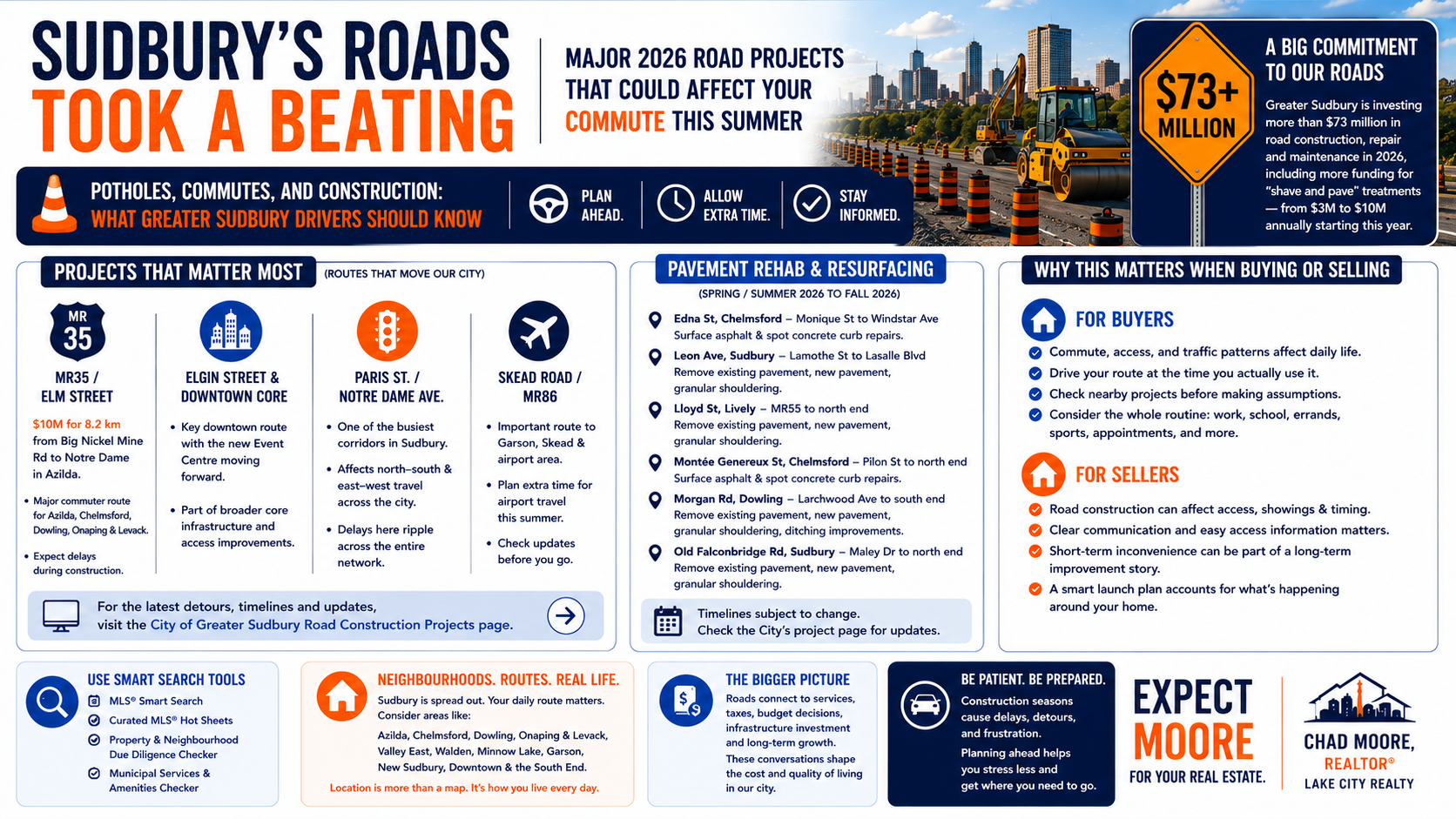
Sudbury roads 2026 blog graphic highlighting potholes, commutes, construction, and major Greater Sudbury road projects that could affect drivers, buyers, and sellers.

Potholes, commutes, and construction: what Greater Sudbury drivers should know for summer 2026.

This spring, the road conversation in Greater Sudbury feels different.

It is not just one bad stretch, one neighbourhood, or one familiar trouble spot. The general consensus seems to be that the potholes are bigger, more frequent, and harder to avoid — and almost no roads were spared.

For most of us, that is not an abstract infrastructure issue. It is the road we drive to work, the route we take to school drop-off, the way we get across town for appointments, shopping, sports, showings, and everyday life.

And with Greater Sudbury heading into a major 2026 road construction and rehabilitation season, the bigger question becomes:

Which projects are most likely to affect how people move through the city this summer?


Greater Sudbury Is Putting Serious Money Into Road Work

Greater Sudbury has announced a 2026 road rehabilitation strategy that includes more than $73 million for road construction, repair, and maintenance.

The City has also signalled a bigger shift toward pavement renewal work, including increased funding for spreader-laid asphalt treatments — often referred to as “shave and pave” work — rising from $3 million to $10 million annually starting in 2026.

That matters because this year’s road frustration is not just about one street or one pothole. It is part of a larger conversation about how Greater Sudbury maintains a massive road network across a very spread-out city.

For drivers, that means two things can be true at the same time:

The roads feel rough right now.
And a lot of work is either planned, underway, or coming.

For the latest municipal updates, readers can check the City of Greater Sudbury’s road construction project page.


Main Roads Matter: The Projects Most Likely to Affect Commutes

Not every road project affects the city the same way.

A residential street project matters a lot to the people who live there, but work on a main route can ripple across thousands of daily trips. In Greater Sudbury, where communities are spread out and many people drive between areas every day, arterial roads and main thoroughfares shape how the city actually functions.

That is why the 2026 construction season is worth paying attention to.

For buyers, these projects can affect how a neighbourhood feels during the home shopping process. For sellers, road work can affect access, showings, timing, and first impressions when hitting the market. And for everyone else, it may simply mean adjusting routes, allowing extra time, and keeping an eye on the City’s latest construction updates.


️ MR35 / Elm Street: More Than West-End Access

One of the biggest projects to watch is Municipal Road 35.

This is not simply a west-end road. For many residents in Azilda, Chelmsford, Dowling, Onaping and Levack, and surrounding areas, MR35 is the main connection into the city. Without it, the alternative often means a major detour through Valley East.

This one also hits close to home for me.

MR35 is part of my own commute into Sudbury, and I can say first-hand that this stretch has been in rough shape. If you drive it regularly, you do not need a report to tell you it needs attention — you feel it every day.

The City has identified an additional $10 million for rehabilitation of MR35 from Big Nickel Mine Road to Notre Dame in Azilda, covering an 8.2-kilometre corridor.

For west-side and northwest residents, this is not a minor project. It is a major commuter-route improvement that could affect daily travel during construction, but also improve a route that badly needs the work.

It also matters from a real estate perspective.

For buyers comparing homes in Azilda, Chelmsford, Dowling, or Onaping and Levack, commute reality should be part of the conversation. A home is not just where it sits on a map. It is how you get to work, school, errands, sports, appointments, and everything else that makes up daily life.

That is also why area-based searches matter. Buyers looking at homes for sale in Azilda, homes for sale in Chelmsford, homes for sale in Dowling, or homes for sale in Onaping and Levack should think about the route as part of the home search.


️ Elgin Street: Downtown Access, the Event Centre, and Ongoing Core Work

Elgin Street is another important project because of where it sits in the downtown network.

With the new Event Centre moving forward, and with other major downtown construction projects already completed, underway, or tied into the broader core-area conversation, Elgin is more than a road project. It is part of how people will move through and around Downtown Sudbury.

For drivers, that means short-term construction impacts.

For the city, it also connects to longer-term access, event traffic, pedestrian movement, and the way downtown functions during and after major infrastructure work.

That does not mean every downtown project needs to be framed as some magical fix. Sudbury has debated these issues for years. But when major construction decisions move from discussion into actual work, they do affect how people use the core — especially when tied to routes, parking, events, sidewalks, cycling infrastructure, and traffic flow.

For buyers considering Downtown Sudbury or nearby areas, access and daily movement matter. For sellers, construction can be a temporary inconvenience, but it can also be part of a longer-term infrastructure story.


Paris Street / Notre Dame Avenue: One of the Busiest Corridors in the City

Paris Street and Notre Dame Avenue deserve special attention because this is one of the busiest sections of road in Greater Sudbury.

This corridor affects people moving north to south, south to north, and also drivers trying to cross the city east to west.

When work affects Paris or Notre Dame, it is not only a downtown or New Sudbury issue. It can change how people move between the South End, Downtown Sudbury, New Sudbury, Minnow Lake, the West End, the Valley, and the east side of the city.

For commuters, this is one of those routes where even a small delay can ripple into a very different drive.

For buyers, it is a reminder to think beyond the house itself. If you are comparing neighbourhoods, commute routes and daily traffic patterns matter. A home that feels perfect online still needs to work in real life.


️ Skead Road / MR86: Airport-Area Travel

Skead Road / MR86 is also worth a quick mention for anyone heading toward Garson, Skead, or the airport area this summer.

It may not be the daily route for everyone, but if a trip to the airport is part of your summer plans, it would be smart to allow a little extra travel time and check the City’s latest construction updates before heading out.

This is also a good reminder that Greater Sudbury’s road network is not just about the downtown core. Our communities are connected by long routes, and when one of those routes is under construction, it can affect more than the immediate neighbourhood.


Pavement Rehabilitation and Resurfacing: The Detailed List

Along with the major corridor work, the City has also listed pavement rehabilitation and resurfacing work in several areas.

According to the City’s pavement rehabilitation and resurfacing project page, the work is expected to run from spring/summer 2026 to fall 2026, with timelines subject to change.

Edna Street, Chelmsford

Between Monique Street and Windstar Avenue.

Planned work includes surface asphalt placement and spot concrete curb repairs.

Leon Avenue, Sudbury

Between Lamothe Street and Lasalle Boulevard.

Planned work includes removal of existing pavement, new pavement, and granular shouldering.

Lloyd Street, Lively

Between MR55 and the north end.

Planned work includes removal of existing pavement, new pavement, and granular shouldering.

For buyers looking in Lively and the broader Walden area, this is another example of how local road work can tie into daily access and commute patterns.

Montée Genereux Street, Chelmsford

Between Pilon Street and the north end.

Planned work includes surface asphalt placement and spot concrete curb repairs.

Morgan Road, Dowling

Between Larchwood Avenue and the south end.

Planned work includes removal of existing pavement, new pavement, granular shouldering, and ditching improvements.

Old Falconbridge Road, Sudbury

Between Maley Drive and the north end.

Planned work includes removal of existing pavement, new pavement, and granular shouldering.

Because construction timelines, detours, and notices can change, the City’s road construction project page is the best place to check for the most up-to-date details before planning around any one project.


Why Road Work Matters When You’re Buying or Selling

Roads are part of real estate, even if they do not show up in the listing photos.

A home can look perfect online, but the way someone gets there matters. Buyers notice the commute. They notice the condition of the route. They notice construction, detours, access, traffic flow, and whether the neighbourhood feels easy or frustrating to live in.

This is especially true in Greater Sudbury, where many buyers are not choosing between neighbourhoods that are five minutes apart. They may be comparing Azilda or Chelmsford against Valley East or Walden, or weighing Minnow Lake against New Sudbury or Garson.

Those are not just lifestyle choices. They are route choices.

They affect how long it takes to get to work, how convenient errands feel, how easily kids can get to sports or school, and how connected a home feels to the rest of the city.

That is why choosing the right neighbourhood in Greater Sudbury should always include more than price, bedrooms, and square footage. It should include the roads you will use every day.


What Buyers Should Watch This Summer

If you are shopping for a home this summer, road work should not scare you away from a good property — but it should be part of your due diligence.

Drive the route at the time you would actually use it

A ten-minute drive on a Sunday afternoon might be a very different experience on a weekday morning.

Look at access, not just distance

A home can be close on the map but inconvenient in real life if the route is awkward, congested, under construction, or dependent on one main road.

Check nearby projects before making assumptions

A rough route today may already have rehabilitation planned. On the other hand, an active construction zone could affect access for part of the summer.

Think about the whole routine

Work, school, daycare, groceries, sports, family, healthcare, airport access, and recreation all matter. The right home should fit the way you actually live.

This is also where smart search tools can help. When you search for homes in Sudbury, the best approach is not just filtering by price and bedrooms. It is comparing location, commute, nearby services, and how each neighbourhood fits your daily routine.

Tools like my MLS® Smart Search, Curated MLS® Hot Sheets, Property & Neighbourhood Due Diligence Checker, and Municipal Services & Amenities Checker are designed to help buyers look beyond the listing photos and understand how a location actually works.

For example, buyers can compare Sudbury homes for sale, Garson homes for sale, Valley East homes for sale, or Walden homes for sale while also thinking about road access, commute routes, and daily convenience.

For a broader step-by-step overview, my guide to buying a home in Greater Sudbury walks through the bigger decision-making process. And for newer buyers, this is one of those first-time home buyer mistakes in Greater Sudbury that can sneak up on you: loving the house, but underestimating the daily route.


What Sellers Should Keep in Mind

For sellers, road construction can affect the listing experience too.

If your home is near active construction, access and communication matter. Buyers should know how to get to the property easily. Showing instructions should be clear. If there are detours, blocked lanes, or limited driveway access, those details need to be handled properly.

That does not mean construction is automatically a negative.

Sometimes the short-term inconvenience is tied to a long-term improvement. Road rehabilitation, watermain work, sidewalks, lighting, storm sewer upgrades, or resurfacing can all be part of a stronger future location story.

But when you are hitting the market, those details need to be considered as part of the launch strategy.

A good listing plan does not ignore what is happening around the home. It accounts for it.


The Bigger Picture: Roads, Services, Taxes, and Growth

Road work also connects to the bigger municipal conversation.

Greater Sudbury is a large, spread-out city with many communities, long connecting roads, and significant infrastructure demands. Roads, underground services, transit, emergency response, recreation, development, and growth all compete for attention and funding.

That is why conversations about Greater Sudbury’s 2026 municipal budget, property taxes in Greater Sudbury, and infrastructure investment are not separate from real estate. They shape the day-to-day experience of living here.

For homeowners, these decisions affect the services and roads they rely on.

For buyers, they affect long-term affordability, commute patterns, neighbourhood confidence, and the practical cost of living in one area compared to another.

For sellers, they affect how buyers perceive location, access, value, and future upside.


Final Thoughts

This spring, Sudbury drivers do not need convincing that the roads have been rough.

We have all felt it.

The more useful question now is where the work is happening, which routes may affect daily travel, and what these projects say about the communities connected by those roads.

In Greater Sudbury, location has always meant more than a neighbourhood name. It means the route you drive every day, the road network that connects your community, and the infrastructure that supports how a home actually lives.

If you are buying, selling, or simply trying to understand how local infrastructure affects real estate decisions, this is the kind of detail that matters.

Expect Moore for Your Real Estate.
— Chad Moore, REALTOR® | Lake City Realty
May 11, 2026

Property Taxes in Greater Sudbury | Buyer Guide

Property Taxes in Greater Sudbury | Buyer Guide
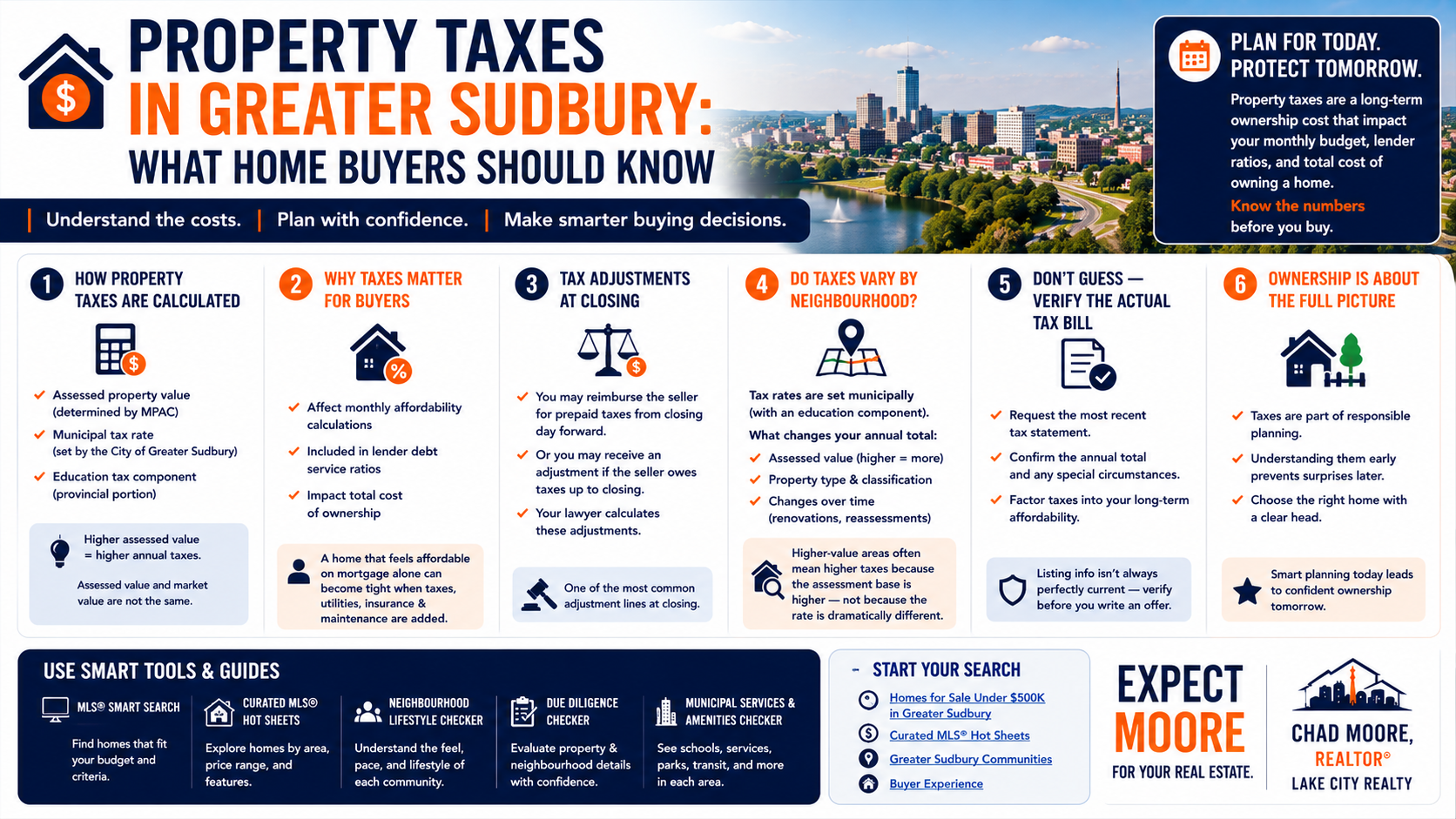
Property taxes in Greater Sudbury for home buyers, including assessed value, municipal tax rates, affordability, closing adjustments, and what to verify before making an offer.

When buying a home, most buyers focus on price and mortgage payments.

But property taxes are a long-term ownership cost that directly affects affordability.

And here’s the part that surprises people: taxes don’t feel like a big deal until they’re baked into your monthly budget, your lender ratios, and your real-life cash flow — every single year.

This guide breaks down how Greater Sudbury property taxes work, how they affect your buying power, and what to verify before you write an offer.

How Property Taxes Are Calculated

Property taxes in Greater Sudbury are based on three core pieces:

  • Assessed property value (determined by MPAC)
  • Municipal tax rate (set by the City of Greater Sudbury)
  • Education tax component (a provincial portion that applies across Ontario)

The key takeaway: the higher the assessed value, the higher the annual tax obligation. That doesn’t always mean a home is overpriced — it just means it will carry a larger annual cost that you need to plan for.

Also worth knowing: assessed value and market value are not the same thing. A home can sell for one number, while the assessment sits higher or lower depending on MPAC timing and methodology.

Why Taxes Matter for Buyers

Property taxes affect more than your future tax bill. They influence:

  • monthly affordability calculations (your real budget, not just the mortgage payment)
  • your lender’s debt service ratios (taxes are included in how lenders measure affordability)
  • total cost of ownership (especially when you’re comparing two homes at similar prices)

Here’s the practical buyer mindset: a home that feels affordable on mortgage alone can become tight when you add taxes, utilities, insurance, and maintenance together.

If you haven’t reviewed budgeting fundamentals, start here: Pre-Approval & Budgeting.

Tax Adjustments at Closing

On closing, taxes are one of the most common adjustment lines buyers see.

Depending on timing and what the seller has already paid:

  • you may reimburse the seller for prepaid taxes from closing day forward
  • or you may receive an adjustment if the seller owes taxes up to closing

Your lawyer calculates these adjustments based on the most current information available at the time of closing.

Learn more about what else shows up at closing: Closing Costs Guide.

️ Do Taxes Vary by Neighbourhood?

Yes — but not usually for the reason people assume.

Tax rates themselves are set municipally (with an education component), so you don’t normally have completely different “neighbourhood tax rates” the way some people talk about it.

What typically changes your annual total is:

  • assessed value (higher assessed homes pay more)
  • property type and classification (residential vs. other classes)
  • changes over time (renovations, additions, and broader reassessment cycles)

So yes, higher-value pockets often result in higher annual taxes — not because the rate is dramatically different street-to-street, but because the assessment base is higher.

If you want to layer neighbourhood context into decision-making, explore: Municipal Services & Amenities.

Don’t Guess — Verify the Actual Tax Bill

This is one of the simplest ways to avoid surprises.

Before making an offer, I recommend you:

  • request the most recent tax statement (or confirmation of annual taxes)
  • confirm the annual total and any special circumstances
  • factor taxes into your long-term affordability the same way you factor mortgage payments

Why this matters: the listing information isn’t always perfectly current, and a small mismatch can change monthly budgeting more than people expect.

Offer structure details here: Making an Offer Guide.

Ownership Is About the Full Picture

Property taxes are part of responsible planning.

Understanding them early prevents surprises later — and helps you choose the right home with a clear head.

For the complete buying roadmap, visit: Buyer Experience.

Expect Moore for Your Real Estate.
Chad Moore, REALTOR® | Lake City Realty

May 6, 2026

Greater Sudbury Real Estate Market Update: April 2026

Greater Sudbury Real Estate Market Update: April 2026

The April 2026 market record shows 180 new-listing events, 116 sold-close events and a $542,500 median close price in Greater Sudbury. The relationship among those measures says more than any one headline on its own.

New listings180
Sold closes116
Median close price$542,500
Median paired ratio99.57%

The numbers and the questions they answer

Greater Sudbury market measures for April 2026
Measure April 2026 Change from March 2026
New-listing events 180 +25.0%
Sold-close events 116 +11.5%
Median close price $542,500 +11.0%
Median close-price-to-export-list relationship 99.57%

Within the April 2026 market record, new-listing events describe the flow of properties entering the dataset. Sold-close events describe transactions whose recorded closing falls in that period. They are not the same group of properties, so one count divided by the other is not a sales conversion rate.

In the April 2026 market record, compared with March 2026, new-listing events change +25.0%, sold-close events change +11.5%, and the median close price changes +11.0%. These are period-to-period movements in separate event groups—not a resale gain or loss for one home.

What the activity flow suggests

Within the April 2026 market record, there is more listing flow than closing flow: the difference between 180 new-listing events and 116 sold-close events is 64. Another way to show the relationship is about 64.4 sold-close events for every 100 new-listing events recorded in the same period. That comparison is directional because a listing can close in a different month or quarter.

The practical point from the April 2026 market record is the combination of a 64-event gap and a 64.4-per-100 relationship—not a label for the whole city. The better question is whether a specific property segment is gaining fresh alternatives faster than qualified buyers are absorbing them. Price range, condition, neighbourhood and property type can produce a very different balance from the city-wide summary.

How to read the $542,500 median

In the April 2026 market record, the median close price is the middle value among the valid positive close prices. It is less sensitive to one extreme sale than an average, but it can still move because a larger share of higher-priced or lower-priced homes happens to close.

The composition of the April 2026 market record is why the $542,500 result cannot be applied as a percentage adjustment to a specific Greater Sudbury property. A valuation needs recent comparable sales with similar location, lot, age, condition, size, utility, updates and market exposure. The median gives the conversation a scale; the comparable set gives it precision.

What the 99.57% paired relationship does—and does not—show

Across the April 2026 market record, the median close-price-to-export-list relationship is 99.57%, which places the midpoint very close to the export list field. Here, the midpoint sits close to that field, even though individual results vary. This measure uses the ListPrice field present in the export; it does not prove the property's original asking price or capture every price change made before the sale.

For a buyer using the April 2026 market record, the ratio is not an automatic offer formula; for a seller, it is not a promise. The useful comparison is the group of current and recently sold homes that compete with the subject property, including the differences that explain why one attracts stronger terms than another.

What buyers can do with April 2026's signal

Test the payment at renewal as well as at the opening contract rate. In the April 2026 market record, the $542,500 market median is not the buyer's budget, and the 99.57% paired relationship is not the required bid. Financing, property tax, utilities, insurance, condo fees and immediate repairs all determine the real monthly cost.

  • Confirm the rate, term, amortization and expiry date of the pre-approval.
  • Compare each serious home with current alternatives and recent closes.
  • Estimate near-term repairs before deciding which property is the better value.
  • Use financing and inspection conditions according to the property's risks and the offer environment.
  • Keep closing costs and an emergency reserve outside the down payment.

The figures in the April 2026 market record are most useful as a prompt to investigate. If new choices are accumulating in the buyer's exact segment, there may be room to slow down and compare. If well-positioned homes are disappearing quickly, preparation and clean decision-making matter more than a city-wide label.

What sellers can do with April 2026's signal

Use showing quality and objections to test the opening position. The gap inside the April 2026 market record—180 listing events against 116 sold closes—creates 64 more listing events, but the decisive competition is still the small set visible to the same buyer.

  • Build the price range from comparable sales and active competition.
  • Account for condition, updates, deferred work and recurring carrying costs.
  • Make the online presentation answer the questions buyers use to eliminate options.
  • Track showing quality, repeat interest and objections from the opening days.
  • Adjust when the competing set and buyer response do not support the original position.

A strong sale within the April 2026 market record still requires alignment among price, property and exposure. The market summary can identify the environment; it cannot compensate for an asking price that qualified buyers cannot defend against the alternatives.

How these Greater Sudbury measures are calculated

For the April 2026 market record, the counts come from nine geographically divided MLS exports used in this local series. Listing events use the recorded ListingContractDate. Sold-close events require a valid CloseDate and a positive ClosePrice. The median paired relationship uses ClosePrice and the export's ListPrice field.

The exports behind the April 2026 market record may not contain every board-wide or City of Greater Sudbury record. These are raw activity and price measures rather than a benchmark index, a same-home appreciation calculation or a forecast. That limitation is why property-level comparable work remains essential.

To compare the April 2026 market record with another public view of the region, see the Sudbury Real Estate Board statistics page from CREA.

The April 2026 bottom line

The April 2026 market record provides a clear four-part snapshot: 180 listing events, 116 sold-close events, a $542,500 median close price and a 99.57% median paired relationship. Read together, they describe activity, price mix and negotiating outcomes without pretending that every home or neighbourhood moves the same way.

Bring the market down to one property

If you are buying or selling in Greater Sudbury while the April 2026 market record shapes the conversation, I can build the current comparison around the home, neighbourhood, condition, financing and timing that actually shape your decision.

Explore the buyer process Explore the seller process

Expect Moore for Your Real Estate.
— Chad Moore
Lake City Realty

May 4, 2026

Buying Waterfront Property in Greater Sudbury

Buying Waterfront Property in Greater Sudbury

Waterfront living is one of Greater Sudbury’s biggest lifestyle advantages.

With hundreds of lakes across the region, lakefront homes offer something unique that many cities simply can’t: the ability to live minutes from town while still enjoying private shoreline, boating, and year-round outdoor access.

But buying lakefront property is very different from buying a standard residential home.

Water access, shoreline conditions, infrastructure, and regulations all play a role in the long-term value and usability of the property.

This guide explains what buyers should evaluate before purchasing waterfront real estate in Greater Sudbury.

Not All Waterfront Is Equal

Greater Sudbury offers a wide variety of waterfront environments, each with its own character and market dynamics.

Some of the most recognizable lake communities include:

Each lake can differ significantly in:

  • water depth and shoreline type
  • year-round accessibility
  • lot size and privacy
  • development patterns and housing style

For example, some lakes have established residential neighbourhoods with municipal services nearby, while others may feel more like cottage communities with larger lots and fewer nearby amenities.

Understanding the lake itself is just as important as evaluating the house sitting on it.

Waterfront Lot Characteristics

When evaluating waterfront property, the physical characteristics of the lot often matter more than the building itself.

Important factors include:

  • shoreline type (rock, sand, gradual entry, deep water)
  • lot depth and slope (steep lots can affect usability and construction)
  • orientation and sunlight (west-facing waterfront often commands premium demand)
  • privacy between neighbouring cottages or homes

A property with beautiful views may still have limitations if shoreline access is difficult or if the terrain restricts future upgrades.

️ Shoreline Regulations

Waterfront properties are often subject to additional planning and environmental considerations.

These can include:

  • shoreline setback requirements
  • environmental protection guidelines
  • dock or boathouse rules
  • shoreline alteration restrictions

These rules exist to protect shoreline ecosystems and water quality.

Before assuming renovation flexibility, buyers should confirm zoning and property details through tools such as the Land Use & Utilities Checker.

Septic Systems & Water Supply

Unlike many urban homes, waterfront properties frequently rely on private infrastructure.

This may include:

  • septic systems
  • lake water intake systems
  • private wells

Each of these systems requires maintenance and inspection to ensure proper function.

For example:

  • septic systems must meet capacity and setback requirements
  • water intake systems require proper filtration and winterization
  • wells may require water quality testing

This is why inspections become especially important for waterfront properties.

Learn what to expect here: Home Inspection Guide.

️ Insurance Considerations

Insurance for waterfront homes can sometimes differ from traditional residential coverage.

Factors that may affect premiums include:

  • distance to fire services
  • shoreline exposure or erosion risk
  • dock structures or waterfront liability
  • seasonal vs year-round occupancy

Buyers should confirm insurance availability early in the process, especially before removing financing or inspection conditions.

Long-Term Value of Waterfront Property

Waterfront homes historically maintain strong long-term demand in Greater Sudbury.

Limited shoreline supply and strong lifestyle appeal tend to support long-term value.

However, buyers should still evaluate:

  • shoreline stability and erosion risk
  • lot usability and access
  • road maintenance and winter accessibility
  • long-term infrastructure considerations

These factors influence resale potential just as much as the home itself.

Waterfront Requires Extra Due Diligence

Lakefront living can be incredible — quiet mornings on the dock, swimming in the summer, skating in the winter, and the sense of space that waterfront provides.

But waterfront purchases require deeper evaluation than typical residential homes.

Taking the time to understand shoreline characteristics, regulations, and infrastructure helps ensure you’re buying a property that works both today and long into the future.

Search current listings here: MLS® Smart Search.

For the complete buying roadmap, visit: Buyer Experience.

Expect Moore for Your Real Estate.
Chad Moore, REALTOR® | Lake City Realty

April 29, 2026

Bank of Canada Holds at 2.25%: April 29, 2026

Bank of Canada Holds at 2.25%: April 29, 2026

Today, April 29, 2026, the Bank of Canada has held its target for the overnight rate at 2.25%.

The policy settings

Policy settings announced April 29, 2026
Measure Setting Why it matters
Target overnight rate 2.25% Anchor for the Bank's monetary-policy stance
Change at this decision No change Most direct signal for variable-rate borrowing
Bank Rate 2.50% Rate charged on one-day advances to financial institutions
Deposit rate 2.20% Rate paid on deposits held at the Bank

Why the Bank makes this choice

Growth and jobs. Growth is resuming after a late-2025 contraction, but tariffs weigh on exports and investment, housing remains weak and unemployment stays in a 6.5% to 7% range.

Inflation. March CPI rises to 2.4% on gasoline and is expected near 3% in April; core inflation is just above 2% and wider pass-through from oil is still limited.

The policy judgment. The Bank looks through the immediate energy spike but holds at 2.25% while watching for any persistent second-round inflation.

What changes for borrowers

A hold leaves the Bank's policy setting unchanged; it does not freeze every mortgage quote. Variable products remain anchored to lender prime rates, while fixed offers can still move with bond yields, funding costs, term length and competition.

Because the policy rate does not move, there is no new Bank-driven basis-point change to apply to a balance today. Existing payment pressure remains, and individual lender offers can still change.

When comparing fixed and variable products, look beyond the starting rate. Payment structure, prepayment privileges, portability, penalties and conversion terms affect the cost of changing plans. Ask a lender or licensed mortgage professional to calculate the result for your balance and expected time in the home.

For Greater Sudbury buyers

Start with three numbers: a comfortable monthly housing cost, a purchase-price ceiling and the cash left after closing. Two homes at the same price can carry very different costs once taxes, heating, insurance, condo fees and immediate repairs are included. Use comparable sales and available alternatives to test the price of the specific property.

  • Refresh the pre-approval and confirm the rate-hold expiry.
  • Test the payment at the offered rate and a higher renewal rate.
  • Keep closing costs and a repair reserve separate from the down payment.
  • Match financing and inspection conditions to the property’s actual risks.

For owners approaching renewal

Compare equivalent offers before deciding whether to stay with the current lender. Include discharge charges, appraisal or legal requirements and the flexibility you may need during the term. Extending amortization may lower the payment while increasing total interest and slowing principal repayment. A sustainable structure matters more than correctly guessing the next announcement.

For sellers

The rate decision can influence buyer confidence and financing, but it does not automatically reset Greater Sudbury prices. Position the home against current competition and recent relevant sales. Resolve avoidable objections, make the carrying costs and condition clear, and use actual showing and offer feedback to guide adjustments.

What to watch next

Oil and gasoline, inflation expectations, tariff effects, housing weakness and whether energy costs spread into other goods and services. Those developments will help show whether the Bank’s assessment is holding up. A household plan should still work under more than one rate or market outcome.

Read the official Bank of Canada announcement.

For a local plan, explore the Buyer Experience or Seller Experience. You can also browse the Bank of Canada Decisions & Mortgage Rate Context Archive.

Expect Moore for Your Real Estate.
— Chad Moore, REALTOR®
— Lake City Realty Ltd., Brokerage

April 28, 2026

Greater Sudbury Real Estate Spring Market Update 2026

Greater Sudbury Real Estate Spring Market Update 2026
Greater Sudbury Real Estate Spring Market Update 2026 showing that the market has reset, not reversed, with local inventory, pricing, buyer, and seller insights.

If you have been watching the Greater Sudbury real estate market, you may have noticed something that feels confusing.

Some homes are taking longer to sell. Buyers seem more cautious. The urgency of 2021 and early 2022 is gone.

But at the same time, many buyers still feel like there is not enough to choose from. Well-priced homes in key price ranges are still getting attention. And prices have not fallen back to anything close to where they were before COVID.

So what is actually happening?

Greater Sudbury is no longer in the COVID-era frenzy, but we are also not going back to the old pre-COVID market.

That is the point buyers and sellers need to understand.

The market has cooled from the peak, but the data does not support the idea that inventory is about to spike back to 2016 levels or that prices are about to crash back to 2019 levels. Barring a major macro-economic shock, the more realistic view is that Greater Sudbury has moved into a new market baseline: less frantic than the boom, but still shaped by limited supply, higher prices, and more selective buyers.

This market cannot be explained by one interest rate announcement, one monthly sales report, or one headline about Ontario real estate. Greater Sudbury has its own story — and it has been building for years.

The Market Was Already Tightening Before COVID

It is easy to blame everything on COVID, but the Greater Sudbury housing market was already changing before 2020.

In 2016, there were an average of 923 active residential listings in Greater Sudbury.

By 2019, that had dropped to 494.

That is a major decline before the pandemic even started.

At the same time, sales were gradually improving:

Year Residential Sales New Listings Average Active Listings Approx. Months of Inventory Average Sale Price Close Price to Original Price
2016 1,819 3,391 923 6.1 $272,119 95.7%
2017 1,811 3,171 820 5.4 $276,077 95.6%
2018 1,911 2,969 662 4.2 $277,179 96.2%
2019 1,985 2,759 494 3.0 $290,875 96.8%

So before COVID, Greater Sudbury was already moving from a higher-inventory market toward a tighter one.

But compared with today, buyers still had far more choice.

In 2019, Greater Sudbury had roughly 3 months of inventory, an average sale price of about $290,875, and homes were selling at about 96.8% of their original asking price.

That means sellers were doing fine, but buyers generally had more room to compare, negotiate, and take their time.

The old market was not weak. It was just more balanced than what came next.

COVID Accelerated the Inventory Shortage

Then came 2020 and 2021.

COVID did not create Greater Sudbury’s inventory problem, but it absolutely accelerated it.

In 2020, residential sales rose to 2,088, while average active listings dropped to 320.

Then 2021 became the true frenzy year.

Greater Sudbury saw:

  • 2,486 residential sales
  • only 178 average active listings
  • less than 1 month of inventory
  • homes selling in a median of under 10 days
  • properties selling at about 105.5% of original asking price

That was not a normal market.

That was the kind of market where buyers felt pressure to move quickly, offer aggressively, and compete hard for good homes. It also reset expectations for both buyers and sellers.

For sellers, it created the feeling that almost anything could sell quickly.

For buyers, it created frustration, fatigue, and the sense that every good home came with competition.

But that level of pressure was never going to be sustainable.

2022 Was the Rate-Shock Year — But Not the Real Reset

Many people think the market started softening immediately in 2022 because interest rates began rising.

Affordability definitely started to change.

But the local data shows something more complicated.

In 2022, Greater Sudbury still had:

  • 2,053 residential sales
  • only 212 average active listings
  • an average sale price of about $473,925
  • homes selling at about 109.1% of original asking price

In other words, the interest-rate shift had started, but the market was still carrying a lot of leftover momentum from 2021.

Inventory was still extremely low. Buyers were starting to feel the pressure of higher borrowing costs, but there still were not enough homes available.

That is why prices did not suddenly fall.

2022 was the rate-shock transition year — not the reset year.

️ 2023 Was the Real Reset

The real shift showed up in 2023.

Residential sales dropped to 1,693, the lowest annual sales total in the last 10 years of Greater Sudbury residential data.

Average sale price flattened compared with 2022. Buyer urgency cooled. Homes stopped selling dramatically above original asking price.

The close-price-to-original-price ratio dropped from 109.1% in 2022 to 99.8% in 2023.

That was the reset.

Buyers became more selective. Sellers had to be more realistic. Price, condition, location, layout, updates, presentation, and timing started to matter again.

The frenzy ended, but the inventory shortage did not.

Average active listings rose slightly in 2023, but only to 264. That was still far below the 494 average active listings Greater Sudbury had in 2019 — and dramatically below the 923 average active listings seen in 2016.

The market cooled, but it did not return to the old normal.

2024 and 2025 Stabilized — But Did Not Return to Normal

By 2024 and 2025, the market started to stabilize.

Sales recovered:

  • 2024: 1,905 residential sales
  • 2025: 1,962 residential sales

That put sales close to 2019 levels.

But inventory did not recover.

In 2019, Greater Sudbury had 494 average active residential listings.

In 2024 and 2025, that number was only 280.

That is one of the biggest reasons the market feels different today.

By 2025, Greater Sudbury was selling a similar number of homes as it did before COVID, but buyers were doing it with far fewer options and much higher prices.

Year Residential Sales Average Active Listings Average Sale Price Market Read
2019 1,985 494 $290,875 More balanced pre-COVID market
2024 1,905 280 $496,914 Stabilized, but still low supply
2025 1,962 280 $529,225 Sales near 2019, inventory far lower

In 2019, the average sale price was about $290,875.

In 2025, it was about $529,225.

That does not mean every home doubled in value, and it does not mean every neighbourhood or property type moved the same way. But it does show how much the market baseline has shifted.

Greater Sudbury did not reverse back to the old market.

It reset into a new one.

Heading Into Spring 2026: Slower, More Selective, Still Tight

The first quarter of 2026 gives us a good look at where the market stands now.

Q1 Period Residential Sales New Listings Average Active Listings Average Sale Price Median Days to Sell Close Price to Original Price
Q1 2025 304 444 198 $510,809 10.5 100.5%
Q1 2026 281 378 184 $506,338 18.9 99.2%

Compared with Q1 2025:

  • Sales fell from 304 to 281
  • New listings fell from 444 to 378
  • Average active listings fell from 198 to 184
  • Average sale price was nearly flat
  • Median days to sell rose from about 10.5 days to 18.9 days
  • Homes sold at about 99.2% of original asking price

That tells us a lot.

Buyers are more selective.

Homes are taking longer to sell.

Overpricing is less likely to be rewarded.

But inventory is still low.

That is why this is not a buyer’s market in the traditional sense. Buyers have more breathing room than they did in 2021 or early 2022, but they still do not have the selection they had before COVID.

The increase in days on market does not mean every home will sit. It means how long it takes to sell often depends on launch momentum, pricing, presentation, and whether the listing needs to be corrected after the market responds.

It is slower than the boom, tighter than the old normal, and more strategic than it has been in years.

The Old Market Is Not Coming Back Overnight

One of the biggest mistakes buyers and sellers can make is assuming the market is simply working its way back to where it used to be.

The data does not support that.

Period Average Active Residential Listings What It Shows
2016 923 High-inventory buyer-choice market
2019 494 Tighter, but still more balanced than today
2025 280 Stabilized sales, but far less supply
Q1 2026 184 Slower sales, but still limited inventory

That is not a temporary blip. That is a long-running supply shift.

Prices tell the same story.

In 2019, the average residential sale price in Greater Sudbury was about $290,875.

In 2025, it was about $529,225.

A return to 2019 prices or 2016 inventory levels would require more than a normal market cooldown. It would likely require a major economic disruption, a sharp and sustained surge in listings, or a major drop in demand.

That is not what the current data shows.

So while buyers may have more breathing room than they did during the frenzy, waiting for the old market to come back could mean waiting for something that may not happen.

And while sellers cannot assume every listing will sell instantly, they also should not mistake a more selective market for a collapsing one.

Be Careful With National and Provincial Headlines

This is where local context really matters.

Be careful reading national or Ontario real estate headlines and assuming they apply directly to Greater Sudbury.

They often do not.

Across Ontario, CREA/OREA data shows active residential listings in March 2026 were 49.2% above the 10-year average for that month.

That is not what the Greater Sudbury residential market feels like on the ground.

SREB/CREA data shows that the broader Sudbury Real Estate Board area remains tighter than long-term norms. In March 2026, active listings were still 34.8% below the 10-year average for March, and new listings were 30.1% below the 10-year average.

That is why buyers here can still feel limited by choice, even when provincial headlines talk about more inventory.

Nationally, CREA reported that active listings across Canada at the end of March 2026 were still 10.6% below the long-term average, with overall supply generally declining since May 2025.

Greater Sudbury is not exactly the same as Ontario. It is not exactly the same as Canada. And it should not be interpreted through a Toronto, Ottawa, or GTA lens.

Do not use national headlines to make local real estate decisions.

Why Prices Are Holding Better Than Some People Expected

When sales slow down, people often assume prices must fall.

But real estate does not work that simply.

Prices are affected by demand, but they are also affected by supply. And in Greater Sudbury, supply is still the bigger story.

SREB/CREA data supports that. In March 2026, the broader board’s average sale price was down year over year, but the MLS® HPI benchmark price was $524,900, up 6.2% from March 2025. CREA describes the MLS® Home Price Index as a more advanced and accurate tool for tracking home price levels and trends than simple average or median price measures.

That distinction matters.

Average prices can move around depending on what sold in a particular month. If fewer higher-end homes sell, the average can drop. If more expensive homes sell, the average can rise.

That does not always mean home values are rising or falling across the board.

In Greater Sudbury, the better read is this:

Prices are being supported by low inventory, but buyers are no longer rewarding every listing automatically.

That is why some homes still sell quickly, while others sit longer.

In this kind of market, pricing is a positioning decision. It is not just about choosing the highest number you can justify. It is about positioning the home properly against the competition buyers are actually seeing.

A slower market does not automatically mean a cheaper market.

The $400K–$500K Range Still Matters

The middle of the market remains one of the most important parts of the Greater Sudbury story.

SREB/CREA data showed that in Q1 2026, the single-detached market was tightest in the $400K–$500K range, where demand was strongest relative to supply. Homes in that range also spent the least amount of time on market before selling.

That lines up with what many local buyers are feeling.

The affordable detached home has become harder to find. The middle of the market has moved up. And when a good home hits the market in a key price range, buyers still notice.

That does not mean every home has room for a discount.

It also does not mean every good home will automatically end in a bidding war.

It means buyers and sellers both need to read the specific listing, price range, condition, and competition — not just the overall headline.

For buyers, that means being ready when value is real, but disciplined enough to walk away when the numbers no longer make sense. This is why prepared buyers can win without chasing every listing.

For sellers, it means understanding that more offers do not automatically mean better offers, and that pricing too low or too high can both create problems if the strategy is not thought through.

️ What About New Construction?

New construction helps, but it is not a quick fix for resale inventory.

Local CMHC-based reporting from the City of Greater Sudbury showed housing starts were up sharply from January to July 2025, rising from 77 starts in 2024 to 164 starts in 2025 over the same period. Single-detached starts rose from 40 to 53, while the larger increase came from other housing types.

That is positive.

But it needs context.

A strong percentage increase can still be a modest number in raw terms. And new construction does not immediately translate into more resale choice.

Some projects take time to complete. Some are not single-detached homes. Some may be rental-oriented or multi-unit. Some new-build pricing may not match what the average resale buyer is shopping for.

So yes, new construction is part of the long-term supply solution.

But it does not erase the current resale inventory shortage overnight.

What to Expect Moving Forward

No forecast is perfect, and real estate can always be affected by unexpected economic events.

But based on the data, I would be cautious about expecting a major flood of new listings or a sudden collapse in prices.

Spring always brings more listings than winter. That is normal seasonality.

But seasonality is not the same as a true inventory recovery.

Based on Q1 2026, new listings were lower than both Q1 2025 and Q1 2024. That suggests sellers are cautious too.

A lot of homeowners who might like to move are also asking themselves the same question buyers are asking:

Where would I go next?

Some are holding lower mortgage rates. Some are concerned about affordability. Some do not see enough options to make their next move comfortable.

That is why listing volume may remain flat or slightly lower, with any small increase or decrease being practically insignificant for buyers on the ground.

And without a meaningful increase in supply, it is difficult to make the case for a broad price crash.

That does not mean every home is safe from price pressure. Overpriced listings can still sit. Properties with condition issues may need to adjust. Some price ranges may perform better than others.

But overall, the more realistic outlook is a market that remains selective and supply-constrained.

My base-case outlook for 2026 is:

  • Residential sales softer than 2024 and 2025
  • New listings flat to slightly lower, or not meaningfully higher
  • Active inventory still well below pre-COVID levels
  • Prices generally supported, especially for well-positioned homes
  • Buyers more selective than last year
  • Sellers needing stronger pricing and presentation strategy
  • Days on market likely higher than 2025, but still below the older pre-COVID norm

A reasonable working range for Greater Sudbury residential sales in 2026 is approximately:

1,625 to 1,750 residential sales.

That would be softer than 2024 and 2025, but not a collapse.

For prices, the most likely path is not a broad crash and not a runaway surge.

The better expectation is:

Mostly stable, with performance depending heavily on price range, location, condition, competition, and pricing strategy.

Greater Sudbury has reset, not reversed.

That is the difference.

Practical Advice for Buyers

For buyers, this market requires patience and preparation.

You do not need to panic-buy.

But waiting for the market to suddenly become easy may not work either.

The biggest mistake buyers can make is assuming that slower sales automatically mean lots of choice and deep discounts.

That is not what the local inventory picture shows.

At the same time, buyers should not assume every good home will become a bidding war. Some listings will attract strong attention. Others may sit longer. It depends on the price, condition, location, and how much direct competition is available.

The goal is not to be aggressive.

The goal is to be prepared enough to act decisively when value is real — and disciplined enough to walk away when the numbers, risk, or competition no longer make sense.

Buying a home in Greater Sudbury starts with a plan, not just scrolling listings and hoping the right one appears.

A few practical steps:

When the right home appears, remember that a strong offer is more than just price. Deposit, closing date, conditions, timelines, and risk management all matter.

And if competition happens, competing does not mean getting reckless.

Sometimes the right move is to write confidently.

Sometimes the right move is to step back.

Practical Advice for Sellers

For sellers, this is still a good market for the right listing strategy.

But it is less forgiving than the frenzy years.

The most important shift is that buyers are more selective. They are comparing price, condition, location, updates, photos, layout, and perceived value more carefully.

That means sellers should focus on:

This is not a market where every home automatically gets multiple offers.

But it is still a market where a well-prepared home can stand out.

The sellers who struggle most are usually the ones trying to price from memory — using 2021, early 2022, or a neighbour’s peak-market result as their main benchmark.

The sellers who do best are the ones who price against today’s competition.

In this market, pricing, positioning, and promotion need to work together. Strong marketing can amplify the right strategy, but it cannot fully rescue the wrong price.

Overpricing can reduce showings and weaken leverage. Underpricing can attract attention, but more offers do not automatically mean better offers.

And even though homes are taking longer to sell than they did during the hottest years, the first week on market still matters. That is when your listing gets its strongest visibility, its first wave of buyer attention, and some of the clearest feedback.

The market is not punishing sellers who prepare properly.

It is punishing assumptions.

Final Takeaway

Greater Sudbury’s housing market has changed, but it has not fallen apart.

The COVID frenzy is gone. The 2023 reset changed buyer behaviour. Homes are taking longer to sell than they did during the hottest years.

But that does not mean the market is simply drifting back to the way it used to be.

The data does not support that.

Before COVID, Greater Sudbury buyers had far more choice and much lower prices. Today, even with softer sales and more selective buyers, residential inventory remains far below the levels we saw 8–10 years ago. Prices are operating from a much higher baseline, and there is no clear evidence that supply is about to rebuild enough to pull the market back to the old normal.

Could prices soften in certain segments? Yes.

Could some overpriced listings sit? Absolutely.

Could inventory improve modestly? Of course.

But a broad return to the pre-COVID market would likely require a much bigger economic disruption than anything currently visible in the local data.

So the best way to understand the 2026 market is this:

It is not the boom anymore. But it is not the old market either.

It is slower than the peak, tighter than the pre-COVID normal, and more strategic than it has been in years.

For buyers, that means being prepared, realistic, and disciplined.

For sellers, it means pricing and presentation matter more than ever.

And for everyone watching the headlines, it means one thing above all:

Greater Sudbury’s market needs to be understood locally — not through national averages, Ontario-wide inventory headlines, or memories of what the market used to be.

Expect Moore for Your Real Estate.
— Chad Moore, REALTOR® | Lake City Realty