Local evidence. Practical guidance.

Greater Sudbury Real Estate Blog

Market updates, buying and selling guidance, Ontario real estate information and straight answers for people making real decisions in Greater Sudbury.

Latest articles

New and recently refreshed guidance appears first.

July 15, 2026

Bank of Canada Holds at 2.25%: July 15, 2026

Bank of Canada Holds at 2.25%: July 15, 2026

Today, July 15, 2026, the Bank of Canada has held its target for the overnight rate at 2.25%.

The policy settings

Policy settings announced July 15, 2026
Measure Setting Why it matters
Target overnight rate 2.25% Anchor for the Bank's monetary-policy stance
Change at this decision No change Most direct signal for variable-rate borrowing
Bank Rate 2.50% Rate charged on one-day advances to financial institutions
Deposit rate 2.20% Rate paid on deposits held at the Bank

Why the Bank makes this choice

Growth and jobs. Growth is estimated near 2.5% in the second quarter after a weak start to the year, consumer spending is solid and housing is stabilizing, though unemployment remains 6.5%.

Inflation. May CPI reaches 3.2% because of gasoline; inflation excluding gasoline is 2.2% and core measures stay close to 2%, with headline inflation expected to ease as oil pressure fades.

The policy judgment. Improving growth and an energy-driven headline spike make a steady 2.25% rate the balanced choice while economic slack is gradually absorbed.

What changes for borrowers

A hold leaves the Bank's policy setting unchanged; it does not freeze every mortgage quote. Variable products remain anchored to lender prime rates, while fixed offers can still move with bond yields, funding costs, term length and competition.

Because the policy rate does not move, there is no new Bank-driven basis-point change to apply to a balance today. Existing payment pressure remains, and individual lender offers can still change.

When comparing fixed and variable products, look beyond the starting rate. Payment structure, prepayment privileges, portability, penalties and conversion terms affect the cost of changing plans. Ask a lender or licensed mortgage professional to calculate the result for your balance and expected time in the home.

For Greater Sudbury buyers

Start with three numbers: a comfortable monthly housing cost, a purchase-price ceiling and the cash left after closing. Two homes at the same price can carry very different costs once taxes, heating, insurance, condo fees and immediate repairs are included. Use comparable sales and available alternatives to test the price of the specific property.

  • Refresh the pre-approval and confirm the rate-hold expiry.
  • Test the payment at the offered rate and a higher renewal rate.
  • Keep closing costs and a repair reserve separate from the down payment.
  • Match financing and inspection conditions to the property’s actual risks.

For owners approaching renewal

Compare equivalent offers before deciding whether to stay with the current lender. Include discharge charges, appraisal or legal requirements and the flexibility you may need during the term. Extending amortization may lower the payment while increasing total interest and slowing principal repayment. A sustainable structure matters more than correctly guessing the next announcement.

For sellers

The rate decision can influence buyer confidence and financing, but it does not automatically reset Greater Sudbury prices. Position the home against current competition and recent relevant sales. Resolve avoidable objections, make the carrying costs and condition clear, and use actual showing and offer feedback to guide adjustments.

What to watch next

Oil and gasoline, the breadth of price pressure, housing stabilization, export recovery and the annual CUSMA review process. Those developments will help show whether the Bank’s assessment is holding up. A household plan should still work under more than one rate or market outcome.

Read the official Bank of Canada announcement.

For a local plan, explore the Buyer Experience or Seller Experience. You can also browse the Bank of Canada Decisions & Mortgage Rate Context Archive.

Expect Moore for Your Real Estate.
— Chad Moore, REALTOR®
— Lake City Realty Ltd., Brokerage

July 15, 2026

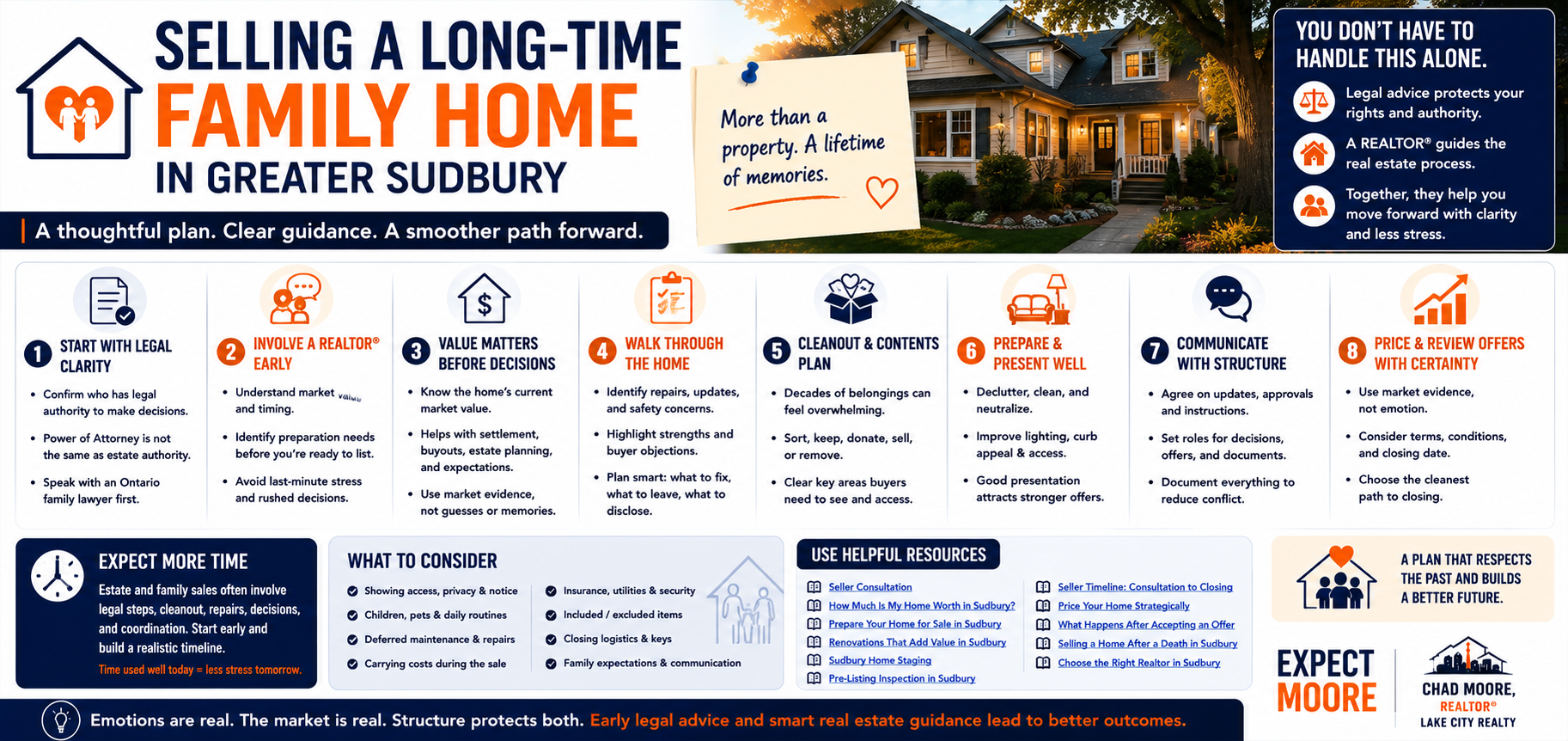
Selling a Long-Time Family Home in Greater Sudbury | Aging Parents & Estate Sales

Selling a Long-Time Family Home in Greater Sudbury | Aging Parents & Estate Sales
Selling a long-time family home in Greater Sudbury during an estate sale, power of attorney situation, downsizing transition, or major family change.

Some homes are not just properties.

They are the place where birthdays were celebrated, kids were raised, gardens were planted, holidays were hosted, and decades of memories were built.

That is what makes selling a long-time family home so different from a typical real estate transaction.

In Greater Sudbury, these sales often happen during major life transitions. A parent may be moving into a smaller home, retirement residence, or long-term care. Adult children may be helping with decisions. A family may be dealing with an estate. A long-time owner may be ready to move, but overwhelmed by the thought of sorting through decades of belongings.

The real estate side matters.

But so does the emotional side.

The goal is not to rush the process. The goal is to create a plan that respects the situation, protects the value of the home, and helps the family move forward with more clarity and less stress.


️ Important Note Before You Start

This article is general real estate information for Greater Sudbury homeowners and families. Estate administration, probate, power of attorney, capacity, ownership, signing authority, and the distribution of sale proceeds are legal issues. Speak with a qualified Ontario lawyer before making decisions about listing, selling, signing, or distributing proceeds from a property connected to an estate, power of attorney, or major family transition.

A REALTOR® can help with the real estate process. A lawyer should advise on the legal authority behind it.

️ Start With Authority and Legal Clarity

Before anyone focuses on staging, photos, pricing, or listing dates, the first question is simple:

Who has legal authority to make decisions about the property?

That answer may depend on the situation.

If the homeowner is alive and capable, they may be the person making the decisions.

If someone is acting under a power of attorney, the authority needs to be reviewed carefully.

If the homeowner has passed away, the property may be part of an estate, and the estate trustee may need legal authority before the home can be sold.

These are legal questions, not REALTOR® questions.

A REALTOR® can help with market value, preparation, timing, buyer objections, listing strategy, showings, offers, and the sale process. But legal authority, estate administration, capacity, power of attorney, probate, and distribution of proceeds should be reviewed with a qualified Ontario lawyer.

That legal clarity should happen early.

The last thing a family wants is to prepare the home, attract a buyer, negotiate an offer, and then discover that the proper authority was not in place.

Power of Attorney and Estate Authority Are Not the Same Thing

This is an important distinction.

A power of attorney applies while someone is alive. In Ontario, a Continuing Power of Attorney for Property can allow an appointed person to manage financial and property matters if the person later becomes mentally incapable. Community Legal Education Ontario explains that an attorney for property may be able to buy or sell real estate, pay bills, sign legal documents, and arrange home repairs unless the document limits that authority. You can review CLEO’s plain-language guide here: Continuing Power of Attorney for Property.

But a power of attorney does not continue after death.

Once someone passes away, estate authority becomes the issue.

In Ontario, the estate trustee is responsible for administering the estate and carrying out the terms of the will if there is one. The Government of Ontario provides more information about estate administration here: Administering estates.

Depending on how the property is owned and what is required by the estate, the estate trustee may need a Certificate of Appointment of Estate Trustee, often still called probate in everyday conversation. Ontario explains that this certificate can be applied for through the Superior Court of Justice: Apply for probate of an estate.

From a real estate perspective, the takeaway is simple:

Do not assume the family member helping with the home automatically has authority to sell it. Confirm that early.

Involve a REALTOR® Early — Even Before the Family Is Ready to List

Many families wait until the house is cleaned out, the legal work is finished, and everyone is emotionally ready before they call a REALTOR®.

That is understandable.

But it can also create unnecessary pressure.

Early real estate guidance does not mean the home needs to be listed right away. It means the family can understand the home, the market, the likely buyer concerns, the preparation needs, and the possible timeline before everything becomes urgent.

A structured Seller Consultation can help answer practical questions early:

  • What might the home be worth in the current Greater Sudbury market?
  • What repairs or updates are worth considering?
  • What should be left alone?
  • How much preparation is realistically needed?
  • What buyer objections are likely?
  • How long might the sale process take?
  • What documents or details should the family start gathering?
  • Should the home be sold occupied, vacant, staged, or lightly prepared?

Those answers can help the family make better decisions before money, time, and energy are spent in the wrong places.

One recent example was the sale of 1638 George Street in Val Caron. The family reached out before the home was to be listed, which allowed us to build a preparation and marketing plan around a property that had been lovingly cared for by the same owners for decades. That early planning helped remove uncertainty and ensured the home was ready when it was time to go to market.

Value Matters Before Decisions Are Made

Sometimes families start with a number in mind.

That number may come from an old purchase price, a neighbour’s sale, an online estimate, a tax assessment, or a memory of what the home “should” be worth.

But the market does not price memories.

It prices the property.

That includes location, condition, layout, age, updates, deferred maintenance, buyer demand, competition, and timing.

For families making decisions around aging parents, estate planning, downsizing, or settlement, a realistic value range can be helpful before major decisions are made.

It may affect whether the home is sold now or later.

It may affect whether one family member wants to buy it.

It may affect whether repairs are worth doing.

It may affect how quickly the family wants to move.

It may affect financial planning, estate conversations, or expectations among beneficiaries.

If the goal is to understand the current market, How Much Is My Home Worth in Greater Sudbury? is a helpful starting point.

But in a long-time family home sale, value should not be treated as a guess.

It should be grounded in market evidence.

Walk Through the Home Before Deciding What to Do

Long-time homes often have layers.

There may be updates from different decades. Some areas may be well maintained. Others may need attention. There may be old paperwork, full storage rooms, tools, furniture, collectibles, family photos, and belongings that make it hard to see the home clearly.

That is why a walkthrough matters.

Before the family decides what to clean, fix, donate, sell, move, paint, repair, or leave alone, it helps to have a real estate perspective on what actually affects buyer confidence.

A walkthrough can identify:

  • obvious repair concerns
  • safety issues
  • deferred maintenance
  • outdated finishes
  • strong selling features
  • clutter that may affect buyer perception
  • rooms that need better access
  • mechanical areas buyers may want to inspect
  • documents worth gathering
  • items that should be removed before photos
  • preparation work that may not be worth doing

The goal is not to judge the home.

The goal is to understand it.

A long-time family home does not need to be perfect to sell well. But it does need a plan.

Contents, Belongings, and Cleanout Can Overwhelm the Sale

For many families, the hardest part is not pricing the home.

It is dealing with the contents.

A long-time family home can hold decades of furniture, tools, paperwork, clothing, photos, keepsakes, holiday decorations, and items that belonged to different generations.

That can slow the process down quickly.

Family members may disagree about what to keep. Some items may have sentimental value. Some may need to be appraised, donated, sold, stored, or removed. Some rooms may be hard to access because there is simply too much in them.

This is where families can get stuck.

The cleanout starts to feel so big that the real estate plan never moves forward.

A better approach is to separate the emotional work from the market work.

Not everything needs to be decided at once.

But the family should know which areas need to be cleared for safety, photos, showings, inspections, and buyer confidence.

That may include:

  • mechanical rooms
  • electrical panels
  • attic access
  • crawl spaces
  • basements
  • garages
  • sheds
  • storage rooms
  • entrances and hallways
  • bedrooms and closets
  • areas with personal documents or valuables

The goal is not to erase the family history.

The goal is to prepare the home so buyers can understand the property.

My guide on how to prepare your home for sale in Sudbury goes deeper into the practical preparation process.

Deferred Maintenance Is Common in Long-Time Homes

Long-time ownership does not mean a home has been neglected.

In fact, many long-time owners have taken excellent care of their homes.

But it is also common for maintenance priorities to change over time.

As people age, certain repairs may be delayed. Larger updates may feel unnecessary. A roof, furnace, electrical panel, deck, windows, foundation concern, plumbing issue, or drainage problem may not have been addressed yet because the owner was comfortable living with it.

Buyers may see those same issues differently.

That does not mean every problem needs to be fixed before listing.

But it does mean the family should understand how those issues may affect value, buyer confidence, conditions, negotiation, and financing.

A Sudbury Pre-Listing Inspection may be worth discussing in some situations, especially if there are concerns that could surface during a buyer’s inspection.

The right answer depends on the home.

Some issues should be addressed before listing.

Some should be disclosed and priced accordingly.

Some may not matter enough to justify the cost.

The important thing is knowing the difference.

Decide What to Fix and What to Leave Alone

One of the biggest mistakes families can make is assuming they need to renovate the home before selling.

Another mistake is assuming they should do nothing.

The best answer is usually somewhere in the middle.

The right preparation plan depends on the property, the likely buyer pool, the cost of the work, the condition of the market, and the expected return.

Some repairs are about value.

Some are about buyer confidence.

Some are about safety.

Some are about reducing objections.

Some are simply not worth doing.

Before spending money, it helps to ask:

  • Will this repair affect buyer confidence?
  • Will this improvement likely change the sale price?
  • Will it reduce conditions or negotiation risk?
  • Will buyers notice if it is not done?
  • Is this a repair, an update, or a full renovation?
  • Is the family prepared to manage the work?
  • Will the timeline still make sense?

My article on Renovations That Add Value Before Selling in Sudbury is a useful companion here because not every improvement produces a meaningful return.

In a long-time family home, the goal is not to chase perfection.

The goal is to make smart decisions that support the sale.

️ Presentation Still Matters, Even When the Sale Is Emotional

It can feel uncomfortable to talk about presentation when a family is dealing with aging parents, downsizing, or an estate.

But presentation still matters.

Buyers are not walking through the home with the same memories the family has.

They are trying to understand space, condition, layout, light, storage, updates, maintenance, and whether the home fits their life.

That means the home needs to be presented in a way that helps buyers see the property clearly.

This may involve:

  • decluttering
  • cleaning
  • removing excess furniture
  • improving lighting
  • neutralizing some rooms
  • highlighting key features
  • making rooms easier to understand
  • improving curb appeal
  • preparing for professional photos
  • considering light staging where appropriate

This is not about pretending the home is something it is not.

It is about helping buyers see what is there.

Sudbury Home Staging can be especially helpful for families who are not sure how much presentation work is actually needed.

Sometimes a full staging plan is not necessary.

Sometimes simple editing, cleaning, and better room flow can make a meaningful difference.

That was the approach taken at 1638 George Street. Rather than trying to modernize everything, the preparation and marketing focused on the home’s pride of ownership, its strongest features, and the qualities most likely to resonate with buyers. Professional presentation, strategic pricing, and a coordinated launch helped the property receive two competing offers on the same day it was activated on MLS®.

Every property, market, and family situation is different, so no particular result can be guaranteed. But the sale demonstrated that a long-time family home does not always need a major renovation to attract strong buyer interest. It needs an honest assessment, thoughtful preparation, clear presentation, and a plan suited to the property.

️ Family Communication Needs Structure

When more than one person is involved, communication can become one of the hardest parts of the sale.

There may be siblings, spouses, adult children, beneficiaries, lawyers, accountants, caregivers, or other family members involved.

Not everyone may agree.

One person may want to move quickly.

Another may need more time.

One person may focus on value.

Another may focus on memories.

One person may live nearby.

Another may be making decisions from out of town.

This is where the process needs structure.

Before the home is listed, it should be clear:

  • who has legal authority to make decisions
  • who will communicate with the REALTOR®
  • who receives updates
  • who approves repairs
  • who approves price
  • who reviews offers
  • who signs documents
  • who communicates with the lawyer
  • how family members will be kept informed

Without structure, the sale can become emotionally exhausting.

With structure, the family has a clearer path.

The Sudbury Seller Timeline can help families understand the overall process from consultation to closing.

Pricing Needs Market Evidence, Not Family Memory

A long-time family home can be difficult to price emotionally.

The family may remember what the home meant.

The market is focused on what the home offers now.

That difference matters.

Buyers are comparing the home to other available properties. They are looking at condition, location, updates, layout, lot, parking, storage, mechanicals, and price.

They are not pricing the memories.

That does not make the memories less important.

It simply means they are not the same thing as market value.

A strong pricing strategy should be based on:

  • comparable sales
  • current competition
  • condition
  • location
  • buyer demand
  • property features
  • likely objections
  • timing
  • market segment

This is where market evidence can help reduce family tension.

A clear pricing strategy gives everyone something concrete to review. It moves the conversation away from opinion and toward evidence.

As I explain in How to Price Your Home Strategically in Greater Sudbury, pricing is not just a number. It is positioning.

That is especially true when selling a home with decades of family history attached to it.

The sale of 1638 George Street reinforced that the strongest strategy respects the home’s history while still relying on objective market evidence. The memories remained important to the family, but the pricing and launch decisions were based on the property, the competition, current buyer demand, and how the home was positioned in the market.

Estate and Family Sales Can Take Longer Than Expected

A normal sale already has several stages.

A family-transition sale may have more.

There may be legal steps, estate questions, power of attorney documents, capacity issues, family discussions, cleanout work, repairs, appraisals, donation pickups, contractor visits, insurance questions, or out-of-town decision-makers.

That does not mean the process has to drag on.

But it does mean families should be realistic.

The earlier the planning starts, the less stressful the final steps usually feel.

A REALTOR® can help build a real estate timeline around the practical work that needs to happen, while the lawyer handles legal authority, estate administration, or power of attorney questions.

The process may include:

My article on What Happens After You Accept an Offer in Sudbury? is a helpful resource once the property reaches the offer stage.

But in these situations, the work often starts long before the offer arrives.

The Goal Is a Calm, Organized Sale

Selling a long-time family home can be emotional.

It can also be practical.

Those two things can be true at the same time.

The home may represent decades of life, but the sale still needs legal authority, market evidence, preparation, communication, pricing strategy, buyer access, offer review, and closing coordination.

The best process is usually not the fastest possible process.

It is the clearest one.

That means starting early, getting the right legal advice, involving a REALTOR® before the sale becomes urgent, understanding the home’s value, preparing the property thoughtfully, and making decisions with evidence instead of pressure.

The experience at 1638 George Street is one practical example of how those principles can come together. The home’s history was respected, the family had a clear plan, the preparation focused on what mattered, and the property was presented and positioned for the buyers most likely to appreciate it.

A family home deserves care.

The sale process does too.

If your family is starting to think about selling a long-time home in Greater Sudbury, the best first step is not always listing right away.

Sometimes the best first step is simply understanding what you are working with — the home, the market, the timeline, and the decisions ahead.

That early clarity can make the next steps feel much more manageable.

Expect Moore for Your Real Estate.
— Chad Moore, REALTOR® | Lake City Realty

June 29, 2026

Selling a Home During Separation or Divorce in Ontario | Greater Sudbury Guide

Selling a Home During Separation or Divorce in Ontario | Greater Sudbury Guide
Selling a home during separation or divorce in Ontario, with guidance for Greater Sudbury sellers on legal clarity, real estate planning, communication, pricing, preparation, offers, and closing.

When a relationship ends, the family home can become one of the hardest decisions to deal with.

It may be the largest financial asset involved. It may also be the place where children were raised, routines were built, and major life memories were made.

That makes selling a home during separation or divorce different from a typical real estate transaction.

In Greater Sudbury, the process is not just about putting a sign on the lawn, setting a price, and waiting for offers. It requires legal clarity, realistic market guidance, strong communication, careful preparation, and a plan that keeps the real estate side from adding more stress than necessary.

The goal is not to take sides.

The goal is to create structure.

A family lawyer can help you understand your legal rights and obligations. A REALTOR® can help you understand value, timing, home preparation, pricing, marketing, showing access, offers, and the practical steps involved in getting the home sold.

Both forms of guidance matter — and both should usually happen early.


️ Important Note Before You Start

This article is general real estate information for Greater Sudbury homeowners. Separation, divorce, ownership, consent, possession, equalization, court orders, and the division of sale proceeds are legal issues. Speak with a qualified Ontario family lawyer before making decisions about listing, selling, signing, refinancing, occupying, or distributing proceeds from a home involved in a separation or divorce.

A REALTOR® can help with the real estate process. A lawyer should advise on the legal framework behind it.

️ Start With Legal Advice — But Do Not Wait to Understand the Real Estate Side

Separation and divorce involve legal issues that a REALTOR® cannot answer for you.

Ownership, possession, consent, equalization, separation agreements, court orders, and the division of sale proceeds are legal matters. Those questions belong with a qualified Ontario family lawyer.

That said, the legal side and the real estate side are connected.

Waiting until every legal detail is finalized before asking about the property itself can create unnecessary pressure later. By the time everyone is “ready to list,” the home may still need repairs, decluttering, cleaning, staging, photography, documents gathered, rental items clarified, or showing access sorted out.

That is why early real estate guidance can be so valuable.

A REALTOR® can help both sides understand:

  • what the home may realistically be worth in the current Greater Sudbury market
  • what preparation may be needed before listing
  • what buyer objections should be addressed early
  • how long the sale process may take
  • what showing access may be required
  • what property details should be clarified before buyers start asking questions
  • how pricing, marketing, offers, and closing timelines may affect the process

Legal advice helps you understand what can or must happen.

Real estate guidance helps you understand what the market is likely to do once the home is exposed to buyers.

Those are different conversations — but both can shape the outcome.

For homeowners who are still at the early planning stage, a structured Seller Consultation can help create clarity before the sale process feels urgent.

Understand That the Matrimonial Home Has Special Rules in Ontario

One of the biggest misunderstandings in a separation is assuming that the person on title automatically controls everything.

That is not always the case.

In Ontario, the matrimonial home has special legal treatment under the Family Law Act. The Act states that both spouses have an equal right to possession of a matrimonial home. You can review Ontario’s Family Law Act directly through the Government of Ontario.

That means a spouse may have rights connected to the home even if they are not the only person on title — or even if they are not on title at all.

Community Legal Education Ontario also explains that neither spouse can sell or mortgage the matrimonial home without the other spouse’s written permission. Their plain-language legal information is available through CLEO’s property division guide for married couples.

From a real estate perspective, the takeaway is simple:

Do not assume who can approve the sale, who needs to sign, or who has the authority to move the process forward. Confirm that early.

This is especially important before signing listing paperwork, accepting an offer, agreeing to a closing date, or making assumptions about how the sale proceeds will be handled.

Married and Common-Law Situations May Be Different

It is also important not to treat every relationship the same way.

Ontario’s matrimonial home rules may apply differently depending on the situation. Married spouses and common-law partners may not have the same rights and obligations.

That does not mean common-law situations are simple. It means the legal questions may be different.

Before a home is listed, everyone involved should understand:

  • who owns the property
  • who has the right to remain in the home
  • who needs to consent to the sale
  • who needs to sign listing and sale documents
  • whether there is a separation agreement
  • whether there is a court order
  • how proceeds are expected to be handled after closing

A REALTOR® can help manage the sale process.

A lawyer should advise on the legal authority behind it.

This distinction matters because a sale can become much more stressful if the real estate process gets ahead of the legal process.

What If One Person Wants to Keep the Home?

Not every separation automatically leads to a sale.

Sometimes one person wants to keep the home. That may involve refinancing, a buyout, mortgage qualification, legal agreements, or a valuation that helps both sides understand what the home may be worth.

Those are legal and financial decisions, not decisions a REALTOR® can make for you.

But real estate guidance can still help.

Before either side builds expectations around keeping the home, selling the home, or dividing equity, it can be helpful to understand what the property may realistically be worth in the current Greater Sudbury market.

Online estimates, old purchase prices, assessed values, and neighbourhood rumours are not a pricing strategy.

The current market matters.

Comparable sales matter.

Property condition matters.

Location, timing, buyer demand, and available competition all matter.

A current market opinion can help both sides have more informed conversations with their lawyers, mortgage professionals, and financial advisors.

If one person hopes to keep the home, that value conversation should happen early — not after months of assumptions have already hardened.

Value Matters Even Before the Home Is Listed

Sometimes the first real estate step is not listing the home.

Sometimes the first step is understanding value.

That may be important for:

  • deciding whether the home should be sold
  • discussing whether one person can keep the home
  • understanding possible equity
  • planning settlement discussions
  • assessing refinancing options
  • preparing for a future sale
  • deciding whether repairs or improvements are worth doing
  • avoiding unrealistic expectations

In a typical sale, market value helps guide pricing.

In a separation sale, market value may also affect planning.

That is why a value conversation should happen before the process is rushed. A realistic value range can help reduce conflict, clarify expectations, and give both sides something more grounded than guesswork.

If you are trying to understand where your home may sit in the current market, the article How Much Is My Home Worth in Greater Sudbury? is a helpful starting point.

Involve a REALTOR® Early — Not Just When You Are Ready to List

In many separation situations, people wait until the decision to sell is final before speaking with a REALTOR®.

That can create avoidable stress.

Early real estate guidance does not mean the home has to be listed right away. It means the property can be assessed, the market can be discussed, and the preparation process can begin before everything becomes urgent.

This can be especially helpful when both sides are still working through legal, financial, or personal details.

A REALTOR® can help identify value, timing, property condition, preparation priorities, marketing strategy, showing logistics, and likely buyer concerns before the listing timeline is set.

That early guidance can prevent both sides from building expectations around a number the market may not support.

It can also help avoid a rushed launch later.

In a separation sale, the real estate process often works better when the home is not treated as an afterthought.

The legal process and the real estate process do not need to move at the exact same speed, but they should be aware of each other.

That is where early guidance matters.

Start Preparing the Home Before Everything Feels Final

One of the best ways to reduce stress is to start preparing the home before everything feels urgent.

In many separation or divorce situations, the legal and financial details take time. While those details are being sorted out, the property itself can often be prepared gradually.

That does not mean forcing the home onto the market before people are ready.

It means using the time wisely.

Early preparation may include:

  • identifying necessary repairs
  • dealing with deferred maintenance
  • decluttering slowly
  • removing excess personal items
  • organizing storage areas
  • improving access to mechanical rooms, electrical panels, crawl spaces, attics, and utility areas
  • gathering utility bills, permits, warranties, renovation records, and repair receipts
  • clarifying rental items, such as hot water tanks or other equipment
  • deciding what is included or excluded from the sale
  • improving curb appeal
  • planning for cleaning, staging, photography, and showings

Preparation is not about making the home perfect.

It is about removing friction for buyers — the small doubts that can reduce showings, weaken urgency, and turn strong interest into cautious offers. My existing guide on how to prepare your home for sale in Sudbury goes deeper into that room-by-room mindset.

The goal is not to turn a difficult life transition into a renovation project.

The goal is to eliminate avoidable buyer objections before they become offer problems.

A minor repair, cluttered basement, missing paperwork, unclear rental item, or unresolved maintenance issue may not feel urgent months before listing. But once buyers are walking through the home, those same issues can affect confidence, price, conditions, and negotiation strength.

Starting early gives everyone more breathing room.

It also reduces the chance that one person feels rushed, blamed, or pressured when the listing date gets closer.

In a separation sale, time can either become another source of stress or it can become a tool. Starting early helps turn time into a tool.

For related preparation decisions, sellers may also find it helpful to review Renovations That Add Value Before Selling in Sudbury, Sudbury Home Staging, and Sudbury Pre-Listing Inspection before the listing timeline becomes urgent.

Carrying Costs Should Be Discussed Early

While the home is being prepared, listed, sold, or held, the expenses do not stop.

That can create tension if it is not discussed early.

Carrying costs may include:

  • mortgage payments
  • property taxes
  • utilities
  • insurance
  • repairs
  • maintenance
  • snow removal
  • lawn care
  • cleaning
  • staging-related costs
  • pre-listing improvements
  • security or vacant-home considerations

A REALTOR® should not decide who is legally responsible for those costs.

That is a legal and financial issue.

But from a practical standpoint, these costs can affect the sale process. If nobody is maintaining the property, buyer confidence can suffer. If repairs are delayed, objections can build. If the home sits vacant without proper planning, insurance, security, and presentation may become concerns.

These issues should be discussed with lawyers and documented early.

The real estate side also benefits from clarity.

If repairs are needed, who approves them?

If staging is recommended, who decides?

If snow removal or lawn care is required, who handles it?

If utilities need to stay active for showings, inspections, and closing, who is responsible?

These may seem like small details, but small details can create unnecessary conflict when everyone is already under stress.

Choose a REALTOR® Both Sides Can Trust to Follow the Process

In a separation sale, choosing a REALTOR® can feel different.

One person may have a prior relationship with an agent. One person may worry the REALTOR® is “on the other side.” One person may want speed, while the other wants maximum value.

That is why process matters.

The REALTOR®’s role is not to advocate for one spouse against the other.

The role is to market the property, provide market evidence, explain the process, document instructions, communicate clearly, and help manage the sale professionally.

Both parties should understand:

  • how updates will be shared
  • who will receive showing feedback
  • how pricing recommendations will be explained
  • how preparation decisions will be handled
  • how offers will be reviewed
  • how instructions must be confirmed
  • whether lawyers need to be copied on certain matters

This is where a structured approach matters more than salesmanship.

A good process helps reduce suspicion.

Market evidence helps reduce emotion.

Written communication helps reduce misunderstanding.

When the REALTOR® stays focused on the property, the market, and the documented instructions, the sale has a better chance of moving forward without unnecessary friction.

If you are evaluating representation, How to Choose the Right Realtor in Greater Sudbury can help frame what actually matters beyond personality, promises, or name recognition.

️ Agree on Communication Before the Listing Goes Live

Communication matters in every sale.

During a separation, it matters even more.

Before the home goes live, it should be clear how updates will be shared, who needs to approve decisions, and how instructions will be given.

That includes decisions about:

  • listing price
  • preparation work
  • showing access
  • photography and media timing
  • price adjustments
  • offer review
  • accepted terms
  • closing dates
  • included and excluded items
  • communication with lawyers

In a typical sale, unclear communication is inconvenient.

In a separation sale, unclear communication can delay decisions, create mistrust, or put the transaction at risk.

This is why written direction matters.

Both parties should know how the process will work before buyers enter the picture. If lawyers need to be included in certain decisions, that should be understood early too.

The smoother sales are usually not the ones with no emotion.

They are the ones with clear instructions, documented decisions, and fewer moving targets.

For a broader look at the full process, the Sudbury Seller Timeline explains how a typical sale moves from consultation to closing.

Pricing Needs Market Evidence, Not Emotion

Pricing can become one of the most emotional parts of a separation sale.

One person may want the highest possible price.

Another may want the fastest possible sale.

One person may be thinking about settlement.

Another may be thinking about where they are going next.

That is why the pricing conversation needs market evidence.

Comparable sales, current competition, property condition, buyer demand, location, presentation, and timing matter more than emotion.

Overpricing can extend conflict by leaving the home sitting on the market.

Underpricing can create resentment if one party feels the property was not properly protected.

A clear, evidence-based pricing strategy helps both sides understand the recommendation.

It does not remove every disagreement.

But it gives the conversation a more stable foundation.

The market does not know the personal circumstances behind the sale. Buyers respond to price, presentation, condition, location, and perceived value.

That is why the home needs to be positioned based on evidence, not pressure.

As I explain in How to Price Your Home Strategically in Greater Sudbury, pricing is positioning — it affects buyer attention, showings, urgency, and negotiation leverage.

For separation sales, that matters even more because poor pricing can increase stress, extend the process, and make every later decision harder.

If there is disagreement over price, it may also help to review The Risks of Overpricing Your Sudbury Home and The Hidden Risks of Underpricing a Home.

Showing Access, Privacy, and Occupancy Need a Plan

If one person is still living in the home, showing access needs to be handled carefully.

Buyers need reasonable access to view the property, but the person living in the home also needs privacy, notice, and a clear process.

There may be children in the home.

There may be pets.

There may be shift work, personal documents, valuables, security concerns, or emotional sensitivity around strangers walking through the property.

Those details should be discussed before the listing goes live.

The goal is to make the property accessible enough to sell properly while keeping the process respectful and organized.

Limited access can reduce buyer activity.

Poor preparation can hurt first impressions.

Unclear showing instructions can frustrate buyers and agents.

A good showing plan helps protect the seller experience and the buyer experience at the same time.

This does not mean the person living in the home has no say.

It means the showing plan should be realistic, agreed to, and understood before the first buyer books a visit.

‍‍‍ If Children Are Involved, Timing and Routine Matter

When children are involved, the sale may require additional care.

A REALTOR® does not advise on parenting arrangements or legal decision-making. Those are legal and family matters.

But the real estate process can still affect daily life.

Showings, photography, cleaning, packing, pets, school routines, closing dates, and moving timelines can all create pressure. If parenting schedules or school timing are part of the bigger picture, those realities should be considered when planning the listing process.

That might mean:

  • setting reasonable showing notice
  • planning media day around family schedules
  • avoiding unnecessary last-minute disruptions
  • discussing preferred closing timelines early
  • keeping children’s rooms photo-ready without making day-to-day life impossible
  • securing personal items before showings
  • making the process as predictable as possible

The goal is not to make the sale perfect.

The goal is to make it manageable.

A thoughtful plan can reduce stress for everyone living in the home.

Protect Privacy Before Photos and Showings

Before listing photos, video, 3D tours, or buyer showings begin, privacy should be taken seriously.

This is important in every sale, but it can be especially important during separation or divorce.

Homes may contain:

  • financial documents
  • legal paperwork
  • mail
  • medication
  • personal calendars
  • children’s information
  • family photos
  • valuables
  • sentimental items
  • passwords or access codes
  • documents related to the separation

Those items should be removed, secured, or kept out of view before buyers, photographers, inspectors, or other professionals enter the home.

This is not only about appearance.

It is about privacy, safety, and peace of mind.

Listing photos and virtual tours can live online for a long time. Once personal items appear in media, they may be difficult to fully control.

A good pre-listing walkthrough should identify not only repairs and presentation issues, but also privacy concerns.

This is another reason not to wait until the last minute.

️ Conflict Can Quietly Cost Money

A difficult personal situation does not automatically mean the sale will go poorly.

But unresolved conflict can affect the result if it starts interfering with the process.

That can happen through:

  • delayed signatures
  • rejected showings
  • unclear instructions
  • disagreement over repairs
  • disagreement over price
  • poor preparation
  • emotional responses to offers
  • arguments over included items
  • last-minute closing issues

The market does not pause because the personal situation is difficult.

Buyers still compare the home against other homes.

They still notice condition.

They still react to price.

They still care about access, presentation, confidence, and certainty.

If the sale process becomes disorganized, buyers may not know the reason — they only see the result.

That is why structure matters.

The more the process is documented, planned, and communicated clearly, the less room there is for conflict to quietly damage the sale.

Offers Should Be Reviewed Through Certainty, Not Just Price

When an offer comes in, price matters.

But it is not the only thing that matters.

During a separation sale, sellers should also consider:

  • deposit amount
  • financing conditions
  • inspection conditions
  • sale-of-property conditions
  • closing date
  • included and excluded items
  • buyer flexibility
  • risk of the deal falling apart
  • how the closing date lines up with legal or personal timelines

The highest offer is not always the cleanest path forward.

A slightly lower offer with stronger terms, fewer risks, and a practical closing date may be more useful than a higher offer with uncertainty built into it.

This is where legal and real estate guidance need to work together.

A REALTOR® can explain the real estate terms, market implications, buyer strength, negotiation options, and practical risks.

A lawyer can advise on legal consequences and how the sale fits into the broader separation process.

Both perspectives matter.

For sellers who want a deeper understanding of offer structure, Conditional Offers in Sudbury: What Sellers Should Know explains how conditions can protect a buyer but also affect seller certainty.

If the home attracts competing interest, Multiple Offers in Sudbury: How Sellers Should Prepare Strategically is another helpful guide.

Closing Details Should Not Be Left Until the Last Minute

The accepted offer is not the end of the process.

Sellers still need to deal with lawyers, mortgage payout, utilities, insurance, keys, cleaning, vacant possession, rental equipment, included items, excluded items, and closing logistics.

In a separation sale, these details should not be left until the final week.

Questions that should be clarified early include:

  • Who is communicating with the lawyer?
  • Who is responsible for utilities until closing?
  • Who is maintaining insurance?
  • Who is handling final cleaning?
  • What happens with furniture and personal property?
  • Are any appliances, fixtures, or equipment excluded?
  • Are there rental contracts the buyer needs to assume?
  • Will the home be vacant on closing?
  • Who will provide keys, garage remotes, mailbox keys, and access codes?

Small details can become stressful when they are left too late.

A structured process helps prevent closing from becoming more complicated than necessary.

For a closer look at what happens once a seller accepts an offer, see What Happens After You Accept an Offer in Sudbury?, which covers conditional periods, deposits, lawyer steps, and closing preparation.

The Goal Is Structure, Not Taking Sides

A REALTOR® is not there to take sides in a separation.

The role is to help the real estate side of the transition stay organized, documented, realistic, and market-focused.

That means helping sellers understand value, preparation, timing, marketing, showing access, buyer objections, offer terms, and the practical steps needed to move from uncertainty to a completed sale.

The separation itself may be complicated.

The sale does not need to be more complicated than necessary.

With early legal advice, early real estate guidance, thoughtful preparation, clear communication, and market-based decision making, the sale can be handled with more structure and less unnecessary stress.

If you are facing a possible sale and are not sure where to begin, start with information. Understand the market. Understand the process. Understand what the home may need before buyers ever see it.

That early clarity can make the next steps easier.

Expect Moore for Your Real Estate.
— Chad Moore, REALTOR® | Lake City Realty

June 22, 2026

Should You Waive Conditions When Buying in Greater Sudbury?

Should You Waive Conditions When Buying in Greater Sudbury?

In competitive situations, buyers sometimes hear this advice: “Go in firm.”

And yes — a firm offer can be more attractive to a seller. But waiving conditions isn’t just a tactic. It’s a risk decision.

In Greater Sudbury (especially when inventory tightens), buyers can feel pressure to remove protections in order to compete. The problem is that pressure doesn’t change the math. If you remove the safety nets, you don’t just increase your odds of winning — you increase the size of the consequences if something goes sideways.

This guide breaks down what conditions protect, what you actually risk by waiving them, and what smarter alternatives often look like.

What Are Conditions (And What Do They Actually Protect)?

Conditions are clauses in an offer that give you time to confirm key pieces before your deal becomes firm.

Most commonly, they protect buyers by allowing time to:

  • complete a home inspection
  • secure financing approval (for this property)
  • review documents and legal details

Here’s the part many buyers miss: conditions don’t exist because buyers are “unsure.” They exist because real estate has moving parts — lenders, inspectors, paperwork, property condition, timelines — and most of those parts can’t be fully verified in one afternoon.

Learn how offers are structured here: Making an Offer Guide.

Waiving the Home Inspection Condition

When you remove inspection protection, you are choosing to proceed without a professional evaluation of the home’s major systems — and you give up the ability to renegotiate based on discoveries.

Practically, that means:

  • No opportunity to renegotiate based on defects
  • No formal evaluation of structure, roof, electrical, plumbing, heating, moisture patterns, etc.
  • Full responsibility for repairs that show up after you own it

What this looks like in real life: a house can photograph beautifully and still have expensive issues hiding behind finished walls, under flooring, in the attic, or around foundation corners. An inspection doesn’t guarantee perfection — but it often identifies the big-ticket risks early enough for you to make a clear decision.

Understand inspection value here: Home Inspection Guide.

Waiving Financing Conditions

This is one of the most misunderstood risks — because many buyers think pre-approval means the loan is already guaranteed.

Pre-approval is a strong start. But final approval often still depends on:

  • the specific property (type, condition, location factors, heat source, zoning/legal use)
  • appraisal confirmation (if required)
  • final document review (income, debts, down payment sourcing)

Waiving financing can be especially risky if:

  • Your approval is not fully underwritten
  • The lender requires appraisal confirmation
  • Your income situation is complex (self-employed, variable income, commissions, recent job change)
  • You are close to qualification limits and don’t have room for rate/payment movement

Bottom line: if financing fails after a firm offer, you may still be obligated to close. And if you can’t close, your deposit can be at risk — and the consequences can escalate beyond that depending on the situation.

Waiving Document / Review Conditions

Not every deal needs a document condition — but you should understand what you’re giving up if you waive the chance to review key items. Depending on the property, that could include:

  • surveys or property descriptions (what you’re actually buying)
  • access / right-of-way issues
  • easements (utilities, shared driveways, drainage rights)
  • rental items or contracts (if applicable)
  • anything unusual flagged by your lawyer during title search

Most buyers don’t need to become legal experts — you just want to avoid being surprised by something that changes how the property functions or what you’re responsible for.

When Might Firm Offers Make Sense?

There are situations where a firm offer can be a rational move — but it should be the result of preparation, not pressure.

Firm offers tend to make the most sense when:

  • You have strong cash reserves (repair buffer + closing buffer)
  • Your financing is thoroughly vetted (ideally underwritten, not just pre-qualified)
  • You’ve done meaningful pre-offer due diligence
  • The property type is straightforward and you understand the risk profile

Even then, it’s not “firm at all costs.” It’s about choosing where to be strong without being reckless.

Smarter Alternatives to “No Conditions”

If you want to compete without taking unnecessary risk, the goal is to reduce uncertainty before you write — and tighten timelines where possible.

Depending on the situation, options can include:

  • Shorter conditions (where the logistics actually support it)
  • Pre-booking an inspector so you can move quickly after acceptance
  • Strengthening the offer structure (deposit, clean dates, clear terms)
  • Reducing variables by staying within a budget range that leaves you room
  • Asking the right questions early instead of discovering issues late

In competitive deals, a clean offer is powerful — but a clear buyer wins more often than a desperate one.

Strategy Beats Pressure

Competition alone should not dictate your risk tolerance.

Strong buyers win by:

  • Preparation
  • Clear financial positioning
  • Structured negotiation ️

If you want the full step-by-step plan (from prep to possession), start here: Buyer Experience.

Expect Moore for Your Real Estate.
Chad Moore, REALTOR® | Lake City Realty

June 19, 2026

Greater Sudbury Real Estate Market Update: June 2026

Greater Sudbury Real Estate Market Update: June 2026

June 2026 is still in progress. The latest complete month is May 2026, with 358 new-listing events, 197 sold-close events and a $511,000 median close price. That completed baseline is the most useful way to judge choices in the market now.

New listings358
Sold closes197
Median close price$511,000
Median paired ratio101.27%

The numbers and the questions they answer

Latest complete Greater Sudbury period: May 2026
Measure May 2026 Change from April 2026
New-listing events 358 +98.9%
Sold-close events 197 +69.8%
Median close price $511,000 -5.8%
Median close-price-to-export-list relationship 101.27%

Within the completed May 2026 baseline behind this June 2026 update, new-listing events describe the flow of properties entering the dataset. Sold-close events describe transactions whose recorded closing falls in that period. They are not the same group of properties, so one count divided by the other is not a sales conversion rate.

In the completed May 2026 baseline behind this June 2026 update, compared with April 2026, new-listing events change +98.9%, sold-close events change +69.8%, and the median close price changes -5.8%. These are period-to-period movements in separate event groups—not a resale gain or loss for one home.

What the activity flow suggests

Within the completed May 2026 baseline behind this June 2026 update, there is more listing flow than closing flow: the difference between 358 new-listing events and 197 sold-close events is 161. Another way to show the relationship is about 55.0 sold-close events for every 100 new-listing events recorded in the same period. That comparison is directional because a listing can close in a different month or quarter.

The practical point from the completed May 2026 baseline behind this June 2026 update is the combination of a 161-event gap and a 55.0-per-100 relationship—not a label for the whole city. The better question is whether a specific property segment is gaining fresh alternatives faster than qualified buyers are absorbing them. Price range, condition, neighbourhood and property type can produce a very different balance from the city-wide summary.

How to read the $511,000 median

In the completed May 2026 baseline behind this June 2026 update, the median close price is the middle value among the valid positive close prices. It is less sensitive to one extreme sale than an average, but it can still move because a larger share of higher-priced or lower-priced homes happens to close.

The composition of the completed May 2026 baseline behind this June 2026 update is why the $511,000 result cannot be applied as a percentage adjustment to a specific Greater Sudbury property. A valuation needs recent comparable sales with similar location, lot, age, condition, size, utility, updates and market exposure. The median gives the conversation a scale; the comparable set gives it precision.

What the 101.27% paired relationship does—and does not—show

Across the completed May 2026 baseline behind this June 2026 update, the median close-price-to-export-list relationship is 101.27%, which places the midpoint above the export list field. Here, competition is visible in the midpoint of the paired records. This measure uses the ListPrice field present in the export; it does not prove the property's original asking price or capture every price change made before the sale.

For a buyer using the completed May 2026 baseline behind this June 2026 update, the ratio is not an automatic offer formula; for a seller, it is not a promise. The useful comparison is the group of current and recently sold homes that compete with the subject property, including the differences that explain why one attracts stronger terms than another.

What buyers can do with May 2026's signal

Treat the pre-approval maximum as a boundary, not the shopping target. In the completed May 2026 baseline behind this June 2026 update, the $511,000 market median is not the buyer's budget, and the 101.27% paired relationship is not the required bid. Financing, property tax, utilities, insurance, condo fees and immediate repairs all determine the real monthly cost.

  • Confirm the rate, term, amortization and expiry date of the pre-approval.
  • Compare each serious home with current alternatives and recent closes.
  • Estimate near-term repairs before deciding which property is the better value.
  • Use financing and inspection conditions according to the property's risks and the offer environment.
  • Keep closing costs and an emergency reserve outside the down payment.

The figures in the completed May 2026 baseline behind this June 2026 update are most useful as a prompt to investigate. If new choices are accumulating in the buyer's exact segment, there may be room to slow down and compare. If well-positioned homes are disappearing quickly, preparation and clean decision-making matter more than a city-wide label.

What sellers can do with May 2026's signal

Respond to the competing set rather than waiting for the monthly median to rescue the price. The gap inside the completed May 2026 baseline behind this June 2026 update—358 listing events against 197 sold closes—creates 161 more listing events, but the decisive competition is still the small set visible to the same buyer.

  • Build the price range from comparable sales and active competition.
  • Account for condition, updates, deferred work and recurring carrying costs.
  • Make the online presentation answer the questions buyers use to eliminate options.
  • Track showing quality, repeat interest and objections from the opening days.
  • Adjust when the competing set and buyer response do not support the original position.

A strong sale within the completed May 2026 baseline behind this June 2026 update still requires alignment among price, property and exposure. The market summary can identify the environment; it cannot compensate for an asking price that qualified buyers cannot defend against the alternatives.

How these Greater Sudbury measures are calculated

For the completed May 2026 baseline behind this June 2026 update, the counts come from nine geographically divided MLS exports used in this local series. Listing events use the recorded ListingContractDate. Sold-close events require a valid CloseDate and a positive ClosePrice. The median paired relationship uses ClosePrice and the export's ListPrice field.

The exports behind the completed May 2026 baseline behind this June 2026 update may not contain every board-wide or City of Greater Sudbury record. These are raw activity and price measures rather than a benchmark index, a same-home appreciation calculation or a forecast. That limitation is why property-level comparable work remains essential.

To compare the completed May 2026 baseline behind this June 2026 update with another public view of the region, see the Sudbury Real Estate Board statistics page from CREA.

The June 2026 bottom line

The completed May 2026 baseline behind this June 2026 update provides a clear four-part snapshot: 358 listing events, 197 sold-close events, a $511,000 median close price and a 101.27% median paired relationship. Read together, they describe activity, price mix and negotiating outcomes without pretending that every home or neighbourhood moves the same way.

Bring the market down to one property

If you are buying or selling in Greater Sudbury while the completed May 2026 baseline behind this June 2026 update shapes the conversation, I can build the current comparison around the home, neighbourhood, condition, financing and timing that actually shape your decision.

Explore the buyer process Explore the seller process

Expect Moore for Your Real Estate.
— Chad Moore
Lake City Realty

June 15, 2026

Buying Rural Property Near Greater Sudbury: What Buyers Need to Know

Buying Rural Property Near Greater Sudbury: What Buyers Need to Know

Rural living around Greater Sudbury offers something many buyers are looking for: space, privacy, and access to Northern Ontario’s landscape.

But buying a rural property is very different from buying a typical home in town. Water supply, septic systems, road access, zoning rules, and service availability all become part of the decision.

Before you fall in love with acreage or a quiet country setting, it’s important to understand the infrastructure that supports the property — and the responsibilities that come with it.

Water Supply: Understanding Wells in Greater Sudbury

Access to potable water is one of the first things to confirm when purchasing a rural property.

In Greater Sudbury, wells are typically one of three types:

  • Drilled wells
  • Dug wells
  • Sand point wells (less common locally)

Most drilled wells encountered in the Sudbury area tend to fall in the 75- to 300-foot range, though deeper wells — sometimes 500 feet or more — are not unheard of depending on the geology of the area.

Each type of well has different characteristics.

Drilled wells
- deeper and generally more protected from surface contamination
- typically provide more consistent water supply

Dug wells
- shallower and wider
- may be more vulnerable to seasonal changes or contamination

Sand point wells
- driven into sand or gravel aquifers
- less common in this region but occasionally encountered

Not all rural properties are waterfront, and not all benefit from easy access to what feels like an unlimited water source. That makes the well itself a major part of the buying decision.

When evaluating a property with a well, buyers should confirm:

  • well type and depth
  • water flow rate
  • water quality testing history
  • pump age and condition

Water testing is typically part of rural due diligence and should always be confirmed before finalizing a purchase.

Septic Systems and Wastewater

Most rural homes outside urban service areas rely on septic systems rather than municipal sewer.

A typical system includes:

  • a septic tank
  • a weeping bed or leaching field

While these systems can operate reliably for decades, they require proper maintenance and eventually need replacement.

Important questions for buyers include:

  • age of the septic system
  • last pump-out or inspection
  • size of the tank relative to the home
  • condition of the leaching bed

Repairs or replacement can represent a significant expense, which is why septic inspection is often part of the same due diligence process as a home inspection.

For a closer look at inspection considerations, see: What to Expect from a Home Inspection in Greater Sudbury.

️ Zoning and Land Use

Rural properties often fall under different zoning classifications than homes inside city neighbourhoods.

Zoning can affect:

  • what structures can be built
  • whether additional dwellings are permitted
  • whether agricultural or commercial uses are allowed
  • setbacks from water or property lines

In Greater Sudbury, zoning rules can vary widely depending on the specific area and designation.

Before planning renovations, outbuildings, or future development, it’s wise to verify zoning through the municipality or by reviewing land-use information using tools like the Land Use & Utilities Checker.

Private Roads and Shared Maintenance

Another factor that surprises many buyers is road access.

While some rural homes sit on municipally maintained roads, many properties around Greater Sudbury are located on private roads maintained by the residents who use them.

These roads are typically maintained through informal agreements or small homeowner associations.

Costs may include:

  • snow plowing
  • grading or resurfacing
  • culvert replacement
  • seasonal maintenance

Those costs are usually shared among the properties on the road.

Buyers should confirm:

  • whether the road is municipal or private
  • how maintenance is organized
  • whether there are written agreements
  • approximate annual costs

This type of infrastructure responsibility is part of the trade-off that comes with rural privacy.

Internet and Utility Infrastructure

Another practical consideration for rural buyers is internet access.

In some rural parts of Greater Sudbury, traditional broadband infrastructure may not be available.

Depending on the location, internet access may rely on:

  • rural wireless providers
  • satellite internet services

For buyers who work from home or rely heavily on stable connectivity, verifying internet options before purchasing is essential.

Where satellite internet is necessary, buyers should consider:

  • connection speeds
  • reliability during severe weather
  • installation costs

Utilities matter too. Rural buyers should confirm heating source, hydro service, and whether any part of the property relies on older or shared infrastructure.

Services and Distance to Amenities

Living outside urban areas also means thinking about everyday logistics.

Some rural homes may be:

  • farther from grocery stores and services
  • outside municipal garbage collection zones
  • on school bus routes with longer travel times

These factors don’t necessarily make a property less attractive — but they should be part of the overall decision.

To explore available listings and areas, buyers can review homes through MLS® Smart Search or browse the Greater Sudbury Curated Hot Sheets.

Property Size and Maintenance

Many rural properties include larger lots or acreage, which brings additional considerations.

Buyers should think about:

  • driveway length and snow clearing
  • tree maintenance
  • drainage and grading
  • fencing or land management

A property that looks manageable in summer may require much more effort during Northern Ontario winters.

Why Due Diligence Matters More for Rural Properties

Buying a rural home is not just about the structure itself.

It’s about the entire property system — water, waste, road access, utilities, internet, and land use.

That’s why rural purchases often involve more questions and more research than a typical in-town home.

And if the property you’re considering is vacant land rather than an existing rural home, the financing, servicing, zoning, title, and due diligence questions become even more specialized. I broke that down further here: Buying Vacant Land in Greater Sudbury? What Buyers Need to Know Before They Start Shopping.

If you’re still building your plan, start with Market Preparation and work through the full Buyer Experience.

The Bottom Line

Rural living near Greater Sudbury can offer incredible lifestyle benefits — privacy, land, and proximity to Northern Ontario’s lakes and forests.

But those advantages come with additional responsibilities.

Understanding wells, septic systems, zoning, road access, and service availability ensures you’re making a confident and informed decision before you commit to a rural property.

Expect Moore for Your Real Estate.
Chad Moore, REALTOR® | Lake City Realty
June 11, 2026

Bank of Canada Holds at 2.25%: June 11, 2026

Bank of Canada Holds at 2.25%: June 11, 2026

One day after the Bank's June 10, 2026 announcement, the Bank of Canada has held its target for the overnight rate at 2.25%.

The policy settings

Policy settings announced June 10, 2026
Measure Setting Why it matters
Target overnight rate 2.25% Anchor for the Bank's monetary-policy stance
Change at this decision No change Most direct signal for variable-rate borrowing
Bank Rate 2.50% Rate charged on one-day advances to financial institutions
Deposit rate 2.20% Rate paid on deposits held at the Bank

Why the Bank makes this choice

Growth and jobs. First-quarter GDP slips 0.1%, housing and business investment weaken and unemployment is 6.6%, leaving the economy in excess supply despite signs of a second-quarter rebound.

Inflation. April CPI reaches 2.8% on energy and a carbon-tax base effect, while core inflation is near 2% and broad pass-through from higher oil prices remains limited.

The policy judgment. The Bank holds as weak activity argues for support but elevated oil prices and trade uncertainty argue for patience.

What changes for borrowers

A hold leaves the Bank's policy setting unchanged; it does not freeze every mortgage quote. Variable products remain anchored to lender prime rates, while fixed offers can still move with bond yields, funding costs, term length and competition.

Because the policy rate does not move, there is no new Bank-driven basis-point change to apply to a balance today. Existing payment pressure remains, and individual lender offers can still change.

When comparing fixed and variable products, look beyond the starting rate. Payment structure, prepayment privileges, portability, penalties and conversion terms affect the cost of changing plans. Ask a lender or licensed mortgage professional to calculate the result for your balance and expected time in the home.

For Greater Sudbury buyers

Start with three numbers: a comfortable monthly housing cost, a purchase-price ceiling and the cash left after closing. Two homes at the same price can carry very different costs once taxes, heating, insurance, condo fees and immediate repairs are included. Use comparable sales and available alternatives to test the price of the specific property.

  • Refresh the pre-approval and confirm the rate-hold expiry.
  • Test the payment at the offered rate and a higher renewal rate.
  • Keep closing costs and a repair reserve separate from the down payment.
  • Match financing and inspection conditions to the property’s actual risks.

For owners approaching renewal

Compare equivalent offers before deciding whether to stay with the current lender. Include discharge charges, appraisal or legal requirements and the flexibility you may need during the term. Extending amortization may lower the payment while increasing total interest and slowing principal repayment. A sustainable structure matters more than correctly guessing the next announcement.

For sellers

The rate decision can influence buyer confidence and financing, but it does not automatically reset Greater Sudbury prices. Position the home against current competition and recent relevant sales. Resolve avoidable objections, make the carrying costs and condition clear, and use actual showing and offer feedback to guide adjustments.

What to watch next

The durability of the growth rebound, employment, oil prices and any spread of energy costs into broader consumer inflation. Those developments will help show whether the Bank’s assessment is holding up. A household plan should still work under more than one rate or market outcome.

Read the official Bank of Canada announcement.

For a local plan, explore the Buyer Experience or Seller Experience. You can also browse the Bank of Canada Decisions & Mortgage Rate Context Archive.

Expect Moore for Your Real Estate.
— Chad Moore, REALTOR®
— Lake City Realty Ltd., Brokerage

June 10, 2026

How to Compete in Multiple Offers | Sudbury Buyers

How to Compete in Multiple Offers | Sudbury Buyers

Multiple offers can feel intense.

But winning in a competitive market isn’t about panic — it’s about preparation and strategy.

Here’s the truth: in a bidding situation, you don’t get to control what other buyers do. You only control two things:

  • How prepared you are before you write
  • How disciplined you stay when emotions kick in

This guide breaks down how to compete in Greater Sudbury without getting reckless — and without waking up after closing wondering what you just agreed to.

1️⃣ Get Fully Pre-Approved (Not “Sort Of Approved”)

Before you compete, your financing needs to be solid enough that your offer doesn’t fall apart under pressure.

A true competitive position usually means:

  • Verified income and employment (not just stated)
  • Credit confirmed and reviewed
  • Down payment documented and accessible
  • A lender/broker who can move fast when the right home shows up

Why it matters: a buyer with shaky financing often tries to “solve it later” by making the offer look stronger than their file actually is. That’s how people end up either scrambling during conditions — or taking on risk they don’t understand.

If you’re not there yet, start here: Pre-Approval & Budgeting Guide.

2️⃣ Understand True Market Value (So You Don’t “Win” a Bad Deal)

Winning doesn’t always mean overpaying.

It means understanding where fair market value actually sits — and whether the price you’re considering still makes sense for:

  • the home’s condition and upgrades
  • location and street-level appeal
  • comparable sales and current competition
  • your long-term plans (how long you expect to stay)

Sudbury reality: two homes can look similar online and still have very different value once you account for layout, basement finish, heating type, lot, and neighbourhood micro-pockets.

Read: What Makes a Good Deal?

️ 3️⃣ Strengthen Terms — Carefully (Because Terms Are Risk)

Price is one factor. Terms can be just as powerful — and sometimes more.

Depending on the seller’s situation, these can matter a lot:

  • Closing date flexibility (matching the seller’s timeline can be huge)
  • Deposit strength (shows seriousness and capability)
  • Clean offer structure (fewer moving parts = fewer worries for the seller)

But here’s the caution: every “strengthening” move should be evaluated as a risk decision, not a flex.

If you’re thinking about adjusting conditions, read this first: Waiving Conditions Guide.

4️⃣ Do Your Due Diligence Before You Write

In multiple offers, time is tight. That doesn’t mean you skip smart checks — it means you do them earlier.

Before you compete, we want clarity on:

  • major systems and obvious red flags (roof age, heating, signs of moisture, electrical concerns)
  • the street and immediate surroundings (traffic patterns, noise, access, winter realities)
  • anything that could change your comfort level after closing

Goal: you don’t want to be the buyer who has to “convince themselves” after the offer is accepted. You want to be the buyer who already understands what they’re signing up for.

5️⃣ Write a Clean, Confident Offer (Clarity Signals Strength)

A well-organized offer demonstrates seriousness. It also reduces the seller’s fear of delays, confusion, and renegotiation drama.

That means:

  • clear dates and timelines
  • no unnecessary conditions or add-ons
  • deposit details that make sense for the price point
  • terms aligned with the seller’s needs where possible

Offer strategy overview: Making an Offer.

6️⃣ Emotional Control Wins (And “Not This One” Is a Power Move)

Not every property is the right property. Competing strategically means knowing when to step back.

Here are the moments where disciplined buyers protect themselves:

  • when the price moves beyond what the home can justify
  • when you feel pressure to waive protections you don’t understand
  • when your future self is going to resent the decision

My rule: I’d rather lose a house than win a regret.

Competitive Doesn’t Mean Reckless

The goal isn’t just to win.

The goal is to win wisely — with terms you can live with, a payment you can handle, and risk you understand.

For the full buying roadmap: Buyer Experience.

Expect Moore for Your Real Estate.
Chad Moore, REALTOR® | Lake City Realty

June 8, 2026

What Is the Mortgage Stress Test in Canada? A Greater Sudbury Guide

What Is the Mortgage Stress Test in Canada? A Greater Sudbury Guide

When buyers in Greater Sudbury get pre-approved, one of the most confusing parts of the process is the mortgage stress test.

It sounds technical, but the concept is actually simple: lenders use a higher qualifying rate to make sure buyers could still afford their mortgage if rates rise or their financial picture tightens.

In practical terms, that means your real-world payment might look manageable — but the amount you qualify for can still come in lower than expected. For buyers in Greater Sudbury, that directly affects what price range makes sense, which homes are realistic targets, and how early financing preparation should happen.

What the Mortgage Stress Test Actually Is

In Canada, the mortgage stress test is tied to the minimum qualifying rate used by federally regulated lenders for uninsured mortgages.

In simple terms, buyers generally have to qualify at the higher of:

  • their actual mortgage contract rate plus 2%, or
  • 5.25%

That means if you are offered a mortgage rate of 4.49%, your lender may need to qualify you at 6.49% instead. The stress test is not the rate you pay — it is the rate used to test whether your budget can absorb higher borrowing costs.

If you want to better understand where that actual mortgage rate comes from in the first place, read: How Banks Set Mortgage Rates in Canada.

Why the Stress Test Matters in Greater Sudbury

For buyers in Greater Sudbury, the stress test is more than just a banking rule. It affects your search strategy.

It can influence:

  • how much home you actually qualify for
  • what neighbourhoods fit your budget
  • whether you need to raise your down payment
  • how much flexibility you have when multiple offers appear

This is why serious buyers start with a real financial plan before touring homes. If you have not yet built that foundation, begin with Pre-Approval & Budgeting and then work through How Much Down Payment Do You Need to Buy a Home in Greater Sudbury?.

Why Buyers Get Caught Off Guard by It

Many buyers focus on the payment they think they can handle today. The stress test looks further ahead.

That gap creates confusion because:

  • a buyer may feel comfortable at one payment level
  • the lender may still qualify them at a much stricter rate
  • the approved price range may end up lower than expected

That is why two buyers with similar incomes can end up shopping in different price ranges depending on debts, down payment, credit strength, and overall file quality.

What It Means for Your Home Search

In Greater Sudbury, the stress test can reshape your search in practical ways.

It may mean:

  • shifting into a lower price band
  • targeting different neighbourhoods
  • choosing a smaller home or different property type
  • waiting until your financial position is stronger

That is why I look at the stress test as a search strategy issue, not just a mortgage issue.

When buyers understand it early, they search smarter through MLS® Smart Search and the Greater Sudbury Curated Hot Sheets, instead of wasting time on homes that were never going to fit their approval range.

Why Pre-Approval Matters Even More Because of the Stress Test

A casual mortgage conversation is not enough.

If you are shopping seriously, your income, debts, down payment, and documentation all need to be reviewed properly. The stress test is one of the biggest reasons buyers need a real pre-approval instead of a rough estimate.

This article should naturally work alongside:

How Buyers Can Improve Their Position

While buyers cannot control the stress-test rule itself, they can strengthen how they qualify.

That may include:

  • increasing the down payment
  • reducing monthly debt obligations
  • improving credit strength
  • tightening documentation before pre-approval
  • adjusting the target price range early

Those changes do not remove the stress test, but they can improve how your application performs under it.

The Bottom Line

The mortgage stress test exists to make sure buyers can afford more than just today’s interest rate.

For buyers in Greater Sudbury, the smartest move is not to fear it — it is to understand it early, build it into your planning, and let it guide a more realistic and more confident home search.

Expect Moore for Your Real Estate.
Chad Moore, REALTOR® | Lake City Realty

June 2, 2026

Why Some Greater Sudbury Listings Fail to Sell

Why Some Greater Sudbury Listings Fail to Sell
When the market says no: what failed listings reveal about price, condition, presentation, buyer acceptance, and relisting strategy in Greater Sudbury real estate.

An active real estate market does not mean every listing sells.

That is one of the biggest lessons sellers need to understand in Greater Sudbury right now.

Homes are selling.

Some are selling quickly.

Some are still selling over asking.

Some are attracting multiple offers.

But some listings are also expiring, cancelling, suspending, withdrawing, relaunching, reducing expectations, or returning to market with a different strategy.

That does not mean the house is automatically unsellable.

It means the market said no to something.

Sometimes the market rejects the house. More often, it rejects the price, the presentation, the condition, the timing, or the strategy.

After reviewing the 2025 failed-listing data and comparing it with properties that returned in the 2026 Greater Sudbury MLS® data, the message is clear:

A failed listing is market feedback.

And if sellers understand that feedback properly, the next attempt can be much stronger.


What the Failed-Listing Data Showed

The dataset includes failed single-family listing attempts from 2025 and compared them against properties that returned to market in 2026.

In the 2025 failed-listing data, there were approximately 496 unique properties that had failed to sell through cancelled, expired, suspended, or withdrawn listing outcomes.

Of those, 91 unique properties returned to market in the 2026 dataset.

By the time of the export, 47 of those returned properties had sold.

That is important.

It means the market did not reject every one of those homes forever.

Many came back and sold.

But they usually did not come back with the exact same story.

  • About two-thirds of the returned-and-sold properties came back at a lower list price.
  • The median relist price change was about 2.6% lower.
  • The old listing attempt had a median DOM of about 80 days.
  • The successful 2026 attempt had a median DOM of about 19 days.
  • Only 5 of the 47 returned-and-sold properties sold above the previous failed list price.

That tells us a lot.

The market was not necessarily saying, “Nobody wants this house.”

In many cases, it was saying:

Not at that price. Not with that presentation. Not with that strategy. Not at that moment.


️ A Failed Listing Is Not Always a Failed House

This is where sellers need to be careful.

When a listing expires or cancels, it is easy to take it personally.

The seller may feel like the market rejected their home.

But that is not always the right interpretation.

A failed listing can happen for several reasons:

  • The home was priced above what buyers were willing to accept.
  • The condition did not support the asking price.
  • The photos or presentation did not create enough confidence.
  • The listing remarks did not explain the value clearly.
  • The home needed better preparation before launch.
  • The buyer pool for that property was narrower than expected.
  • The strategy did not match the price lane the home was actually in.

That is why a failed listing should be studied, not ignored.

There is usually a reason buyers did not act.

Sometimes the feedback is obvious.

Sometimes it is buried in showing activity, comments, comparable sales, price resistance, days on market, online engagement, or how buyers reacted once they saw the home in person.

The key is to be honest about what the market was saying.

Because if the next listing attempt repeats the same mistakes, the result may not change.

If you want a broader seller-focused breakdown, my article on why a home may not be selling in Sudbury is a useful related read.


Price Is Usually the First Place Buyers Push Back

Price is not the only reason a listing fails.

But it is usually the first place buyers show resistance.

That resistance can show up in different ways.

No showings.

Showings but no offers.

Low offers.

Negative feedback.

Buyers comparing the home to better options.

Agents saying their clients liked the house, but not at that price.

That does not mean the home has no value.

It means buyers are weighing the property against alternatives and deciding whether the price makes sense.

In the returned-and-sold group, about two-thirds came back at a lower price, and the successful listing attempt moved much faster than the previous one.

That does not mean every failed listing needs a massive reduction.

It means the market often needs a better match between price and buyer expectations.

Buyers do not price homes based on what the seller needs. They price them against what else they can buy.

That is why pricing strategy matters so much.

A seller may believe the home is worth more because of memories, renovations, carrying costs, plans, replacement cost, or what they hoped to net.

But buyers are comparing value.

They are looking at condition, location, features, layout, updates, risk, and competing homes.

If the home does not line up with the price, the market usually shows it.

For more on this, see my article on the risks of overpricing a Sudbury home.


️ Condition Can Make or Break the Price

Condition matters more than many sellers realize.

Buyers are not just asking, “Do I like this house?”

They are asking:

  • How much work does it need?
  • How soon will I need to spend money?
  • Can I get insurance?
  • Will financing be affected?
  • Can I live with the repairs?
  • Do I have the time and budget to renovate?
  • Is this priced like a project or priced like a finished home?

That last question is the big one.

A project home can absolutely sell.

But it needs to be priced like a project.

If buyers walk into a house and immediately start adding up roof, windows, furnace, basement, electrical, plumbing, kitchen, bathroom, flooring, paint, grading, water issues, or deferred maintenance, they are not thinking about the home the same way the seller is.

The seller may see potential.

The buyer sees cost.

The seller may see what the house could become.

The buyer sees what they need to pay for after closing.

That gap matters.

A home can be a great opportunity and still be overpriced if the asking price does not reflect the work buyers see.

This is where preparation before launch can make a real difference. My Seller Experience is built around understanding that before the home hits the market — not after buyers have already judged it.


Presentation Is Not Just Decoration

Presentation is not about making a home look fake.

It is about helping buyers understand the home clearly.

Strong presentation can help buyers see:

  • how the rooms function
  • how much space the home offers
  • what has been updated
  • what the layout feels like
  • where the value is
  • why the home is worth seeing in person

Weak presentation does the opposite.

Poor photos, cluttered rooms, dark images, vague remarks, missing details, or unclear value can make buyers hesitate.

And hesitation matters.

Online buyers are making quick judgments.

They compare your listing against everything else in their price range.

If another home looks cleaner, clearer, easier, better maintained, or more move-in ready, buyers may choose that one first.

That does not mean presentation can overcome a bad price.

It cannot.

But presentation can help the right price work harder.

That is why the launch matters. Media, preparation, copy, timing, and positioning all shape how buyers respond in the first week.

For more on how buyers judge listings before they ever step inside, read my article on the hidden judgment happening in listing photos.


The First Strategy Matters Because the Market Remembers

A listing launch is not just a listing going live.

It is the market forming its first opinion.

That first opinion matters.

If a home launches too high and sits, buyers notice.

If the photos are weak, buyers may skip it.

If the price drops later, buyers may wonder what changed.

If the listing disappears and comes back, buyers may ask why.

None of that is impossible to overcome.

But it means the next attempt needs to be sharper.

In the dataset, the old failed listing attempts had a median DOM around 19 days on the successful relist attempt. By comparison, fresh new listing had a median DOM of only 10 days.

That is a major difference.

It suggests that many properties did not need endless time. They needed a better match between the listing strategy and the market. But they still suffered from their previous attempt.

That could mean better pricing.

Better preparation.

Better photos.

Better positioning.

Better timing.

Better explanation of value.

Or a more realistic understanding of what buyers were willing to accept.

If you are preparing to list, this is why the Hitting the Market stage matters so much.


Relisting Is Not a Reset Unless the Strategy Changes

Some sellers think relisting creates a clean slate.

Sometimes it helps.

But only if the relaunch gives buyers a reason to look again.

If the home comes back with the same price, same photos, same condition, same remarks, and same strategy, buyers may treat it like the same listing.

A proper relaunch should answer a simple question:

What is different this time?

That difference might be price.

It might be staging.

It might be repairs.

It might be updated media.

It might be a stronger launch plan.

It might be better timing.

It might be a clearer explanation of the buyer profile the home fits.

But something has to change.

The data supports that idea.

Many returned-and-sold properties came back with a lower list price, and the successful attempt moved much faster than the previous failed attempt.

That does not mean every relist must be discounted heavily.

But it does mean sellers need to be honest about why the first attempt did not work.

Relisting without learning from the first attempt is not strategy.

It is repetition.


Buyer Acceptance Is the Real Test

Sellers often ask, “What is my home worth?”

That is the right question.

But the answer is not only about comparable sales.

It is also about buyer acceptance.

Buyer acceptance means the market looks at the home and says:

  • the price makes sense
  • the condition makes sense
  • the location makes sense
  • the features make sense
  • the tradeoffs make sense
  • the risk makes sense

If buyers accept the value, they act.

If they do not, the listing struggles.

That is true in every price range.

It is true under $400K.

It is true under $500K.

It is true at $700K.

It is true with waterfront.

It is true with unique homes.

It is true with project homes.

It is true with premium homes.

The buyer pool changes by price and property type, but the principle stays the same.

Buyers pay when they understand the value and believe it is worth the price.

That is why understanding Sudbury buyer psychology matters when pricing and presenting a home.


What Sellers Should Do Before Listing Again

If your home failed to sell, the next step is not simply to put it back on MLS® and hope for a different result.

The next step is to diagnose the problem.

Before relisting, sellers should ask:

  • Was the original price supported by the market?
  • Did buyers object to condition?
  • Did the home photograph well?
  • Were the strongest features obvious?
  • Were the tradeoffs priced properly?
  • Was the buyer pool narrower than expected?
  • Did the listing explain the value clearly?
  • Did the first week create enough activity?
  • Did feedback point to the same issue repeatedly?

Then the relaunch should be built around the answer.

If price was the problem, fix the price.

If presentation was the problem, fix the presentation.

If condition was the problem, either improve the condition or price accordingly.

If the value was unclear, explain it better.

If the buyer pool was narrow, market to the right buyer instead of trying to appeal to everyone.

A strong relaunch is not about pretending the first attempt did not happen.

It is about learning from it.

The Seller Consultation, Home Valuation, Media Day, and Offer Negotiation parts of my seller process are designed to address those questions before they become expensive market feedback.


Final Thoughts

A failed listing does not always mean the house is unsellable.

Sometimes it means the first strategy did not match the market.

The data showed that many failed 2025 listings that returned in 2026 were able to sell.

But most of the returned-and-sold properties did not simply prove that the original strategy was right.

They often came back with a different price, a different presentation, different remarks, different timing, or a better match between the home and buyer expectations.

That is the lesson.

The market is active.

But it is selective.

Buyers are still moving.

But they are not accepting everything.

If a home fails to sell, the question is not just:

“Why didn’t it sell?”

The better question is:

What did the market tell us, and how do we use that feedback to build a better strategy?

That is how a failed listing becomes a stronger next attempt.

Expect Moore for Your Real Estate.
— Chad Moore, REALTOR® | Lake City Realty