Local evidence. Practical guidance.

Greater Sudbury Real Estate Blog

Market updates, buying and selling guidance, Ontario real estate information and straight answers for people making real decisions in Greater Sudbury.

Latest articles

New and recently refreshed guidance appears first.

Feb. 16, 2026

Home Inspection in Sudbury | What Buyers Should Expect

Home Inspection in Sudbury | What Buyers Should Expect

A home inspection isn’t about finding a “perfect” house. It’s about understanding risk. ️

For buyers in Greater Sudbury, an inspection gives you clarity before your offer becomes firm — and leverage if issues show up.

What a Home Inspector Actually Reviews

A professional inspector evaluates the major systems of the property and looks for visible signs of wear, damage, moisture, and safety concerns. Most inspections cover:

  • Roof surface, flashing, and attic indicators (when accessible)
  • Foundation, structure, and visible framing
  • Heating systems (furnace, boiler, baseboard, heat pumps) and basic venting
  • Plumbing supply/drainage and visible leaks
  • Electrical panel(s), visible wiring, and common safety issues
  • Windows, insulation indicators, ventilation, and humidity control
  • ️ Drainage basics: grading, downspouts, and water management around the home

Rural properties often need extra due diligence beyond a standard inspection:

  • Well water testing (potability + sometimes flow/yield depending on your needs)
  • Septic system inspection (function + condition)
  • Outbuildings, pumps, treatment equipment, and seasonal lines

Inspectors aren’t judging décor. They’re identifying material concerns and documenting risk so you can make a decision with your eyes open.

Important: A home inspection is a professional visual assessment — not a guarantee and not a replacement for specialist opinions (roofing, HVAC, electrical, structural, well/septic, etc.) when something needs deeper evaluation.

When Inspections Happen (And How the Timeline Usually Works)

In most buyer scenarios, inspections are tied to a condition in your Agreement of Purchase and Sale. That condition gives you time to:

  • Book the inspection quickly after acceptance
  • Review findings (and get quotes if needed)
  • Decide whether to proceed, renegotiate, or walk away

If you want the full breakdown of offer structure and conditions, start here: Making an Offer.

Pro tip: In competitive situations, timing matters. Your best leverage is being prepared before you find the house — so your condition timelines can be realistic and confident. If you’re still early, build the plan first: Market Preparation.

️ Common Issues That Show Up in Sudbury Homes

Every region has patterns. In Greater Sudbury, inspections frequently uncover themes like:

  • Foundation movement indicators, moisture intrusion, or recurring dampness
  • ️ Drainage and grading issues (water management around the home)
  • Heating systems near end-of-life, older venting, or uneven heat performance
  • Roofing near end-of-life, flashing problems, or attic ventilation concerns
  • Older electrical setups that deserve a closer look (panel age, wiring types, DIY modifications)
  • Humidity and ventilation problems (bath fans, attic airflow, condensation patterns)

Pro tip: Cosmetic issues rarely kill deals. Structural and safety problems do. The key is separating normal maintenance from issues that create real financial or safety risk.

How to Read the Report Without Panicking

Most inspection reports look intense because they’re designed to document everything the inspector saw. The goal isn’t to find a house with a blank report — it’s to understand what matters.

Normal Maintenance

Small repairs, aging components, routine upkeep. Useful to know — not usually deal-breaking.

️ Material Risk

Moisture patterns, structural red flags, electrical safety concerns, roof failures, major system risks. This is where we slow down and get clarity.

️ Specialist Follow-Up

When the inspector recommends a licensed trade or specialist, that’s not “doom” — it’s a next step to confirm scope and cost.

If a term in the report feels like jargon, the plain-language reference is here: Real Estate Dictionary.

What to Do With the Findings

Once you have the report, most buyers land in one of these paths:

  • Proceed as-is (common when issues are minor or expected)
  • ️ Request repairs or an adjustment based on findings and quotes
  • Walk away if the risk is bigger than you’re comfortable carrying

The goal isn’t to “win” the inspection. The goal is to make a decision you can live with after closing.

Smart Questions to Ask During (or After) the Inspection

Good questions turn a report into a plan. A few I like buyers to ask:

  • “If this were your purchase, what would you fix first?”
  • “What items are urgent vs. watch-and-maintain?”
  • “Which issues could become expensive if ignored?”
  • “Are there moisture patterns that suggest a recurring problem?”
  • ️ “Which items need a licensed trade for proper diagnosis?”

That keeps the focus on priorities, not perfection.

Go Beyond the Inspection: Layer Your Due Diligence

An inspection is one tool. Smart buyers add context before they firm up. These MLS® Smart Search tools can help reduce surprises:

These don’t replace an inspector — they help you understand the property’s context so your questions (and decisions) get sharper.

Rural & Out-of-Town Homes: A Few Extra Layers

If you’re shopping outside the core — or in areas where private systems are common — inspections often need a more deliberate plan. This is especially true in many Greater Sudbury communities and rural pockets.

  • For well water, don’t just ask “Is it potable?” — ask what testing has been done recently and what treatment equipment exists.
  • For septic, confirm age, service history, and whether an inspection is recommended for the system type.
  • For heating fuel (propane/oil/wood), confirm what is owned vs rented and what certifications are current.

If you’re browsing inventory by area, these Curated Hot Sheets can help you shortlist properties faster: Chelmsford, Azilda, Valley East, Garson, Walden, or Waterfront Homes.

Why Inspections Protect Buyers

When handled properly, inspections:

  • Reduce surprise costs
  • Strengthen negotiation confidence
  • Prevent emotional decision-making
  • Provide clarity before closing

A great inspection doesn’t kill deals — it protects good ones.

For the full roadmap from search to closing, visit the Buyer Experience.

Expect Moore for Your Real Estate.
Chad Moore, REALTOR® | Lake City Realty

Feb. 10, 2026

Ontario Real Estate Laws & Consumer Rights in Greater Sudbury | TRESA Guide

Ontario Real Estate Laws & Consumer Rights in Greater Sudbury | TRESA Guide

️ 

What this means for Greater Sudbury

Buying or selling a home in Ontario is a legal transaction governed by provincial law.

The real estate industry is regulated under the Trust in Real Estate Services Act (TRESA), with oversight from the Real Estate Council of Ontario (RECO). Industry standards and tools are supported by the Ontario Real Estate Association (OREA), the Canadian Real Estate Association (CREA), and local boards like the Sudbury Real Estate Board.

This guide explains — in plain language — what protections you have as a consumer. If you’re trying to understand how the process actually plays out in the real world, you’ll also find helpful step-by-step breakdowns inside Buyer Experience and Seller Experience.

What Is TRESA?

TRESA replaced the former Real Estate and Business Brokers Act (REBBA) on December 1, 2023. Its purpose is to strengthen consumer protection, modernize disclosure requirements, and clarify relationships between consumers and real estate professionals.

Key consumer-focused updates include:

  • Mandatory delivery of the RECO Information Guide
  • Clear explanation of representation options, including client relationships and self-representation
  • Improved disclosure requirements around compensation, services, and multiple representation
  • Enhanced advertising and marketing standards under RECO’s Registrar’s policies
  • Authorization of Personal Real Estate Corporations (PRECs), without reducing consumer protections

For consumer-friendly definitions of common terms you’ll see in offers, disclosures, and representation paperwork, browse the Real Estate Dictionary.

️ Who Protects Consumers in Ontario Real Estate?

RECO licenses real estate professionals, enforces TRESA, investigates complaints, and administers discipline.

OREA develops the standard forms used in Ontario transactions and provides education and professional guidance.

CREA governs national REALTOR® standards and operates the MLS® systems used by local boards.

The Sudbury Real Estate Board supports local enforcement of professional standards and MLS® access in Greater Sudbury.

If you want to see how these rules translate into what happens in a real transaction, these pages help: Making an Offer and Offer Negotiation.

Core Consumer Protections You Benefit From

  • Representation clarity — you must know who represents you, and what duties are owed (see Buyer Experience)
  • Offer and negotiation rules — including regulated disclosure in multiple-offer situations (see Offer Negotiation)
  • Trust-held deposits — deposits are held in brokerage trust accounts, subject to RECO rules (see Closing & Moving)
  • Material fact disclosure — known facts that could affect a buyer’s decision must not be concealed (see Hitting the Market)

Want to pair the “rules” with live market context? Use MLS® Smart Search and the Greater Sudbury Curated Hot Sheets to see active listings, pricing patterns, and what buyers are actually competing on.

️ Important Note

This guide provides general information only and does not constitute legal advice. Real estate laws and obligations can vary based on your situation. Consumers may wish to seek independent legal advice.

For a deeper legal overview, visit our Ontario Real Estate Laws & Regulations reference page.

The first consumer document is the RECO Information Guide

Ontario consumers receive the Real Estate Council of Ontario Information Guide before an agent provides services or assistance. It explains representation, the difference between being a client and being self-represented, the duties owed by a brokerage, and the risks of proceeding without representation. Read it before signing so the relationship matches the help you expect.

Representation choices affect the information you receive

Questions to settle before an offer or listing agreement
Question Why it matters Useful next step
Am I a client? A client has a representation agreement and receives the brokerage duties described in that agreement. Ask for the scope, duration, services, fees and termination terms in writing.
Is the brokerage representing another party? Multiple representation limits some advocacy and requires the parties' consent. Ask what information can and cannot be shared before consenting.
What if I remain self-represented? The other party's representative works for their client, not for you. Use independent legal, inspection, financing and other advice as needed.
How do I check registration? Ontario real estate salespeople and brokers must be registered. Use RECO's registrant search and review any relevant discipline information.

Put material instructions and changes in writing

Offer timing, inclusions, conditions, disclosure directions and changes to a representation agreement should not depend on memory. Ask questions until the document reflects the decision you intend to make, keep signed copies, and involve a lawyer when the issue is legal rather than promotional or market-related.

Useful official resources: RECO Information Guide and RECO's TRESA questions and answers.

Expect Moore for Your Real Estate.
— Chad Moore

Feb. 10, 2026

Buyer Case Study: Prepared Buyers Win in Sudbury’s Competitive Market

Buyer Case Study: Prepared Buyers Win in Sudbury’s Competitive Market

Some home purchases feel chaotic. Others feel calm, deliberate, and controlled.

the buyers’s purchase in 2025 firmly fell into the second category — and not by accident.

This wasn’t a story about “winning” a bidding war or chasing the hottest listing on the market. It was about preparation, clarity, and making decisions based on facts instead of fear.

Starting in the Right Place

When the buyers first reached out to talk about buying a home, they were already ahead of the curve.

They came to our first meeting with a pre-approval in hand and a clear understanding of their budget. What they didn’t yet know was what that budget actually meant in the real market. That’s why the early work matters so much — building a real plan through Pre-Approval and Budgeting and the broader Market Preparation process.

So before booking showings, we reviewed MLS listings together — not to pick a house, but to build context. We looked at a range of properties across different price points, layouts, and conditions using MLS® Smart Search and a focused Home Shopping strategy. That process helped them quickly identify:

  • A realistic price band to focus on
  • Which features were non-negotiable
  • Where they might stretch if the value made sense

That groundwork mattered, especially since the buyer worked out of town. Their time needed to be used efficiently.

Learning the Market Before Chasing It

After just a few days of early viewings, we were preparing for a full Saturday of showings when the buyer called me about a listing she had seen online.

Her first question wasn’t excitement — it was skepticism:

“Why is this home listed so low… and what will it actually sell for?”

The home looked great on paper, but the price was clearly too low for what it offered. She asked whether something was wrong with it.

I explained that the house appeared fine — but the list price was a strategy. It was listed roughly $100,000 below market value to flood the property with traffic and generate a bidding frenzy. ️ This is exactly why buyers need to understand the difference between list price and actual value before reacting emotionally — something I break down in What Makes a Good Deal in Greater Sudbury Real Estate?.

This approach often draws in many buyers who realistically can’t compete at the home’s true value — and the seller’s goal is to push the price as high as possible through volume and competition.

Even though the likely sale price was within their budget and the home ticked a lot of boxes, the buyers made a conscious decision to step back. They didn’t want the circus. That kind of discipline matters in competitive situations, and it’s a big part of how I coach buyers through multiple-offer strategy in Greater Sudbury.

They chose to skip that home entirely during our scheduled viewings, knowing we could always circle back later if needed.

️ A Focused Day of Showings

That Saturday, we viewed approximately eight homes. By the end of the day, two stood out:

  • Minnow Lake detached: extensively renovated top to bottom (turnkey)
  • New Sudbury oversized semi: significantly more space and stronger long-term value

The renovated detached was well done and move-in ready — but it was priced at the very top end of market value. It would work for them, but it didn’t offer much room to grow or improve beyond normal appreciation. For buyers comparing neighbourhood fit as carefully as property value, both Minnow Lake and New Sudbury offer very different lifestyles.

The semi-detached home was different. It had more bedrooms, more bathrooms, and nearly double the square footage — better value for them. The bones were excellent: continuous hardwood flooring, real wood cabinetry, and overall good structure.

While slightly dated by modern standards, the updates it needed were straightforward. In practical terms, it fit the kind of value buyers often find when they stay open-minded about 4+ bedroom homes, especially in stronger family-oriented areas like Sudbury.

Pressure-Tested Decisions (With the Right People in the Room)

We scheduled second viewings and brought the buyer’s parents along. Her father, who works in construction, independently echoed the same points I had made.

The renovated detached was essentially “finished.” The semi offered an opportunity to build sweat equity — and the updates required were manageable, affordable, and within the scope of what they could do themselves with guidance from dad. That kind of upside is exactly why some buyers benefit from understanding when a home with a little work can be the smarter long-term play, rather than automatically chasing turnkey finishes. It’s the same principle I talk about in Buying a Fixer-Upper in Greater Sudbury.

This wasn’t about emotion or aesthetics. It was about long-term fit, value, and flexibility.

Despite initially ruling out semi-detached homes altogether, the buyers could now see clearly that this option better aligned with their goals.

The Outcome (And Why It Worked)

The results validated every decision along the way:

  • ️ The underpriced detached they skipped received heavy competition and sold slightly above the value we expected.
  • The renovated Minnow Lake home attracted 3 competing offers from buyers chasing turnkey.
  • The semi they chose had just one other offer besides theirs.

We discussed value openly and transparently. I advised that adding a small “competition premium” wasn’t strictly necessary — but if they felt this was the home they wanted to grow into, a slight overpay of $5,000 was a small price to pay for certainty in a medium-to-long term home. ️ That’s the kind of decision that sits right at the intersection of market value, competition, and offer structure — the same thinking behind making an offer strategically, not emotionally.

They agreed. Their offer was accepted.

What the buyer Had to Say

The Real Lesson

After everything was done, I left them with a simple message:

They were successful because they came prepared.

  • They understood their budget and stayed realistic about it.
  • They learned the market before reacting to it.
  • They listened to advice — from me and from family — without outsourcing their decision-making.
  • They stayed analytical rather than emotional.
  • And they were willing to challenge their own assumptions.

While 16 buyers chased a listing that most never had a real chance to secure, the buyers secured the right home with far less stress — because they made decisions intentionally.

They gave me a lot of credit, but the truth is simple: I was the messenger. The choices were theirs, and they made them for themselves.

That’s the message of this case study: Ask the questions. Listen to the advice. Then use it to formulate the best answer for yourself. Buyers who take that approach tend to avoid the common mistakes I see when people rush, react, or overextend themselves, which is exactly why I wrote First-Time Home Buyer Mistakes in Greater Sudbury.

Thinking About Buying?

If you’re considering a move — whether it’s your first home or your next one — the biggest advantage you can give yourself isn’t speed or aggression.

It’s clarity.

Understanding your budget, learning how the market actually behaves, and knowing when not to compete can dramatically change your experience and your outcome.

If you want to approach your purchase the same way — prepared, informed, and in control — start with the full Buyer Experience, build your plan through Market Preparation, explore homes through MLS® Smart Search, or browse focused inventory in the Curated MLS® Hot Sheets.

If you want to approach your purchase the same way — prepared, informed, and in control — I’m always happy to start with a conversation. No pressure. No rush. Just clear answers and honest guidance.

Chad Moore
REALTOR® | Lake City Realty
Greater Sudbury, Ontario
705-691-1805  |  ️ chad@lakecityrealty.ca

If you’re ready to start asking the right questions, let’s talk.

Feb. 10, 2026

The Risks of Overpricing Your Sudbury Home | Chad Moore REALTOR®

The Risks of Overpricing Your Sudbury Home | Chad Moore REALTOR®

It’s a common instinct:

“Let’s price it high and leave room to negotiate.”

In Greater Sudbury, that approach often backfires. Overpricing can reduce showings, weaken leverage, and change how buyers (and their agents) interpret your listing.

Note: This is general information for Ontario sellers. Every home and market moment is different, and there’s no pricing approach that guarantees a specific outcome.

1) Overpriced Homes Get Filtered Out — Fast

Buyers search in price brackets. If your home sits above a key threshold, you can disappear from the exact group of buyers most likely to buy it.

Example: A home listed at $459,900 may miss buyers searching under $450,000. And to the buyers shopping closer to $499,000, it can still feel expensive beside better options.

This “bracket effect” is a big part of why list price is a strategy decision, not just a number. More here: Pricing Strategy.

It is also one of the first things that should be discussed during a structured Seller Consultation, because the right pricing lane affects who sees your home, how quickly they react, and how much leverage you have when offers arrive.

2) The First 10–14 Days Are a High-Visibility Window

Most listings get their strongest attention early:

  • new-listing placement and buyer alerts
  • highest online engagement (“saves” and clicks)
  • most curious showings and comparisons

If the price is misaligned during that window, you don’t just lose traffic — you lose urgency. And urgency is what creates leverage.

If you want to understand how buyer decision-making works in that first impression window: Sudbury Buyer Psychology.

That early launch window is also why the Hitting the Market stage matters so much. A listing should not simply be posted and hoped for. It should launch with pricing, preparation, media, and buyer attention working together.

3) Buyer Psychology Shifts When a Listing “Lingers”

When activity is low, buyers start to assume:

  • “It’s overpriced — we’ll wait.”
  • “If nobody’s jumping, there must be a reason.”
  • “They’ll take less later.”

That’s the stale-listing effect. Even when nothing is wrong with the home, the market starts negotiating against you.

This connects directly to why the first week on market is so important. Once early urgency fades, the conversation often shifts from “Should we act quickly?” to “How much less might they take?”

4) Price Reductions Don’t Always Reset the Clock

A price drop can create new attention — but it can also raise questions:

  • “Why didn’t it sell?”
  • “What changed?”
  • “Will they drop again?”

So instead of restoring confidence, the reduction can invite more aggressive terms and more testing from buyers.

If a listing is already struggling, the solution is not always one small reduction after another. Sometimes the better move is a clear strategy reset, which I break down further in Why Your Sudbury Home Isn’t Selling.

5) Days on Market Can Change Offer Strength and Conditions

The longer a listing sits, the more buyers feel the seller might be under pressure. That tends to show up as:

  • lower opening offers
  • more conditions and longer timelines
  • more negotiation “re-trades” after inspection or financing review

And when you do receive an offer, the negotiation dynamic is different than it would have been with strong early momentum. That’s why negotiation strategy matters before you’re in a negotiation: Offer Negotiation.

It is also why sellers should understand the risks attached to conditional offers before they are sitting at the table with one in hand. If the offer has financing, inspection, or sale-of-property conditions, review Conditional Offers in Sudbury so the full risk is clear.

The Better Approach: Price for Momentum (Not Hope)

Correct pricing doesn’t mean underpricing. It means aligning your list price with:

  • recent comparable sales (properly adjusted)
  • today’s active competition
  • how buyers actually search in your bracket
  • your home’s condition and presentation

If you want a clean way to understand what you’re competing against right now, start here: MLS® Smart Search.

And if you’re trying to anchor your plan with a realistic range, this pairs well with pricing strategy: How Much Is My Home Worth in Greater Sudbury?.

Pricing also needs to work with preparation and presentation. A home that is priced correctly but poorly presented can still lose momentum. That is why Media Day and home preparation are part of the pricing conversation, not separate afterthoughts.

Overpricing vs Multiple Offers: Two Different Outcomes

Multiple-offer situations usually happen when price and positioning create confidence and urgency — not when a home is “tested high.” If you’re aiming to build leverage, this is the seller roadmap: Multiple Offers: How Sellers Should Prepare Strategically.

There is also an important difference between strategic pricing and simply underpricing to create noise. More offers do not automatically mean better offers, which is why sellers should understand the hidden risks of underpricing a home before choosing an offer strategy.

What to Do Next

If you want to tighten your plan, these are the best next steps:

If you want a pricing decision that’s grounded in real buyer behaviour (not guesswork), start with a Home Valuation or a Seller Consultation. You’ll get a clear range, a strategy, and a plan for leverage.

Chad Moore
REALTOR® | Lake City Realty
Expect Moore for Your Real Estate.

Feb. 9, 2026

How to Read a Sudbury MLS® Listing | Buyer Guide

How to Read a Sudbury MLS® Listing | Buyer Guide
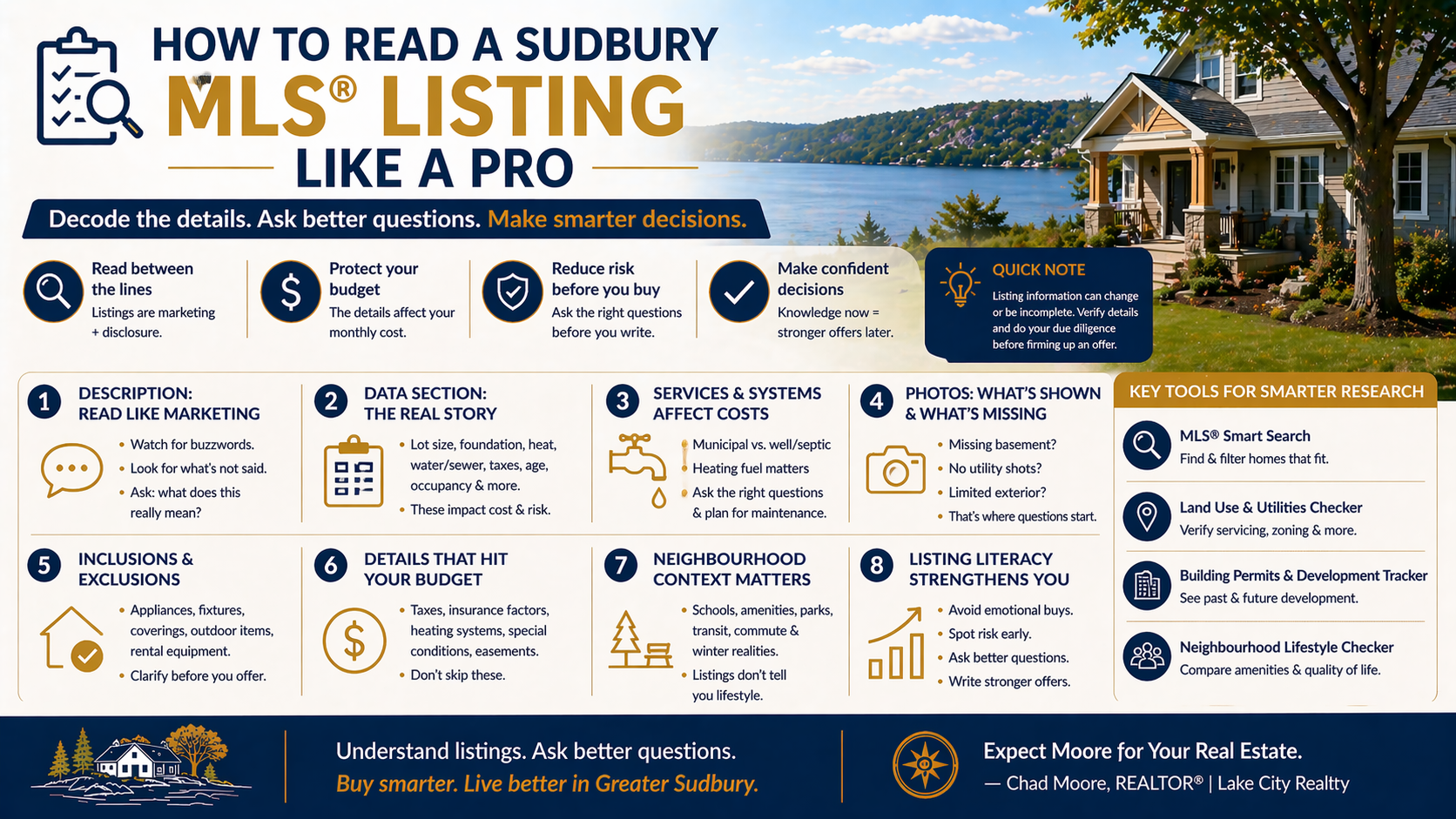
How to read a Sudbury MLS listing like a pro, with tips for decoding listing descriptions, property data, photos, inclusions, services, systems, neighbourhood context, and smarter buyer research tools.

Most buyers scroll listings. Smart buyers analyze them.

If you’ve ever clicked on a Sudbury MLS® listing and thought, “What does any of this mean?” — you’re not alone. Between abbreviations, buzzwords, and details tucked into the data fields, it’s easy to miss the stuff that actually affects your budget, your lifestyle, and your risk.

The good news? Once you know where to look — and what to question — listings get a lot easier to read.

Quick note: Listing information is marketing and disclosure rolled into one. Details can change, be incomplete, or require verification. The goal is to use the listing to ask better questions and do smarter due diligence before you firm up an offer.

1) Start With the Property Description (But Read It Like Marketing)

Descriptions are designed to highlight strengths. That doesn’t mean they’re “wrong” — but they’re written to sell the home. Watch for phrases like:

  • “Cozy” (often smaller square footage)
  • “Charming” ️ (often older — sometimes with older systems)
  • “Opportunity” / “Bring your vision” (may need work)
  • “Fixer-upper” ️ (can range from cosmetic to major)
  • “As-is” ️ (limited seller representations — ask what it means in context)
  • “Updated” (always ask: what year? what scope?)
  • “Investment potential” (ask: legal duplex? zoning? permits? separate meters?)

If terminology feels unclear, keep this handy: Real Estate Dictionary.

And when the wording triggers questions about what’s included, what’s excluded, or what’s “assumed,” you’ll usually find the real answers in the data fields and schedules — not the headline sentence.

2) The Data Section Tells the Real Story

The structured data in an MLS® listing often matters more than the adjectives. Pay close attention to:

  • Lot size / frontage / depth (and whether it’s irregular)
  • Property type (detached, semi, condo, rural, waterfront access, etc.)
  • Foundation (block, poured concrete, stone, slab, crawlspace)
  • Heating type + fuel (forced air, boiler, electric, propane, oil, wood)
  • Water & sewer (municipal vs. well/septic)
  • Property taxes (and whether they reflect reassessment/changes)
  • Year built / age (helps you anticipate systems and maintenance cycles)
  • Occupancy / possession (tenants, timelines, flexibility)

These details directly impact your monthly cost and long-term maintenance — long after the excitement wears off.

If you want to verify context beyond the listing text, especially when servicing, amenities, neighbourhood fit, or property due diligence could matter, use the tools inside MLS® Smart Search:

3) “Municipal” vs. “Rural” Costs: Water, Sewer, Heat, and What That Means

Two homes at the same price can have very different ownership costs depending on services and systems.

  • Municipal water & sewer tends to be simpler day-to-day, but you still want to understand bills, aging infrastructure, and any known issues.
  • Well & septic can be totally fine — but it’s a different maintenance world (water quality, pump systems, septic capacity, inspections, and long-term replacement planning).
  • Heating fuel matters in Sudbury. Older homes, rural homes, and certain layouts can change heating costs dramatically.

If a listing says “well” or “septic,” that’s not automatically a red flag — it’s a cue to ask the right questions and structure the right due diligence. When you get to the offer stage, this guide ties it together: Making an Offer.

4) Photos Tell a Story — and What’s Missing Tells More

Photos are curated. So don’t just look at what’s shown — look for what’s not shown.

  • If every room is photographed except the basement, there’s usually a reason.
  • If there are only a handful of exterior shots (or awkward angles), curb appeal may not hold up in person.
  • If there are no shots of the mechanical room, electrical panel, or utility areas, plan to ask.
  • If the yard is barely shown, ask about grading, drainage, and lot usability.

Gaps in the gallery are often where the best questions start.

Once you’re booking showings, this is how I recommend viewing homes strategically: Home Shopping.

5) Inclusions & Exclusions: The “Wait… I Thought That Stayed?” Section

Always review what’s included in the sale — and what isn’t. Misunderstandings happen here all the time.

Common items to confirm:

  • Appliances
  • Light fixtures
  • Window coverings
  • Outdoor structures (sheds, gazebos, play structures)
  • Any “attached” item that looks permanent but might be excluded
  • Rental items (hot water tank, HVAC, propane tanks, water treatment equipment)

If you care about it, we clarify it before you write an offer — and we make sure the paperwork matches what you think you’re buying.

For contract language and common terms, these references help: Legal & Contract Terms.

6) Don’t Skip the Details That Hit Your Budget

Buried in the listing details are the things that make or break affordability:

  • Heating type and approximate age
  • Water and sewer (and what that implies for maintenance)
  • Property taxes (and whether they reflect recent changes)
  • Insurance considerations (older wiring, wood stoves, past claims, etc.)
  • Any notes about easements, access, shared driveways, or special conditions

If you’re still building your buying plan (and figuring out your real budget), start here: Market Preparation.

7) Neighbourhood Context: Listings Don’t Tell You Lifestyle

A listing tells you about the home — not what it feels like to live there day-to-day.

Before you commit, consider:

  • Schools and routes
  • ️ Amenities and errands
  • Parks, trails, and recreation
  • Commute patterns (and winter realities)

You can compare areas here: Sudbury Communities. And if you want a faster inventory view (by price, area, and features), start with: MLS® Smart Search.

Want quick “filter hubs” to reduce overwhelm? These are great starting points:

️ 8) Why Listing Literacy Protects You (And Strengthens Your Offers)

When you understand listings deeply:

  • You avoid emotional decisions
  • You identify risk earlier
  • You ask better questions before conditions expire
  • You write stronger, cleaner offers with fewer surprises later

Want the next step after you’ve found “the one”? Start here: Making an Offer.

My Advice (How I Help You Read Between the Lines)

I decode listings for my clients every day. I’ll flag when wording is doing heavy lifting, when key details are missing, and when a “small” detail could turn into a big cost later. My job is to help you reduce surprises before the offer is signed and conditions are removed.

If you want to cut through the noise, start with MLS® Smart Search and use the tools that help you verify what you’re seeing — not just what’s being sold to you.

Expect Moore for Your Real Estate.
Chad Moore, REALTOR® | Lake City Realty

Feb. 4, 2026

Offer Transparency in Ontario Real Estate | Buyer & Seller Rights

Offer Transparency in Ontario Real Estate | Buyer & Seller Rights

If you’ve bought or sold a home in Ontario anytime in the last few years, you’ve felt it: offer nights can be intense, confusing, and sometimes frustrating. Since TRESA Phase 2 took effect on December 1, 2023, Ontario’s rules for competing offers changed in an important way — but not the way most people think.

What this means for Greater Sudbury

Here’s the plain-language truth: TRESA did not “ban blind bidding.” What it did was create a seller-controlled option to share certain offer details — while keeping strict guardrails in place.

This guide breaks down exactly what buyers are entitled to know, what sellers can choose to share, what can never be shared, and how the process actually plays out in the real world — including offer nights, delayed offers, and “bully” offers. If you want the “step-by-step” version of how we approach offers from the buyer side, start here: Buyer Experience. If you’re looking at this from the seller side, the strategy lens lives here: Seller Experience.

The 3 Rules Everyone Should Memorize

  1. When there are competing written offers, the number of competing written offers must be disclosed to every buyer who submitted one of those written offers.

  2. The contents (terms) of competing offers can only be shared if the seller gives written direction telling their brokerage what to share.

  3. Buyer identity and personal information can never be shared — even in a transparency / “open offer” style process.

If you only remember one thing: you can’t demand an “open bidding” process — but you can expect a lawful, documented process.

️ For the broader legal backdrop, visit Ontario Real Estate Laws & Your Rights (and if you want the quick, plain-language version for buyers and sellers, this companion post helps: Ontario Real Estate Laws & Consumer Rights).

What “Offer Transparency” Actually Means Under TRESA

“Offer transparency” is the common phrase — but the legal concept is simpler: a seller may give written direction for their brokerage to share all or part of competing offer contents.

That means the seller can choose one of three broad approaches:

  • Traditional confidentiality: competing offer details stay private (except the required offer count to offer-makers).

  • Limited transparency: the seller directs the brokerage to share only certain terms (example: price + closing date).

  • High transparency: the seller directs that most terms be shared (still with strict privacy limits).

Important: TRESA does not create a regulated “auction” system. It doesn’t set rules for live bidding, real-time updates, or a standardized open-offer format. It simply permits the seller’s lawful written direction to be followed. For a practical “how this plays out at the kitchen table” look, see: Offer Negotiation.

The Most Misunderstood Part: What Counts as a “Competing Offer”?

Under Ontario’s rules, “competing offers” refers to written offers received by the seller’s brokerage. That matters, because a lot of confusion comes from casual language like “we have offers coming” or “another offer is being written.”

  • Written offer received counts

  • Verbal offer does not count

  • Offer “being drafted” / “coming soon” does not count

  • Buyer interest / showings / “we’re expecting offers” does not count

So if you’ve submitted a written offer and you’re told there are competing written offers, you are entitled to the number of competing written offers. If you’re still building your buyer plan (pre-approval, timelines, conditions), start here: Buyer Experience.

️ What Can Be Shared — and What Can NEVER Be Shared

If a seller chooses transparency, they can direct their brokerage (in writing) to share all or part of offer contents. This might include things like:

  • Price

  • Deposit amount

  • Closing date

  • Conditions (financing, inspection, sale of property, etc.)

  • Inclusions / exclusions

  • Other terms the seller directs to share

But here’s the hard line: personal information or anything that could identify a buyer must not be shared. No names. No “who it is.” No identifying details.

And another key point: if the seller directs that any offer contents be shared, those shared details must be shared with every person making one of the offers — not selectively. (This is one reason sellers benefit from having a clear plan before offer day — see Hitting the Market.)

Real-World Examples (What It Looks Like in Practice)

Example 1: Traditional confidentiality (most common)

A home in Greater Sudbury gets hot and receives 6 written offers on offer night. In this model, buyers won’t be told the prices or conditions of other offers. But each buyer who submitted a written offer can be told the number of competing written offers.

Example 2: Limited transparency (seller shares only price + closing)

The seller directs the brokerage (in writing) to disclose only two details: price and closing date. Now every offer-maker receives the same shared info, and buyers can decide whether to improve their offer. Conditions, deposits, and other terms remain private unless the seller directs otherwise.

Example 3: Delayed offers, then a pre-emptive (“bully”) offer arrives

The seller sets an offer date for next week — but a strong offer comes in early with a short expiry. At that point, the seller has choices (hold firm, consider early, adjust instructions) — but the process needs to be clear, documented, and communicated properly to avoid confusion and compliance issues.

From the seller side, this is exactly where preparation and positioning matter most: Seller Consultation and Hitting the Market.

What This Means for Buyers (Practical Advice)

Buyers now face a more variable offer environment because the seller controls whether (and what) offer contents get shared. You may encounter:

  1. Traditional offers — limited information (other than the offer count once you submit).

  2. Seller-directed transparency — certain terms may be shared with all offer-makers.

The big takeaway: there is no universal “standard” offer night format in Ontario. Your strategy should be built around what you can control: your price, your conditions, your closing flexibility, and your risk tolerance.

If you’re just starting your search, head over to The Buyer Experience to see how we help buyers stay informed, not blindsided. And if you want to keep your search grounded in what’s actually active and available, use MLS® Smart Search and the Greater Sudbury Curated Hot Sheets.

What This Means for Sellers (How to Choose the Right Approach)

If you’re listing your home, TRESA gives you more flexibility — but it also puts more importance on making smart decisions before offer day. You can:

  • Keep offer terms confidential (the traditional approach),

  • Share limited information to encourage stronger offers, or

  • Use a high-transparency approach (still protecting buyer privacy).

Transparency can be powerful in the right situation — but it’s not automatically “better.” The best approach depends on: market conditions, buyer demand, property type, and the kind of competition your home is likely to attract.

Explore our Seller Experience to learn how we help you navigate today’s rules with confidence and clarity. If you want to see the broader roadmap that supports a clean offer process, start with Media Day and then Offer Negotiation.

️ What Happened to the Offer Summary Disclosure Form?

Under the old framework (pre-TRESA), buyers sometimes heard about an “Offer Summary Disclosure Form.” That form is no longer part of the process.

Instead, the listing brokerage must keep internal records of offers received and the required offer details — and must be able to produce those records to the regulator if requested. That doesn’t mean buyers get “full access” to the paperwork. It means the industry is expected to run a compliant, documented process.

Chad’s Take (What I Tell Clients in Plain English)

Offer transparency isn’t a magic wand — it’s a strategy tool.

My job isn’t just to “explain the rules.” It’s to help you use the rules in a way that protects your goals:

  • For sellers: maximize leverage, control risk, and run a clean process that stands up to scrutiny.

  • For buyers: build the strongest offer you can with the information available — and avoid guessing games where it matters most.

Whether you’re trying to win a home or sell one confidently, the right plan is the one that fits your market and your timeline — not the loudest headline you saw on social media. If you want the bigger “consumer rights” context alongside this, tie it together with: Ontario Real Estate Laws & Consumer Rights.

Final Word

TRESA didn’t force open bidding in Ontario — it created seller-controlled flexibility with strict guardrails. If you’re buying or selling in Greater Sudbury, I’m happy to walk you through what’s realistic in today’s market and what a smart offer strategy looks like for your situation.

Expect Moore for Your Real Estate.

— Chad Moore | Licensed REALTOR® in Greater Sudbury

Feb. 4, 2026

Greater Sudbury Real Estate Market Update: January 2026

Greater Sudbury Real Estate Market Update: January 2026

The January 2026 market record shows 101 new-listing events, 83 sold-close events and a $450,000 median close price in Greater Sudbury. The relationship among those measures says more than any one headline on its own.

New listings101
Sold closes83
Median close price$450,000
Median paired ratio98.71%

The numbers and the questions they answer

Greater Sudbury market measures for January 2026
Measure January 2026 Change from December 2025
New-listing events 101 +44.3%
Sold-close events 83 +3.8%
Median close price $450,000 -0.6%
Median close-price-to-export-list relationship 98.71%

Within the January 2026 market record, new-listing events describe the flow of properties entering the dataset. Sold-close events describe transactions whose recorded closing falls in that period. They are not the same group of properties, so one count divided by the other is not a sales conversion rate.

In the January 2026 market record, compared with December 2025, new-listing events change +44.3%, sold-close events change +3.8%, and the median close price changes -0.6%. These are period-to-period movements in separate event groups—not a resale gain or loss for one home.

What the activity flow suggests

Within the January 2026 market record, there is more listing flow than closing flow: the difference between 101 new-listing events and 83 sold-close events is 18. Another way to show the relationship is about 82.2 sold-close events for every 100 new-listing events recorded in the same period. That comparison is directional because a listing can close in a different month or quarter.

The practical point from the January 2026 market record is the combination of a 18-event gap and a 82.2-per-100 relationship—not a label for the whole city. The better question is whether a specific property segment is gaining fresh alternatives faster than qualified buyers are absorbing them. Price range, condition, neighbourhood and property type can produce a very different balance from the city-wide summary.

How to read the $450,000 median

In the January 2026 market record, the median close price is the middle value among the valid positive close prices. It is less sensitive to one extreme sale than an average, but it can still move because a larger share of higher-priced or lower-priced homes happens to close.

The composition of the January 2026 market record is why the $450,000 result cannot be applied as a percentage adjustment to a specific Greater Sudbury property. A valuation needs recent comparable sales with similar location, lot, age, condition, size, utility, updates and market exposure. The median gives the conversation a scale; the comparable set gives it precision.

What the 98.71% paired relationship does—and does not—show

Across the January 2026 market record, the median close-price-to-export-list relationship is 98.71%, which places the midpoint below the export list field. Here, negotiation below that export field is visible in the midpoint. This measure uses the ListPrice field present in the export; it does not prove the property's original asking price or capture every price change made before the sale.

For a buyer using the January 2026 market record, the ratio is not an automatic offer formula; for a seller, it is not a promise. The useful comparison is the group of current and recently sold homes that compete with the subject property, including the differences that explain why one attracts stronger terms than another.

What buyers can do with January 2026's signal

Compare the next-best active property before deciding how aggressive to be. In the January 2026 market record, the $450,000 market median is not the buyer's budget, and the 98.71% paired relationship is not the required bid. Financing, property tax, utilities, insurance, condo fees and immediate repairs all determine the real monthly cost.

  • Confirm the rate, term, amortization and expiry date of the pre-approval.
  • Compare each serious home with current alternatives and recent closes.
  • Estimate near-term repairs before deciding which property is the better value.
  • Use financing and inspection conditions according to the property's risks and the offer environment.
  • Keep closing costs and an emergency reserve outside the down payment.

The figures in the January 2026 market record are most useful as a prompt to investigate. If new choices are accumulating in the buyer's exact segment, there may be room to slow down and compare. If well-positioned homes are disappearing quickly, preparation and clean decision-making matter more than a city-wide label.

What sellers can do with January 2026's signal

Make the value case visible before buyers begin negotiating around uncertainty. The gap inside the January 2026 market record—101 listing events against 83 sold closes—creates 18 more listing events, but the decisive competition is still the small set visible to the same buyer.

  • Build the price range from comparable sales and active competition.
  • Account for condition, updates, deferred work and recurring carrying costs.
  • Make the online presentation answer the questions buyers use to eliminate options.
  • Track showing quality, repeat interest and objections from the opening days.
  • Adjust when the competing set and buyer response do not support the original position.

A strong sale within the January 2026 market record still requires alignment among price, property and exposure. The market summary can identify the environment; it cannot compensate for an asking price that qualified buyers cannot defend against the alternatives.

How these Greater Sudbury measures are calculated

For the January 2026 market record, the counts come from nine geographically divided MLS exports used in this local series. Listing events use the recorded ListingContractDate. Sold-close events require a valid CloseDate and a positive ClosePrice. The median paired relationship uses ClosePrice and the export's ListPrice field.

The exports behind the January 2026 market record may not contain every board-wide or City of Greater Sudbury record. These are raw activity and price measures rather than a benchmark index, a same-home appreciation calculation or a forecast. That limitation is why property-level comparable work remains essential.

To compare the January 2026 market record with another public view of the region, see the Sudbury Real Estate Board statistics page from CREA.

The January 2026 bottom line

The January 2026 market record provides a clear four-part snapshot: 101 listing events, 83 sold-close events, a $450,000 median close price and a 98.71% median paired relationship. Read together, they describe activity, price mix and negotiating outcomes without pretending that every home or neighbourhood moves the same way.

Bring the market down to one property

If you are buying or selling in Greater Sudbury while the January 2026 market record shapes the conversation, I can build the current comparison around the home, neighbourhood, condition, financing and timing that actually shape your decision.

Explore the buyer process Explore the seller process

Expect Moore for Your Real Estate.
— Chad Moore
Lake City Realty

Feb. 3, 2026

How Much Is My Home Worth in Greater Sudbury?

How Much Is My Home Worth in Greater Sudbury?

It’s one of the most searched real estate questions:

“How much is my home worth?”

In Greater Sudbury, the answer usually isn’t a single number — it’s a strategic range based on real sales data, current competition, and buyer behaviour in your specific price lane.

Note: This is general information for Ontario homeowners. A home’s value can’t be confirmed by a single online tool or a single comparable sale, and no method can guarantee a final sale price.

Why Online Estimates Often Miss the Mark

Automated valuation tools (AVMs) use algorithms, public records, and broad market patterns. They can be useful for a rough starting point — but they often struggle in a market like Sudbury where micro-location and condition matter a lot. See why an online estimate is not the final word on a home’s value, and what needs to be checked beyond the number.

Online tools typically don’t “see”:

  • Interior condition, layout flow, finishes, and upkeep
  • Renovation quality (good work vs. cosmetic shortcuts)
  • Micro-location differences (even within the same neighbourhood)
  • Current buyer demand in your exact bracket
  • Active competition that sets today’s benchmark

That’s why estimates can be meaningfully different from each other — and different from what buyers are actually willing to pay today.

MPAC Value vs Market Value (They’re Not the Same Thing)

MPAC assessments are designed for property taxation, not resale pricing. They can be out of sync with current market conditions, and they don’t reflect active buyer psychology or today’s competition.

Market value is determined by what informed, active buyers are willing to pay right now, given the options they can choose from in the same range.

What Actually Determines Your Home’s Value in Sudbury

In practice, value comes from a combination of:

  • Recent comparable sales (in your immediate area, with similar features)
  • Active listings (your current competition and what buyers will compare you against)
  • Buyer demand in your price bracket (how quickly homes are moving)
  • Condition and presentation (maintenance, updates, cleanliness, staging)
  • Timing (market momentum changes and seasonal patterns)

Value is dynamic. It shifts as supply and demand shift.

That is why the valuation conversation fits naturally inside a broader Seller Consultation. The goal is not just to estimate a number. The goal is to understand how your home would compete if it were introduced to the market today.

Search-Bracket Psychology (Small Price Changes Can Change Exposure)

Buyers don’t search “any price.” They search in brackets:

A home listed at $405,000 can miss buyers searching under $400,000. A home at $509,000 can disappear from under-$500k filters. Those shifts can change:

  • who sees your listing
  • how many showings you get
  • how confident buyers feel about your pricing

This is why pricing is not just math — it’s positioning. If you want the framework I use, start here: Pricing Strategy.

️ Market Value vs Strategic List Price (They Can Be Different)

Even if your home falls within a market-value range, your list price is a strategy decision.

  • Too high: fewer showings, weaker urgency, more buyer hesitation.
  • Too low: more attention, but the approach still needs control and structure.
  • Right lane: the home feels “worth seeing” and buyers act faster.

And when a listing launches well, the first week becomes your best window to build leverage. That first-week concept also ties into: Multiple Offers: Seller Strategy.

If you want to understand how pricing, presentation, and promotion work together, the 3Ps of Selling a Home framework is a helpful companion to this page.

Condition and Presentation Can Move the Needle

Buyers don’t evaluate your property in isolation. They compare it to every other option they’ve saved in the same range — and they judge risk quickly.

That’s why preparation matters. Clean, bright, well-presented homes don’t just “look nicer” — they feel lower-risk to buyers.

Two practical resources:

If you want the “why” behind buyer decisions, this adds context: Sudbury Buyer Psychology.

And once the home is properly prepared, professional presentation becomes part of the value story. That is where Media Day and the broader Hitting the Market process help turn value into buyer confidence.

“What’s My Home Worth?” Is Usually a Planning Question

Most homeowners aren’t just curious — they’re planning their next move. Value impacts:

  • mortgage payout and net proceeds
  • move-up affordability
  • downsizing flexibility
  • relocation timing

A valuation isn’t just a number — it’s the foundation of your next decision.

The Best Way to Get a Realistic Value Range

A professional valuation looks at more than “last sold prices.” It considers:

  • comparable sold data (and how comparable they truly are)
  • active competition (the homes buyers will compare you against today)
  • condition and presentation factors
  • pricing lanes and exposure strategy

If you want a clear range and a plan, start here: Home Valuation. If you’re still early and want to map out timing, prep, and strategy, this is the bigger picture: Seller Experience.

One Last Tip: Compare Like a Buyer (Not Like a Homeowner)

If you’re browsing listings to gauge value, do it the way buyers do:

  • look at homes in the same bracket
  • compare photos, condition, and layout
  • ask “would I choose mine over that?”

If you want a clean way to explore what’s currently competing for attention, start here: MLS® Smart Search. You can also browse current inventory by price lane here: Curated MLS® Hot Sheets.

Chad Moore
REALTOR® | Lake City Realty
Expect Moore for Your Real Estate.

Feb. 2, 2026

Mortgage Types in Ontario | What Home Buyers Need to Know

Mortgage Types in Ontario | What Home Buyers Need to Know

When buyers say, “I’m getting a mortgage,” it can sound like there’s one product and one rate.

In reality, Ontario buyers are choosing between multiple mortgage structures — and the right choice depends less on predicting rates and more on matching the mortgage to your budget, your timeline, and your risk tolerance.

This guide breaks down the mortgage types you’ll hear most often, what they really mean, and who each one is best for — without lender jargon.

If you want definitions as you read, keep this open in another tab: Mortgage & Financing Terms.

Important note: This is general education — not financial advice. Mortgage terms vary by lender and borrower. Always confirm details with your mortgage professional and your lawyer before committing.

Two Words Buyers Mix Up: Term vs. Amortization

Before we talk about rate types, it helps to separate two concepts that get blended together:

  • Mortgage term = how long your rate and lender agreement lasts (often 1–5 years, sometimes longer).
  • Amortization = how long the mortgage is structured to be paid off (often 25 years, sometimes longer depending on the mortgage type and qualification).

Your term affects renewal timelines and penalties. Your amortization affects monthly payment comfort and total interest paid over time.

If you’re still building your buying plan, start here: Market Preparation.

Want to understand what actually drives these rates — and why they can change even when the Bank of Canada doesn’t? Read: How Banks Set Mortgage Rates in Canada.

Fixed, Variable, and Adjustable

Fixed-Rate Mortgage

How it works: Your interest rate stays the same for the full term (commonly 2–5 years). Your payment stays predictable even if interest rates rise.

Best for: buyers who value stability, have tight budgets, or want the “sleep-at-night” payment.

Watch for: breaking a fixed mortgage early can come with larger penalties. Ask your lender how their penalty is calculated and what your prepayment privileges are.

Variable-Rate Mortgage

How it works: Your rate moves with the lender’s prime rate. Variable mortgages are commonly offered in two formats:

  • Fixed-payment variable: your payment stays the same, but how much goes to interest vs. principal changes when rates move.
  • Adjustable-payment variable: your payment changes when rates change.

Best for: buyers with strong cash flow and comfort with rate movement — often longer-term owners who can handle fluctuations.

Watch for: rate increases can tighten budgets quickly. The key is knowing which type of variable you have and how it behaves when rates rise.

Adjustable-Rate Mortgage

How it works: Similar to a variable rate, but your payment adjusts in real time when rates change.

Best for: high-income / low-debt households who want transparency and can handle payment swings.

Watch for: it’s “honest,” but not forgiving — payments can rise quickly when rates rise.

Closed vs. Open Mortgages (Flexibility vs. Cost)

Closed Mortgage

How it works: You’re committed for the term, with restrictions on early payout, refinancing, or switching lenders. Most borrowers use closed mortgages because rates are usually lower.

Best for: buyers confident they won’t move, refinance, or make major changes during the term.

Watch for: life changes — job moves, separation, upsizing — can trigger penalties if you break early. “Cheap money” only stays cheap if nothing changes.

Open Mortgage

How it works: You can pay it off or switch anytime without penalty.

Best for: short-term situations (bridge periods, expected lump-sum payoff, or a near-term sale).

Watch for: rates are typically higher. It’s a tool — not usually a long-term plan.

Insured (High-Ratio) vs. Conventional

Insured / High-Ratio Mortgage ️

How it works: If your down payment is under 20%, mortgage default insurance is typically required. This protects the lender — not the borrower — and the premium increases total borrowing cost.

Best for: first-time buyers and buyers with strong income but limited savings — often a practical stepping stone into ownership.

Watch for: added insurance premiums and specific qualification rules. It’s not a shortcut — just a path in.

Conventional Mortgage

How it works: 20%+ down payment, typically no default insurance premium.

Best for: move-up buyers, owners using equity, or buyers who want more flexibility with property types and longer amortization options (where available).

Watch for: bigger upfront cash requirement — and different rate dynamics depending on lender and product.

Amortization: Payment Comfort vs. Lifetime Cost

Your amortization is how long the mortgage is structured to be paid off (often 25 years, sometimes longer depending on the situation).

  • Longer amortization = lower monthly payments, but higher total interest over time.
  • Shorter amortization = higher monthly payments, faster equity build, and less lifetime interest.

Amortization is a long-term strategy decision — not just a monthly payment decision.

Prepayment Privileges, Penalties, and Why They Matter

Most buyers focus on rate — but the “rules” of the mortgage often matter just as much.

Ask your lender about:

  • Prepayment privileges: how much extra you can pay annually without penalty (lump sums and/or payment increases).
  • Penalty calculation: what happens if you break early (especially important for fixed-rate terms).
  • Portability: whether you can transfer the mortgage to a new property if you move.
  • Assumability: whether a buyer could assume your mortgage (rarely a deciding factor, but valuable in certain rate environments).

If you’re buying with a near-term move in mind (or you’re unsure), flexibility can matter more than a tiny rate difference.

Why Mortgage Structure Matters When You’re Making an Offer

Mortgage structure can influence:

  • How fast your lender can finalize financing
  • How long you need a financing condition
  • How confidently you can negotiate timelines and closing dates

If you’re still in the “getting ready” stage, start here: Market Preparation.

When it’s time to write, this is the next step: Making an Offer.

And if you want to shop with better filters (and fewer dead ends), use: MLS® Smart Search (plus Home Shopping for viewing strategy).

The Bottom Line

There’s no single “best” mortgage.

The right choice depends on your income stability, risk tolerance, timeline, cash reserves, and what you need your mortgage to let you do if life changes.

The most common mistake buyers make isn’t choosing the “wrong rate” — it’s choosing the wrong structure for their life.

If you want a full buying roadmap (from preparation to keys), start here: The Buyer Experience.

Expect Moore for Your Real Estate.
Chad Moore, REALTOR® | Lake City Realty

Jan. 28, 2026

Bank of Canada Holds at 2.25%: January 28, 2026

Bank of Canada Holds at 2.25%: January 28, 2026

Today, January 28, 2026, the Bank of Canada has held its target for the overnight rate at 2.25%.

The policy settings

Policy settings announced January 28, 2026
Measure Setting Why it matters
Target overnight rate 2.25% Anchor for the Bank's monetary-policy stance
Change at this decision No change Most direct signal for variable-rate borrowing
Bank Rate 2.50% Rate charged on one-day advances to financial institutions
Deposit rate 2.20% Rate paid on deposits held at the Bank

Why the Bank makes this choice

Growth and jobs. Fourth-quarter growth likely stalls after a strong third quarter, exports remain exposed to US tariffs and unemployment is 6.8%, although domestic demand and employment have recently improved.

Inflation. December CPI is 2.4% because of tax-holiday base effects; core measures ease toward 2.5% and the Bank expects inflation near 2% over the projection.

The policy judgment. The current rate remains appropriate under the Bank's baseline, with trade policy and geopolitical uncertainty arguing for flexibility rather than an immediate move.

What changes for borrowers

A hold leaves the Bank's policy setting unchanged; it does not freeze every mortgage quote. Variable products remain anchored to lender prime rates, while fixed offers can still move with bond yields, funding costs, term length and competition.

Because the policy rate does not move, there is no new Bank-driven basis-point change to apply to a balance today. Existing payment pressure remains, and individual lender offers can still change.

When comparing fixed and variable products, look beyond the starting rate. Payment structure, prepayment privileges, portability, penalties and conversion terms affect the cost of changing plans. Ask a lender or licensed mortgage professional to calculate the result for your balance and expected time in the home.

For Greater Sudbury buyers

Start with three numbers: a comfortable monthly housing cost, a purchase-price ceiling and the cash left after closing. Two homes at the same price can carry very different costs once taxes, heating, insurance, condo fees and immediate repairs are included. Use comparable sales and available alternatives to test the price of the specific property.

  • Refresh the pre-approval and confirm the rate-hold expiry.
  • Test the payment at the offered rate and a higher renewal rate.
  • Keep closing costs and a repair reserve separate from the down payment.
  • Match financing and inspection conditions to the property’s actual risks.

For owners approaching renewal

Compare equivalent offers before deciding whether to stay with the current lender. Include discharge charges, appraisal or legal requirements and the flexibility you may need during the term. Extending amortization may lower the payment while increasing total interest and slowing principal repayment. A sustainable structure matters more than correctly guessing the next announcement.

For sellers

The rate decision can influence buyer confidence and financing, but it does not automatically reset Greater Sudbury prices. Position the home against current competition and recent relevant sales. Resolve avoidable objections, make the carrying costs and condition clear, and use actual showing and offer feedback to guide adjustments.

What to watch next

US trade restrictions, the CUSMA review, hiring plans and whether domestic spending can offset export weakness. Those developments will help show whether the Bank’s assessment is holding up. A household plan should still work under more than one rate or market outcome.

Read the official Bank of Canada announcement.

For a local plan, explore the Buyer Experience or Seller Experience. You can also browse the Bank of Canada Decisions & Mortgage Rate Context Archive.

Expect Moore for Your Real Estate.
— Chad Moore, REALTOR®
— Lake City Realty Ltd., Brokerage