Local evidence. Practical guidance.

Greater Sudbury Real Estate Blog

Market updates, buying and selling guidance, Ontario real estate information and straight answers for people making real decisions in Greater Sudbury.

Latest articles

New and recently refreshed guidance appears first.

Jan. 27, 2026

Renovations That Add Value Before Selling in Sudbury

Renovations That Add Value Before Selling in Sudbury

Before listing, many sellers ask the same question:

“Should I renovate first?”

The better question is:

Will this improvement increase buyer confidence and perceived value — or just cost money and delay the listing?

In Greater Sudbury, not every project “pays back” the way people assume. Some upgrades genuinely help your home compete in its price lane. Others create disruption, stretch timelines, and don’t change how buyers feel when they walk through the front door.

Note: This is general information for Ontario sellers. Every home, budget, and market moment is different. No renovation guarantees a specific sale price or outcome.

The Two Reasons a Renovation Makes Sense Before Selling

Most pre-listing improvements should accomplish one (or both) of these goals:

  • Increase perceived value (the home looks and feels “worth it” versus the competition)
  • Remove buyer objections (reduce the “what else is wrong?” mindset)

If a project doesn’t clearly do either, it’s often a “nice-to-have” that won’t improve your net result.

This connects directly to how buyers make decisions: Sudbury Buyer Psychology.

It also connects to the larger seller strategy. Renovation decisions should be part of the Seller Consultation, not something homeowners guess at before the pricing and launch plan are clear.

High-Impact, Low-Cost Improvements (The Best Starting Point)

These are the updates that often help most because they improve first impressions quickly and reduce friction without major construction:

  • Fresh neutral paint (especially high-traffic areas and rooms with bold colours)
  • Lighting upgrades (brighter, consistent bulbs; replace dated fixtures where it matters)
  • Hardware refresh (kitchen/bath cabinet pulls, door handles, hinges)
  • Bathroom “mini refresh” (mirror, faucet, towel bars, clean caulking)
  • Minor repairs (the “small stuff” that triggers buyer doubt)
  • Curb appeal cleanup (entryway, landscaping, walkways, exterior tidiness)

These changes improve perception immediately — especially in listing photos and the first few showings.

For the full prep framework (declutter, repairs that matter, staging), start here: How to Prepare Your Home for Sale in Sudbury.

️ “Presentation Renovations” That Often Beat Real Renovations

Sometimes, the best “renovation” is actually presentation — because buyers feel the home differently even if the structure hasn’t changed.

Examples:

  • Declutter and simplify furniture to improve flow
  • Stage key rooms so purpose and scale are obvious
  • Improve lighting and sightlines (buyers love bright, calm spaces)
  • Ensure photos are complete and accurate (missing photos create suspicion)

Staging isn’t decorating — it’s positioning. If you want a practical staging roadmap: Sudbury Home Staging.

And if you want the “photo psychology” piece that quietly impacts offers: Hidden Judgment in Listing Photos.

This is also why Media Day matters. The preparation only helps if buyers can clearly see the value online before they ever book the showing.

️ Kitchens and Bathrooms: Upgrade Carefully

Buyers care a lot about kitchens and bathrooms — but full remodels right before listing rarely return dollar-for-dollar.

Instead of gutting a space, consider targeted improvements that modernize the feel:

  • Paint cabinets (when the layout and cabinet condition are solid)
  • Replace hardware (instant modernization)
  • Update lighting (especially over sinks and islands)
  • Fix obvious wear (chips, broken doors, loose hinges, failing caulking)
  • Refresh surfaces only when damage is clearly visible and affects buyer confidence

The goal is to remove objections and improve perceived value — not chase a “dream kitchen” project that delays your listing.

Mechanical and Structural Confidence Matters More Than Cosmetic Shine

Cosmetic upgrades help, but confidence is what protects negotiations. Buyers pay attention to:

  • roof condition
  • windows and drafts
  • heating systems and service history
  • electrical panels and visible wiring concerns
  • signs of moisture, ventilation issues, or deferred maintenance

If there’s an obvious concern, it often becomes a negotiation focal point later.

If you want fewer surprises during the offer process, a pre-listing inspection can sometimes be appropriate depending on the home and your strategy: Sudbury Pre-Listing Inspection.

Those decisions also affect how offers are reviewed later. A home with fewer obvious concerns can give sellers stronger footing during Offer Negotiation.

Permits, Paperwork, and “Proof” (Where It Helps)

When major work has been completed, buyers may ask about permits, invoices, warranties, or contractor details. Having documentation ready can make the conversation cleaner and reduce uncertainty.

If you’re trying to understand approvals and development context in your area, this tool can be helpful for research: Building Permits & Development Tracker.

Important: Always avoid overstating what documentation “proves.” The goal is clarity and confidence — not promises.

When Renovating Often Doesn’t Make Sense

Heavy renovation is often unnecessary when:

  • it delays your listing significantly
  • the spend won’t change buyer perception enough to matter
  • your home is already competitive in its price lane
  • you’re chasing a moving market instead of positioning strategically

In many cases, pricing and positioning are more impactful than a major remodel. Two good starting points:

Renovation choices should support the strategy, not replace it. That is the same principle behind the 3Ps of Selling a Home: pricing, positioning, and promotion need to work together.

The Smart Approach: Make Renovation Decisions With a Plan

Before spending money, align decisions with a clear listing plan:

  • Will this improve perception immediately?
  • Will this remove a clear buyer objection?
  • Will it move my home into a stronger competitive position?
  • Will the timeline still support a strong first-week launch?

If the answer is “no,” the project may not be worth doing — and your best move may be preparation + presentation + a structured launch instead.

That full roadmap is here: Seller Experience and Hitting the Market.

If you want help sorting “worth it” from “waste of money,” start with a Seller Consultation. We’ll prioritize what matters for your home, your price lane, and your timeline.

Chad Moore
REALTOR® | Lake City Realty
Expect Moore for Your Real Estate.

Jan. 26, 2026

Real Estate Awards in Ontario: What They Really Mean

Real Estate Awards in Ontario: What They Really Mean

If you’re buying or selling a home in Ontario, you’ve probably noticed something curious:

Suddenly, everyone is an award-winning REALTOR®.

Gold. Platinum. Chairman’s. President’s. Top Producer. Top 10%.

If real estate awards were coffee loyalty stamps, half the province would be getting a free latte every morning.

So… what do these awards actually mean? And more importantly—what should you, as a consumer, do with them?

Let’s translate.

First: Awards Aren’t “Fake” — But They’re Often Misunderstood

This isn’t an anti-award article. Some recognition in real estate is genuinely meaningful—especially awards that reflect:

  • Career milestones (long-term consistency over many years)
  • Lifetime achievement or major contribution recognition
  • National-level honours across a wide pool of agents

Those take time, durability, and real commitment. They deserve respect.

But the majority of awards you see promoted online aren’t those.

Most are better understood as internal brokerage recognition programs—and once you know that, the marketing makes a lot more sense.

Why Big Brokerages Love Awards (And Why You See So Many)

Large franchise brokerages run huge agent networks. Awards help those organizations:

  • recognize production internally,
  • keep agents motivated,
  • strengthen the brand, and
  • create marketing momentum.

Think of it like a tiered rewards program:

  • Hit a certain threshold → you qualify
  • Higher thresholds → shinier recognition
  • A small handful → rare, long-term achievement awards

From a business standpoint, it’s smart. From a consumer standpoint, it just means awards need context.

What Most Brokerage Awards Actually Measure

Here’s the simple version:

Most brokerage awards are based on how much business an agent did—not necessarily how well it went for the client.

They’re usually tied to:

  • gross commission earned, and/or
  • total sales volume

They typically do not measure things consumers actually care about, like:

  • pricing accuracy (did it sell where it should?)
  • days on market compared to the local average
  • list-to-sale price ratio
  • how risk was managed when deals got complicated
  • how often transactions fell apart and why
  • communication quality and post-sale support

That doesn’t make an award “bad.” It just means it mostly measures activity, not outcomes.

The “Participation Trophy” Effect (Ontario Edition)

This is the part most consumers don’t realize:

Many awards are threshold-based, not competitive rankings.

In plain English: if you hit the number, you get the badge. And since brokerages want their agents motivated (and marketable), these programs are often designed so a lot of agents qualify for something every year.

So when you see “Award-Winning REALTOR®,” what it may mean is:

“This agent achieved a certain internal production level within their brokerage this year.”

That can still be a respectable accomplishment. But it’s different from:

“This agent consistently outperformed the market for their clients.”

Those are not the same claim.

Same Trophy, Different Experience

Here’s the key takeaway:

Two REALTORS® can hold the same award while delivering very different results.

One might:

  • price strategically,
  • negotiate patiently and aggressively when needed,
  • spot risks early and protect the client.

Another might:

  • overprice and chase the market down with reductions,
  • push speed over strategy,
  • focus on “getting it done” instead of optimizing the outcome.

Same award. Different approach. Different results.

That’s why awards should be treated as one data point—not a decision-maker.

So What Should You Look For Instead?

If you’re hiring someone to guide a purchase or sale that could impact your finances for years, you want clarity.

Here are consumer-friendly questions that matter more than trophies:

  • How do your listings perform compared to the local market average?
  • How do you decide on price—and what happens if the market rejects it?
  • What’s your plan when a deal gets shaky (financing, inspection, appraisal, timelines)?
  • How do you negotiate when emotions are high and stakes are real?
  • What does your process look like—step by step?

A strong REALTOR® won’t be offended by those questions. They’ll welcome them.

Final Thought

Real estate awards aren’t lies. But they can be misunderstood—and sometimes they’re treated like consumer credentials when they’re really internal recognition tools.

Some awards represent long-term excellence and deserve genuine respect. Many are simply part of a large system designed to recognize production in tiers so agents have something to share each year.

Neither is “good” or “bad.”

But neither replaces what really matters:

  • strategy,
  • accountability,
  • local market knowledge, and
  • results.

If you want a straight answer on how the market’s moving—or a clear plan to buy or sell with confidence—I’m always happy to help.

Chad Moore, REALTOR®
Chad Moore Real Estate | Lake City Realty
(705) 691-1805  |  chad@lakecityrealty.com
Expect Moore for Your Real Estate!

Jan. 26, 2026

Making an Offer on a Home in Sudbury | Clauses, Conditions & Strategy

Making an Offer on a Home in Sudbury | Clauses, Conditions & Strategy

Writing an offer isn’t just paperwork — it’s strategy.

In Greater Sudbury, the way your offer is structured can influence:

  • Whether the seller takes you seriously
  • How quickly the deal moves forward
  • ️ How well you’re protected after acceptance

Strong buyers don’t just offer a number. They present a complete, thoughtful package — price, deposit, timelines, and smart conditions — aligned to the property and the market.

If you’re early in the process, it helps to review the full roadmap here: Buyer Experience and Market Preparation.

The Core Components of an Offer

Most offers in Ontario include:

  • Purchase price
  • Closing date (possession)
  • Deposit amount and timing
  • Conditions (your protection phase)
  • Schedules and clauses (the “fine print” that clarifies expectations)

A well-written offer is clear and complete. It reduces ambiguity, keeps timelines realistic, and avoids last-minute surprises.

If contract wording feels unclear, these references help in plain language:

The “Big Three” Conditions Most Buyers Use

1) Financing Condition

A financing condition gives you time to confirm that your mortgage approval works for the specific property — not just your profile as a buyer.

Even with pre-approval, lenders still evaluate factors like:

  • Appraisal value (what the lender believes the home is worth)
  • Property type and location considerations
  • Heating source or age of systems (in some cases)
  • Any changes in your documents or lending policies between pre-approval and underwriting

If you haven’t built your numbers yet, start here: Pre-Approval and Budgeting.

Typical timeline: 3–5 business days (sometimes longer for unique properties or rural systems).

2) Home Inspection Condition

An inspection condition allows a professional review before the deal becomes firm.

The goal isn’t to eliminate every imperfection — it’s to identify material risk and help you make a confident decision.

In Greater Sudbury, inspections often pay close attention to:

  • Foundations and signs of movement
  • Heating systems, venting, and age of equipment
  • Plumbing, drainage, sump systems, and moisture management
  • Roof condition and remaining lifespan
  • Electrical service and safety concerns

Waiving an inspection can make an offer more competitive — but it increases exposure, especially in older homes or properties with additions and renovations where workmanship varies.

If you want guidance on what to watch for during showings before inspection day, review: Home Shopping.

3) Sale of Buyer’s Property Condition

If you’re buying and selling at the same time, this condition ties your purchase to the successful sale of your current home.

It protects you from carrying two properties — but some sellers may be hesitant unless your home is already listed, priced well, and positioned properly.

If you’re balancing both sides, it helps to start with a clear plan and timing strategy through: Seller Consultation and Home Valuation.

Sudbury-Specific Clauses (Especially Outside the Core)

In many parts of Greater Sudbury — especially where properties have more land or different servicing — you’re often buying more than a house. You’re buying systems.

That’s why offers sometimes include clauses tailored to well/septic, heating fuel, and utility realities.

Well Water & Potability Clause

If the property relies on a private well, an offer may include a requirement for:

  • Recent potable water testing results
  • Confirmation the well system is functioning properly
  • Operational well pump at closing

This isn’t cosmetic — it affects daily livability and your first week in the home.

Septic System Clause

For homes on septic, an offer may require:

  • Inspection of the system (or evidence of recent servicing where appropriate)
  • Confirmation of proper function
  • No known immediate replacement requirement

Septic replacement can be significant. The point is to reduce the risk of inheriting a major underground expense immediately after moving in.

Fuel & Utilities Clauses

Depending on the property, offers may also clarify:

  • Propane tank ownership vs. rental
  • Oil tank certification or removal requirements
  • WETT inspection for wood stoves (where applicable)

If you’re unsure what servicing a property has (and what that means), the fastest way to confirm is using:

Deposit Strategy

Your deposit demonstrates seriousness.

A stronger deposit can:

  • Signal stability and intent
  • Increase seller confidence
  • Strengthen your position in competitive situations

Deposits are typically held in trust and applied to the purchase price at closing.

There’s no universal “perfect” deposit — the right amount depends on price point, market conditions, and how the rest of the offer is structured.

️ When to Be Competitive — and When to Be Cautious

There are moments when buyers consider:

  • Waiving or reducing conditions
  • Shortening timelines
  • Adjusting possession dates

Every adjustment increases or decreases risk.

The right strategy depends on preparation, property type, and market context — not emotion.

If you want a smarter way to build a shortlist (so you’re not scrambling when a home appears), start with:

What Happens After Acceptance?

If your offer is accepted conditionally:

  • ️ You complete inspections and any agreed checks
  • You confirm financing
  • You satisfy conditions in writing before the deadline

Once conditions are satisfied, the deal becomes firm and moves into the Closing & Moving stage.

Strategy Beats Speed

The strongest offers are not always the highest.

They’re clear, confident, and well-structured — and they match the property and the seller’s priorities.

For the full roadmap, explore:

Expect Moore for Your Real Estate.
Chad Moore, REALTOR® | Lake City Realty

Jan. 21, 2026

Greater Sudbury Real Estate Market Update: December 2025

Greater Sudbury Real Estate Market Update: December 2025

The December 2025 market record shows 70 new-listing events, 80 sold-close events and a $452,500 median close price in Greater Sudbury. The relationship among those measures says more than any one headline on its own.

New listings70
Sold closes80
Median close price$452,500
Median paired ratio98.77%

The numbers and the questions they answer

Greater Sudbury market measures for December 2025
Measure December 2025 Change from November 2025
New-listing events 70 -58.8%
Sold-close events 80 -44.4%
Median close price $452,500 +0.6%
Median close-price-to-export-list relationship 98.77%

Within the December 2025 market record, new-listing events describe the flow of properties entering the dataset. Sold-close events describe transactions whose recorded closing falls in that period. They are not the same group of properties, so one count divided by the other is not a sales conversion rate.

In the December 2025 market record, compared with November 2025, new-listing events change -58.8%, sold-close events change -44.4%, and the median close price changes +0.6%. These are period-to-period movements in separate event groups—not a resale gain or loss for one home.

What the activity flow suggests

Within the December 2025 market record, there is more closing flow than new-listing flow: the difference between 70 new-listing events and 80 sold-close events is 10. Another way to show the relationship is about 114.3 sold-close events for every 100 new-listing events recorded in the same period. That comparison is directional because a listing can close in a different month or quarter.

The practical point from the December 2025 market record is the combination of a 10-event gap and a 114.3-per-100 relationship—not a label for the whole city. The better question is whether a specific property segment is gaining fresh alternatives faster than qualified buyers are absorbing them. Price range, condition, neighbourhood and property type can produce a very different balance from the city-wide summary.

How to read the $452,500 median

In the December 2025 market record, the median close price is the middle value among the valid positive close prices. It is less sensitive to one extreme sale than an average, but it can still move because a larger share of higher-priced or lower-priced homes happens to close.

The composition of the December 2025 market record is why the $452,500 result cannot be applied as a percentage adjustment to a specific Greater Sudbury property. A valuation needs recent comparable sales with similar location, lot, age, condition, size, utility, updates and market exposure. The median gives the conversation a scale; the comparable set gives it precision.

What the 98.77% paired relationship does—and does not—show

Across the December 2025 market record, the median close-price-to-export-list relationship is 98.77%, which places the midpoint below the export list field. Here, negotiation below that export field is visible in the midpoint. This measure uses the ListPrice field present in the export; it does not prove the property's original asking price or capture every price change made before the sale.

For a buyer using the December 2025 market record, the ratio is not an automatic offer formula; for a seller, it is not a promise. The useful comparison is the group of current and recently sold homes that compete with the subject property, including the differences that explain why one attracts stronger terms than another.

What buyers can do with December 2025's signal

Treat the pre-approval maximum as a boundary, not the shopping target. In the December 2025 market record, the $452,500 market median is not the buyer's budget, and the 98.77% paired relationship is not the required bid. Financing, property tax, utilities, insurance, condo fees and immediate repairs all determine the real monthly cost.

  • Confirm the rate, term, amortization and expiry date of the pre-approval.
  • Compare each serious home with current alternatives and recent closes.
  • Estimate near-term repairs before deciding which property is the better value.
  • Use financing and inspection conditions according to the property's risks and the offer environment.
  • Keep closing costs and an emergency reserve outside the down payment.

The figures in the December 2025 market record are most useful as a prompt to investigate. If new choices are accumulating in the buyer's exact segment, there may be room to slow down and compare. If well-positioned homes are disappearing quickly, preparation and clean decision-making matter more than a city-wide label.

What sellers can do with December 2025's signal

Respond to the competing set rather than waiting for the monthly median to rescue the price. The gap inside the December 2025 market record—70 listing events against 80 sold closes—creates 10 more closing events, but the decisive competition is still the small set visible to the same buyer.

  • Build the price range from comparable sales and active competition.
  • Account for condition, updates, deferred work and recurring carrying costs.
  • Make the online presentation answer the questions buyers use to eliminate options.
  • Track showing quality, repeat interest and objections from the opening days.
  • Adjust when the competing set and buyer response do not support the original position.

A strong sale within the December 2025 market record still requires alignment among price, property and exposure. The market summary can identify the environment; it cannot compensate for an asking price that qualified buyers cannot defend against the alternatives.

How these Greater Sudbury measures are calculated

For the December 2025 market record, the counts come from nine geographically divided MLS exports used in this local series. Listing events use the recorded ListingContractDate. Sold-close events require a valid CloseDate and a positive ClosePrice. The median paired relationship uses ClosePrice and the export's ListPrice field.

The exports behind the December 2025 market record may not contain every board-wide or City of Greater Sudbury record. These are raw activity and price measures rather than a benchmark index, a same-home appreciation calculation or a forecast. That limitation is why property-level comparable work remains essential.

To compare the December 2025 market record with another public view of the region, see the Sudbury Real Estate Board statistics page from CREA.

The December 2025 bottom line

The December 2025 market record provides a clear four-part snapshot: 70 listing events, 80 sold-close events, a $452,500 median close price and a 98.77% median paired relationship. Read together, they describe activity, price mix and negotiating outcomes without pretending that every home or neighbourhood moves the same way.

Bring the market down to one property

If you are buying or selling in Greater Sudbury while the December 2025 market record shapes the conversation, I can build the current comparison around the home, neighbourhood, condition, financing and timing that actually shape your decision.

Explore the buyer process Explore the seller process

Expect Moore for Your Real Estate.
— Chad Moore
Lake City Realty

Jan. 20, 2026

How to Prepare Your Home for Sale in Sudbury

How to Prepare Your Home for Sale in Sudbury
How to prepare your home for sale in Sudbury with a practical seller checklist focused on decluttering, repairs, staging, media day, and first-week launch momentum.

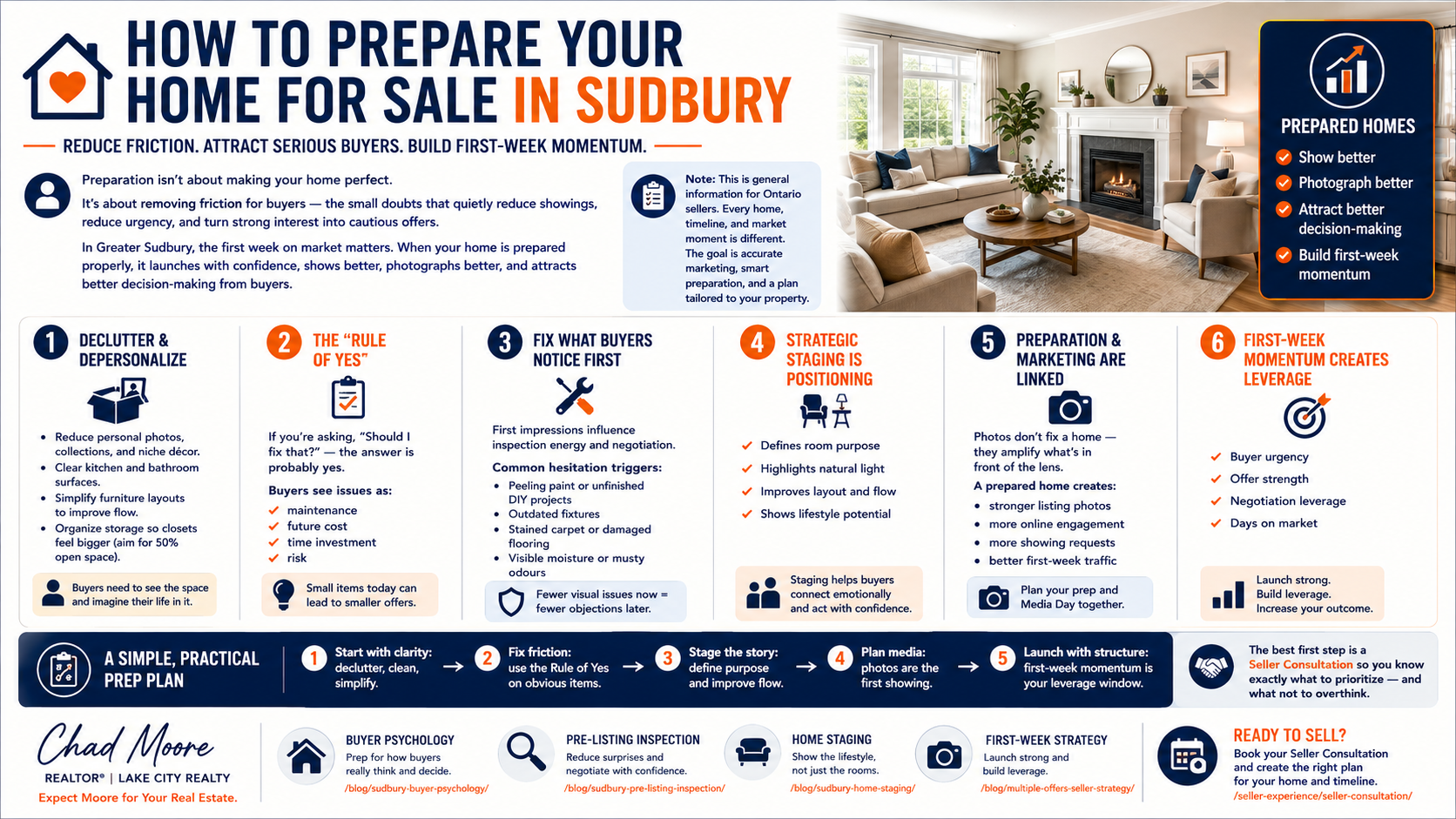
Preparation isn’t about making your home perfect.

It’s about reducing avoidable friction for buyers — the distractions and unanswered questions that can pull attention away from the home itself.

The first week on market deserves a clear plan. Good preparation helps the home photograph accurately, show consistently and launch with fewer avoidable distractions.

Note: This is general information for Ontario sellers. Every home, timeline, and market moment is different. The goal is accurate marketing, smart preparation, and a plan tailored to your property.

Think Like a Buyer (Because Buyers Don’t Shop Like Sellers)

Most buyers walk into a home asking one silent question:

“Can I see myself living here?”

Your goal isn’t to showcase your personality — it’s to create space for theirs.

If a buyer feels work, distraction, or uncertainty, they hesitate. If they feel clarity and ease, they move forward. This connects directly to how buyer decisions actually happen: Sudbury Buyer Psychology.

It also connects to your broader listing strategy. Preparation should never be treated as random cleaning or last-minute tidying. It should be part of the plan created during a structured Seller Consultation, where we identify what matters, what does not, and what will actually help your home compete.

Step 1: Declutter and Depersonalize (Make the Home Easy to Read)

Decluttering isn’t about “minimalist living.” It’s about letting buyers see the space and the function.

  • Reduce personal photos, collections, and niche décor.
  • Clear kitchen and bathroom surfaces.
  • Simplify furniture layouts to improve flow and walkways.
  • Organize storage so buyers can see the available closet and utility space.

Space feels larger when it’s less crowded. Buyers aren’t evaluating how well you live in the home — they’re deciding whether they can live in it.

Step 2: The “Rule of Yes” (A Prep Filter That Prevents Buyer Doubt)

Here’s a simple framework I share with sellers:

If you’re asking, “Should I fix that?” make a deliberate decision about it. Repair it, document it, disclose it when required, or account for it in the selling strategy.

I call it the Rule of Yes. It does not mean every item must be repaired. It means each visible issue deserves a conscious decision because a buyer may read it as:

  • maintenance
  • future cost
  • time investment
  • risk

A visible list of unfinished items can create uncertainty about condition, cost, and the work required after closing.

Low-cost, high-impact fixes that matter

  • Loose baseboards, trim, or handrails
  • Sticky doors, latches, or closet tracks
  • Burnt-out bulbs and mismatched lighting
  • Scuffed walls and chipped paint
  • Cracked outlet/switch plates
  • Leaky faucets and slow drains
  • Torn window screens
  • Worn transition strips and squeaky hinges

If it catches your eye now, it may catch a buyer’s eye later. Decide whether it should be repaired, explained or reflected in the selling plan.

For sellers deciding what is worth fixing versus what may not pay back, this pairs well with Renovations That Add Value Before Selling in Sudbury.

Step 3: Fix What Buyers Notice First (Because Showing Impressions Drive Inspection Energy)

Visible condition issues during a showing can lead buyers to ask more questions about maintenance and unfinished work.

Common hesitation triggers:

  • peeling paint or unfinished DIY projects
  • outdated fixtures in otherwise updated rooms
  • stained carpet or damaged flooring sections
  • visible moisture staining, musty smell, or poor ventilation cues

Preparation can make known condition issues easier to discuss before offer and inspection decisions. The appropriate repair, disclosure, and pricing response depends on the property and the evidence available.

If you want to go one step further and reduce surprises, a pre-listing inspection can sometimes make sense depending on age, condition, and buyer pool: Sudbury Pre-Listing Inspection.

This is not just about cosmetics. Visible condition issues can become part of later Offer Negotiation, especially when new questions arise during an inspection.

Step 4: Strategic Staging Is Positioning (Not Decorating)

Staging highlights:

  • room purpose (no “mystery rooms”)
  • natural light
  • layout and flow
  • lifestyle potential

It can also make the home's purpose and layout easier to understand online. For the full staging breakdown, see Sudbury Home Staging.

And if you want the buyer psychology behind photos and missing information: Hidden Judgment in Listing Photos.

Staging is one part of positioning. Pricing, preparation, presentation, and promotion all need to work together, which is why I often refer sellers back to the 3Ps of Selling a Home.

Step 5: Preparation and Marketing Are Linked (Photos Amplify Everything)

Photography doesn’t “fix” a home — it amplifies what’s in front of the lens.

A prepared home can support:

  • clearer listing photos
  • fewer visual distractions online
  • a more consistent showing experience
  • a launch that matches the selling plan

This is why preparation and Media Day are planned together, not separately.

Preparation and pricing should be planned together. A clean, well-presented home gives buyers a clearer basis for understanding what is being offered. If you are still trying to understand where value and list price should meet, start with How Much Is My Home Worth in Greater Sudbury? and How to Price Your Home Strategically in Greater Sudbury.

Step 6: Plan for the First Week on Market

A deliberate preparation plan helps the photography, showing experience, and launch strategy tell a consistent story.

During the first week, pay attention to:

  • showing activity
  • buyer questions
  • feedback on presentation and condition
  • offer activity, if any

This is why launch structure matters. Here’s the “go live” roadmap: Hitting the Market.

If a multiple-offer strategy becomes relevant, see Multiple Offers: Seller Strategy.

The first-week window deserves its own preparation and review plan. See Why the First Week on Market Is Critical in Sudbury.

A Simple, Practical Prep Plan (So You Don’t Overthink It)

  1. Start with clarity: declutter, clean, simplify.
  2. Fix friction: use the Rule of Yes on obvious small items.
  3. Stage the story: define room purpose and improve flow.
  4. Plan media: photos shape many buyers’ first impression.
  5. Launch with structure: monitor early activity and feedback against the selling plan.

If you’re preparing to sell, the best first step is a structured Seller Consultation so you know exactly what to prioritize — and what not to overthink.

You can also start with a Home Valuation if you want to understand how your home may fit into the current Greater Sudbury market before deciding how much preparation makes sense.

Chad Moore
REALTOR® | Lake City Realty
Expect Moore for Your Real Estate.

Jan. 19, 2026

How to Search for Homes in Sudbury | Smart MLS® Strategies

How to Search for Homes in Sudbury | Smart MLS® Strategies

Scrolling listings is easy. Searching strategically is different.

If you’re buying in Greater Sudbury, the way you search will directly impact:

  • How fast you find the right property
  • Whether the home truly fits your needs
  • How confident you feel when it’s time to make an offer

Smart buyers don’t just browse. They filter intentionally — and they use context, not just criteria.

Step 1: Go Beyond Generic Portals

Large public listing sites are a starting point — but they’re not designed for the kind of detailed filtering buyers often need in Sudbury. Neighbourhood differences, servicing, commute patterns, and property styles can change quickly from one pocket of the city to another.

A better starting place is: MLS® Smart Search.

It gives you more control over your search so you can narrow down listings based on what actually matters to your lifestyle — not just what’s easiest to click.

If you prefer browsing by category first, start here and then refine from there: Curated MLS® Hot Sheets.

Step 2: Build Your “Must-Haves” the Right Way

Most buyers start with a list of must-haves — but the most effective searches separate needs into three tiers:

  • Non-negotiables: the deal-breakers (bedrooms, location constraints, budget ceiling)
  • Strong preferences: what you want, but could compromise on (garage, finished basement, lot size)
  • Nice-to-haves: features that are great, but shouldn’t eliminate good options (granite, certain paint styles, a specific layout)

This matters because the “perfect filter set” often eliminates homes that would be a perfect fit in real life.

If you want a full walkthrough on building your buying plan before you start booking showings, start here: Market Preparation.

Step 3: Search With Context, Not Just Criteria

A 3-bedroom home in one neighbourhood can behave very differently from a 3-bedroom home in another — not just in price, but in lot size, servicing, construction age, commute patterns, and long-term resale.

Before narrowing by bedrooms and price alone, consider:

  • School proximity and school board boundaries
  • ️ Access to services and day-to-day amenities
  • Parks, trails, and recreation options
  • Commute time and traffic flow during real life hours

These tools help you add real-world context to your shortlist:

You can also compare neighbourhood profiles here: Explore Sudbury Communities.

Step 4: Use “Search Lanes” Instead of One Big Search

One of the fastest ways to reduce overwhelm is to create a few focused search lanes instead of trying to capture everything in a single filter set.

Examples:

  • Lane A: “Starter-friendly” options in a comfortable price band (great for learning the market)
  • Lane B: “Step-up” homes that match long-term needs (space, layout, location)
  • Lane C: “Feature-focused” options (garage, waterfront, 4+ bedrooms) if those features matter

These CHS hubs make that approach simple:

Once you find the lane that matches your priorities, it’s easier to refine by area — Sudbury isn’t one market, and this approach helps you see that quickly.

Step 5: Organize Your Search

Serious buyers don’t rely on memory. Once you start seeing 5–10 properties, details blur together — and that’s when good homes get missed or mis-compared.

Using the Sudbury Home Search App helps you:

  • Save properties
  • Set alerts for new listings and price changes
  • Compare options side by side

For listings organized by price, area and features, explore Curated MLS® Hot Sheets.

Step 6: Look for Patterns — Then Adjust

After you’ve viewed or reviewed 5–10 homes, patterns start to emerge:

  • Layout preferences (open concept vs defined rooms)
  • Renovation tolerance (cosmetic vs structural)
  • Storage needs (garage, shed, basement usability)
  • Lot, privacy, and neighbour spacing expectations

Once you see these patterns, the best move is to update your filters and narrow the search. Most buyers don’t need more listings — they need better filters.

If you want the broader roadmap (start to finish), begin here: Buying a Home in Greater Sudbury.

Step 7: Match Your Search Strategy to Your Offer Strategy

The goal of a smart search isn’t just to find a home you like — it’s to position you to act decisively when the right one appears.

That means you’re not scrambling to figure out value, neighbourhood fit, or key questions at the last minute.

When you’re ready to take that step, this is the next stage: Making an Offer.

And if you want guidance on what to watch for during showings, this is the companion page: Home Shopping.

The Smart Search Advantage

When you search with structure and context, you:

  • Waste less time
  • Avoid emotional decisions based on incomplete information
  • Move faster when the right property appears

The full roadmap lives inside the Buyer Experience.

Expect Moore for Your Real Estate.
Chad Moore, REALTOR® | Lake City Realty

Jan. 13, 2026

How to Price Your Home in Greater Sudbury | Strategic Seller Pricing

How to Price Your Home in Greater Sudbury | Strategic Seller Pricing

Pricing isn’t about picking a number you’d like to get.

It’s about positioning your home in the Greater Sudbury market so the right buyers see it, book a showing, and compete for it.

A lot of sellers think pricing is about finding the ceiling. In reality, it is about creating the right reaction. The right price does not just sit on the listing. It shapes how buyers perceive value, how quickly they act, and how much leverage you have once offers start coming in.

Pricing is positioning

Buyers don’t compare your home to what you paid. They compare it to what else is available today.

Your list price determines:

  • how many buyers even see your home
  • whether they book a showing
  • whether you create negotiation leverage

Pricing correctly creates momentum. Pricing incorrectly creates friction.

That is why I look at pricing as a positioning decision first. A good list price should make sense to the market you are entering, the buyers you are trying to attract, and the bracket you want to compete in. If it misses that mark, the rest of the strategy has to work twice as hard.

Pricing is one of the first strategy conversations inside the Seller Experience, because it affects everything that follows: preparation, marketing, launch timing, showing activity, offer strength, and negotiation leverage.

️ The “hoping high” trap (and why it backfires)

It’s tempting to price above market value “just to see what happens.” In today’s Sudbury market, that approach usually creates predictable problems:

  • Fewer showings — buyers are price-savvy and skip listings that feel off
  • Stale listing perception — the longer you sit, the more buyers assume something is wrong
  • Lowball offers — price drops can signal weakness, even if the home is fine
  • Appraisal risk — even if someone agrees to a high number, the lender may not

A home priced too high often ends up helping other homes sell — buyers use it as a comparison and then choose the better-priced option.

This is where seller instinct and market reality can drift apart. Sellers know what they have done to the home, what they have invested, and what they hope to walk away with. Buyers do not see it through that lens. They compare condition, location, layout, and price against the other options they can buy right now.

One of the clearest examples is 1070 Valecrest in Blezard Valley. The pricing strategy went against the sellers’ instincts at first, but the goal was to create competition instead of resistance. That approach helped drive a result that validated the strategy, not the initial emotion.

For a deeper look at the downside of testing too high, see The Risks of Overpricing Your Sudbury Home.

Buyers shop in brackets (price bands matter)

Most buyers don’t search “between $457,000 and $463,000.” They search in brackets — Under $400K, Under $500K, $450K–$600K, and so on.

That means a home priced slightly above a major threshold can lose exposure to a whole segment of buyers.

Example: If your home is worth around $450K, pricing at $429,900 may land in more searches and alerts than $459,900 — even though it’s only a $20K difference on paper.

You’re not just picking a number. You’re picking a lane with traffic.

And traffic alone is not always the goal. The right bracket should attract the right buyers, not just the most buyers. At 111 Pinellas Rd in Chelmsford, the home was positioned at $424,900 instead of dropping into a lower threshold. That helped attract serious buyers in the correct bracket, and the result was a pre-emptive offer, two competing offers, and an unconditional sale over our projected value.

That is an important distinction: strategic pricing is not about underpricing for attention at all costs. It is about placing the home where the strongest likely buyers will recognize the value and act.

If you want to understand the other side of that discussion, I break it down in The Hidden Risks of Underpricing a Home.

Use real comparables — not memories or old markets

There are three common pricing mistakes:

  • Emotional pricing based on memories, not market value
  • Aspirational pricing based on “testing the market”
  • Outdated pricing based on old comparables

A strategic price starts with a current, local reality check:

  • recent comparable sales, not just active listings
  • adjustments for lot, layout, condition, finishes, and location
  • what buyers can get today in the same bracket

Active listings matter, but sold listings matter more. They tell you what buyers were actually willing to pay, not just what another seller hoped to get. Then the real work starts: adjusting for upgrades, layout differences, lot utility, neighbourhood micro-location, and the overall feel of the home compared to the competition.

That is also why online estimates and broad market averages can only take you so far. A strategic pricing decision needs to reflect what buyers in Greater Sudbury are reacting to right now, in your segment of the market, with your type of home.

If you want a real number based on Sudbury data, start with a professional home valuation. If you want a broader explanation of how value is determined, read How Much Is My Home Worth in Greater Sudbury?.

The first 7–10 days are your best window

Regardless of season, your strongest attention window is the first week on market:

  • your listing hits buyer alerts at the top of the feed
  • online engagement is highest
  • serious buyers book showings quickly to avoid missing out

That’s why pricing “right on day one” is so powerful — momentum early often leads to better terms later.

If the home is priced right, presented well, and launched with intent, those first few days can create urgency. If it is overpriced, you can lose the best part of your launch window before you ever have a chance to correct course.

At 789 Gregg Lane in Sudbury, the home sold firm in just 5 days after being positioned to generate immediate interest. That kind of momentum does not happen by accident. It comes from aligning preparation, presentation, and pricing before the listing goes live.

If you want to see what launch strategy looks like beyond the MLS® button, review Hitting the Market. You can also read Why the First Week on Market Is Critical in Sudbury for a closer look at how early buyer psychology shapes momentum.

Watch early feedback (and adjust fast if needed)

The market speaks quickly. Here’s how to interpret it:

  • Lots of views, few showings → price or presentation mismatch
  • Showings, no offers → buyers see better value elsewhere
  • Consistent “feels overpriced” feedback → you’re above the bracket expectation

A small adjustment early ($5K–$10K) is often more effective than a big cut after weeks on market.

What matters is not just hearing feedback, but interpreting it honestly. If the photos are strong, the home shows well, and buyers are still hesitating, the market may be telling you that your value story is not lining up with your price. Waiting too long to react can cost you far more than a smart early adjustment ever will.

For more on the downside of chasing the market downward, see The Risks of Overpricing. If you are already in that situation, Why Your Sudbury Home Isn’t Selling can help diagnose whether the issue is price, presentation, access, or market positioning.

Pricing is the first step in negotiation

Negotiation doesn’t start when the offer arrives — it starts when you choose your list price.

Strong pricing creates:

  • more showing volume
  • stronger offers
  • better leverage on conditions and timing

The wrong price can put you on the defensive before a buyer ever writes. The right price gives you leverage because it creates interest, confidence, and pressure. That can influence not only price, but also conditions, closing flexibility, and how willing a buyer is to compete.

At 1342 Orange Grove Drive in Sudbury, the home was positioned just below value — not to attract random traffic, but to attract serious, qualified buyers. That strategy helped generate six competing offers and a result at the high end of the projected range.

That is the real point of pricing strategically: not simply to get attention, but to shape the negotiation before it begins.

To see how offers are evaluated and negotiated in real life, read Offer Negotiation. For a deeper seller-focused look at competition, review Multiple Offers in Sudbury: How Sellers Should Prepare Strategically.

Want the right number (and the right plan)?

If you’re thinking about selling, the goal isn’t to “aim high.” The goal is to price strategically so you attract the right buyers and protect your leverage.

That starts with understanding your home, your likely buyer pool, your competition, and the bracket where your home has the best chance to stand out. When those pieces line up, pricing becomes less of a guess and more of a plan.

Start with a Seller Consultation and I’ll show you where your home fits in today’s market — and how to price it with intent.

Expect Moore for Your Real Estate.
Chad Moore
REALTOR® | Lake City Realty

Jan. 12, 2026

Pre-Approval and Budgeting in Sudbury | Smart Home Buying Starts Here

Pre-Approval and Budgeting in Sudbury | Smart Home Buying Starts Here

Before you book a single showing in Greater Sudbury, there’s one step that matters more than anything else: financial clarity.

Serious buyers don’t start with listings. They start with preparation.

Understanding what you can comfortably afford — and how that fits into the local market — allows you to search with confidence instead of uncertainty. It also prevents one of the most common buyer mistakes: falling in love with a home before understanding whether it truly fits your financial plan.

If you're just beginning the process, the best place to start is the structured roadmap inside the Market Preparation stage of the Buyer Experience.

Why Pre-Approval Comes Before Showings

A mortgage pre-approval is typically the first practical step in the home-buying process. It allows a lender to review your financial situation and estimate what they may be willing to lend based on your income, debts, credit profile, and current lending rules.

More importantly, it gives you a realistic starting point for your search.

Without pre-approval, buyers often:

  • View homes that are outside their realistic price range
  • Misjudge what monthly payments will actually look like
  • Lose opportunities when the right home appears

In competitive situations, sellers also want to know that buyers are prepared to move forward. A buyer who already understands their financing position can typically act faster and with greater confidence.

What Pre-Approval Actually Means

A lender’s pre-approval is based on several financial factors. These typically include:

  • Verified income
  • Debt ratios
  • Credit history and score
  • Available down payment

Using this information, the lender estimates the loan amount that may be available and the type of mortgage product that could apply.

If you want to better understand what influences the interest rate behind that payment, read: How Banks Set Mortgage Rates in Canada.

If mortgage terminology feels confusing, the Mortgage & Financing Terms section of the Real Estate Dictionary explains many of these concepts in plain language.

️ What Pre-Approval Does Not Mean

A pre-approval gives you a ceiling — not a target.

Just because a lender indicates you may qualify for a certain amount doesn’t necessarily mean that amount fits comfortably into your long-term financial plan.

Smart buyers also consider:

  • How comfortable the monthly payment will feel long-term
  • How future expenses or lifestyle changes may affect affordability
  • Whether the home may require renovations or upgrades

Buying at your maximum borrowing limit can leave little room for the unexpected. Many experienced buyers instead choose a purchase range that allows flexibility for maintenance, improvements, and everyday life.

Understanding the Real Cost of Ownership

Your mortgage payment is only one part of home ownership. Buyers in Greater Sudbury also need to account for several additional costs that vary depending on the property and location.

Common ownership costs include:

  • ️ Property taxes (which vary across neighbourhoods)
  • Heating costs, especially in older homes
  • Municipal water and sewer or well and septic systems
  • ️ Ongoing maintenance and repairs
  • Legal fees, land transfer costs, and closing adjustments

In Northern Ontario, heating systems, insulation quality, and building age can have a noticeable impact on monthly operating costs. This is one reason it helps to compare homes carefully when searching.

To explore different property types and price ranges across the city, many buyers start with MLS® Smart Search, which allows you to filter listings more precisely than most public portals.

If you're evaluating homes by budget range, these curated listing hubs can also help you quickly see what's available:

These pages give buyers a quick sense of what different price levels actually look like in the local market.

Why Preparation Strengthens Your Offer

Preparation does more than organize your finances — it improves your position when the right home appears.

When buyers understand their financing clearly:

  • Their offer appears stronger and more reliable
  • They can make decisions faster
  • Their timelines are easier to structure

This becomes especially important when you're ready to move into the Making an Offer stage of the process.

In many transactions, preparation is the difference between reacting to the market and navigating it strategically.

The Bottom Line

Mortgage pre-approval isn’t about borrowing power alone. It’s about clarity, confidence, and control.

When buyers understand their financial position before they begin searching, they avoid unnecessary stress and make stronger decisions throughout the entire process.

From the first showing to the final closing day, preparation makes the experience smoother — and often more successful.

If you're beginning the process, the full roadmap for buying in Greater Sudbury can be found inside The Buyer Experience.

Expect Moore for Your Real Estate.
Chad Moore, REALTOR® | Lake City Realty

Jan. 12, 2026

Ontario Carbon Monoxide Alarm Rules 2026: New Requirements for Homeowners

Ontario Carbon Monoxide Alarm Rules 2026: New Requirements for Homeowners

Carbon monoxide safety isn’t new — but Ontario’s rules around it have changed, and the update is catching a lot of homeowners off guard.

If you’ve owned your home for a while, there’s a good chance your current setup was perfectly acceptable under the old requirements. That doesn’t automatically mean it meets today’s standard.

Below is the clean, homeowner-friendly breakdown: old rules vs. new rules, plus a simple “do this now” checklist so you can get compliant without stress.


The Old Requirements (What Many Homes Still Have)

Under the previous rules, carbon monoxide (CO) alarms were generally required outside sleeping areas — and typically only in homes where CO was more “obvious” (like a gas furnace or fireplace).

In real life, that meant many homes ended up with:

  • One CO alarm near the bedrooms
  • No CO alarm on the main floor (if bedrooms were upstairs)
  • No CO alarm in the basement (if there were no bedrooms down there)

The New Requirements (What Changed)

The updated Ontario Fire Code requirements expand both where alarms must be installed and which homes are affected.

Now, CO alarms are required:

  • Adjacent to every sleeping area (this part continues)
  • On every storey of the home (including storeys with no bedrooms, like many basements and main floors)

Does This Apply to Your Home?

If your home has any of the following, you should assume these requirements apply and verify your setup:

  • A fuel-burning appliance (gas/oil/propane furnace, water heater, etc.)
  • A fireplace (including fuel-burning units)
  • An attached garage (this is the big one most homeowners miss)

Why the Attached Garage Rule Matters

This is the part that surprises people: even if your home is “mostly electric,” an attached garage can still be a carbon monoxide risk.

CO can enter the home from a vehicle warming up, gas-powered equipment, or exhaust that migrates through shared walls and ceilings. And because CO is invisible and odourless, alarms are the only reliable warning system.


What Homeowners Should Do (Simple Checklist)

  1. Do a quick walkthrough — storey by storey.
    Basement included. If you have 3 levels, think “3 alarms minimum,” plus the sleeping-area placement.
  2. Confirm you have a CO alarm adjacent to each sleeping area.
    The goal is simple: if it goes off at night, it needs to be loud enough to wake you up.
  3. Add an alarm on every storey that doesn’t already have one.
    Main floor and basement are the two most common misses.
  4. Use approved alarms and follow the manufacturer’s instructions.
    CO mixes with air differently than smoke, so follow the placement guidance on the device.
  5. Test monthly, and replace old units when they expire.
    Many alarms have a service life (often 5–10 years). If yours is outdated, swap it.

Why This Matters for Resale (Even If You’re Not Moving Today)

I see CO alarms come up most often during home inspections, insurance reviews, and pre-listing walkthroughs. Missing or incorrectly placed alarms can trigger last-minute fixes and unnecessary negotiation friction.

The good news? This is one of the easiest compliance updates you can do as a homeowner — and it’s the kind of small detail that protects both your family and your future sale.

Bottom Line

The shift is simple: the old setup was often “near bedrooms.” The new standard is “near bedrooms + every storey” — and attached garages are now a major trigger.

If you want a second set of eyes before you list, renovate, or just to make sure you’re covered, reach out. I’d rather help you catch it early than have it show up as a surprise later.


Helpful next steps (Lake City tools & guides)

Expect Moore.
Chad Moore | Lake City Realty

Jan. 5, 2026

Buying a Home in Greater Sudbury: Step-by-Step Guide

Buying a Home in Greater Sudbury: Step-by-Step Guide

Buying a home in Greater Sudbury isn’t just a financial decision — it’s a strategic one.

From established neighbourhoods to fast-growing areas around the city, every community can feel like its own mini-market. Prices, lot sizes, servicing, school access, commute patterns, and even future development plans can vary far more than most buyers expect.

If you’re thinking about buying, the first step isn’t scrolling listings.
It’s building a plan.

That plan should combine financial preparation, neighbourhood research, and a clear understanding of how the local market behaves. The goal isn’t just to find a home — it’s to find the right home with confidence.

Step 1: Get Financially Prepared

Before you look at homes, you need clarity on what you can comfortably afford — and how confident you’ll feel when it’s time to act.

  • Mortgage pre-approval
  • Closing costs (not just your down payment)
  • Property taxes, utilities, insurance, and the real cost of ownership
  • Knowing how much flexibility you have when the right home appears

Many buyers focus only on price range, but monthly affordability can vary widely depending on interest rates, insurance, and the condition of the property.

If you want to better understand why rates move — and how lenders actually decide what rate to offer — read: How Banks Set Mortgage Rates in Canada.

If you want a structured walkthrough of this stage, start here: Market Preparation.

And if you ever run into mortgage or legal terminology that feels confusing, the plain-language reference is here: Real Estate Dictionary.

Step 2: Understand What “Local Market” Really Means

Greater Sudbury isn’t a single uniform market. It’s a network of communities with different housing styles, price ranges, and demand patterns.

A home in one neighbourhood may behave very differently from a similar property across town. Construction age, lot configuration, servicing, and proximity to amenities can all influence value.

Before booking showings, it helps to understand:

  • Which types of homes sell quickly — and why
  • How construction styles vary between areas
  • Which neighbourhoods align with your lifestyle
  • Commute patterns and everyday convenience

If you're comparing communities, these guides can help you narrow your search:

Many buyers also begin by browsing listings by price or area through the Curated MLS® Hot Sheets, which organize listings by features, neighbourhood, and price range.

Step 3: Search Smarter — Not Just Harder

Most buyers begin their search on large public listing portals. That’s normal — but those platforms are rarely designed for detailed filtering or deeper neighbourhood insight.

If you want better control over your search, use MLS® Smart Search.

It allows buyers to filter listings more effectively and combine listing data with municipal context.

These built-in tools can help you understand what surrounds a property:

These tools help you evaluate the broader context around a home — not just the property itself.

If you want listings organized and alerts sent directly to your phone, you can also use the Sudbury Home Search App.

For listings organized by price, area and features, explore Curated MLS® Hot Sheets.

Step 4: View Homes Strategically

When you walk into a home, you’re not just evaluating décor. You’re assessing how the property functions, what future costs may exist, and whether the home fits your long-term needs.

  • Layout functionality
  • Storage and usable space
  • Mechanical systems and age
  • Signs of deferred maintenance
  • Renovation quality

It’s also important to understand how listings are written and what details may require further questions.

If you want a deeper walkthrough of this stage, start here: Home Shopping.

Step 5: Make a Strong, Informed Offer

Writing an offer involves more than filling out forms. Each clause and timeline plays a role in protecting your interests while making your offer competitive.

Offers often include:

  • Financing conditions
  • Home inspection conditions
  • Deposit structure
  • Closing timelines
  • Clauses that clarify responsibilities or expectations

Understanding how these pieces work together can make a significant difference in both negotiation strength and risk management.

For a detailed breakdown of how offers work, start here: Making an Offer.

Step 6: Conditions, Inspections & Due Diligence

Once an offer is accepted conditionally, buyers enter the protection phase of the transaction.

This is where inspections, financing confirmation, and research help ensure the home meets expectations.

A professional home inspection can identify both normal wear and more serious concerns such as structural issues, outdated systems, or moisture problems.

To better understand how this stage works, review the due diligence process here: Due Diligence Process.

If you want a clear explanation of how real estate transactions work in Ontario, you can also review Ontario real estate consumer protections and regulations.

Step 7: Closing and Moving

Once conditions are satisfied, the transaction moves toward closing.

Your lawyer prepares the transfer of ownership, confirms title details, and ensures funds move properly between parties.

This stage also includes:

  • Title searches and legal documentation
  • Insurance coordination
  • Utility transfers and setup
  • Moving logistics
  • Final walkthrough planning

For a full overview of this stage, see: Closing & Moving Day.

Why the Right Guidance Changes Everything

Information about real estate is everywhere. What most buyers need is clarity.

Buying in Greater Sudbury means understanding neighbourhood differences, property construction styles, market timing, and negotiation strategy — and combining that information into a plan that makes sense for you.

If you want the full buying roadmap in one place, start here: The Buyer Experience.

And if you’d like to see how I approach real estate differently, visit: Why Work With Chad Moore.

Expect Moore for Your Real Estate.
Chad Moore, REALTOR® | Lake City Realty